
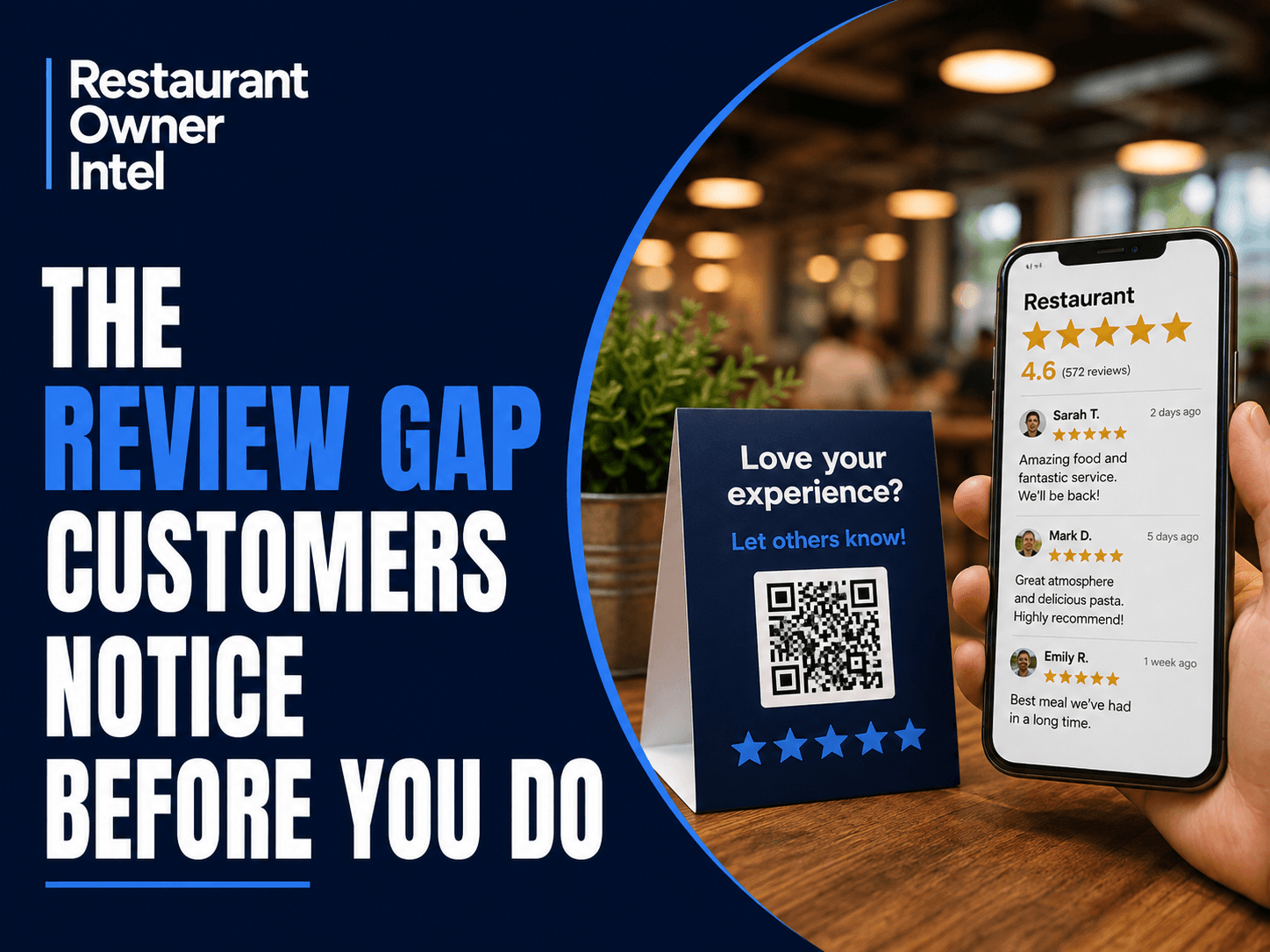
The Review Gap Customers Notice Before You Do
Learn why gaps between recent restaurant reviews can create uncertainty for potential customers and how to build a steadier flow of fresh reviews.
Most restaurant owners look at reviews in two ways. What’s our rating? How many reviews do we have? Those numbers matter. But they can hide something a potential customer may notice almost immediately: when the reviews were actually written. A restaurant might have a 4.6 rating and hundreds of reviews. On paper, that looks reassuring. But if the latest review was six weeks ago, the next one was two months ago, and most of the visible feedback is from last year, a new customer is left with a question the rating alone can’t answer. Is this restaurant still as good now as those reviews suggest? That’s the review gap. It’s the stretch of silence between one recent review and the next. Restaurant owners often don’t notice it because nothing appears to be wrong. The rating hasn’t fallen. No damaging complaint has appeared. The review count is still respectable. But silence can create its own kind of uncertainty. A customer comparing three restaurants for Saturday night isn’t conducting a formal audit. They’re scanning for reassurance. They want signs that other people have eaten there recently, had a good experience, and felt confident enough to say so. A long gap makes that reassurance weaker. This is why review frequency deserves to be treated as a separate signal from review score. A useful distinction is this: Your rating tells customers what people have thought of your restaurant. Your review frequency helps show them whether that experience still appears to be happening. Those are not the same job. Think in terms of review continuity, not review totalsImagine two independent Italian restaurants in the same part of town. Restaurant A has 720 Google reviews and a 4.5 rating. Restaurant B has 390 reviews and a 4.6 rating. At first glance, Restaurant A may seem to have the stronger review profile because it has almost twice as many reviews. Now look closer. Restaurant A’s latest visible reviews were posted 41 days ago, 58 days ago and 73 days ago. Restaurant B has reviews from yesterday, four days ago, nine days ago and two weeks ago. A customer doesn’t need to consciously say, “Restaurant B has superior review recency.” They may simply feel more certain about it. Restaurant B gives them recent evidence. Someone ate there this week. Someone else went recently and mentioned the service. Another guest posted a photo of a dish that still appears to be on the menu. The restaurant feels current. Restaurant A’s older reviews may still be completely accurate. Nothing may have changed. The food may be excellent. The team may be delivering great service every night. But the customer has to assume more. That is the hidden cost of a review gap. It increases the amount of uncertainty the customer has to bridge themselves. When people are choosing between several similar restaurants, small amounts of extra uncertainty matter. They may wonder whether management has changed, whether standards have slipped, whether the restaurant is quieter now, whether the menu is still the same, or simply whether the place still attracts satisfied customers. You don’t need customers to form a negative conclusion for a review gap to hurt you. You only need another restaurant to make the decision feel easier. That leads to a useful way to think about reviews: Don’t ask only whether your restaurant has enough reviews. Ask whether your reviews create continuity. Continuity means a potential customer can scroll through your recent feedback and see an ongoing pattern of real customer experiences rather than a strong historical reputation followed by silence. That is a much more useful diagnostic than total review count alone. The problem usually starts before the gap becomes obviousReview gaps rarely begin because restaurant owners decide to stop collecting reviews. They usually happen because review generation is treated as an occasional activity rather than part of normal operations. A manager notices reviews have slowed down. Someone tells the team to ask more customers. For a few days, staff remember. A QR code gets placed near the till. A post goes on Facebook. A few new reviews arrive. Then service gets busy, attention moves elsewhere, and the habit disappears. Three weeks later, nothing looks urgent. That’s exactly why the gap grows. By the time the owner notices that the latest review is a month old, the problem is already visible to potential customers. The better approach is to manage the interval, not react to the drought. The interval is simply the time between new reviews. You don’t need a complicated dashboard. You need to know what normal looks like for your restaurant. If you usually receive several reviews each week and suddenly ten days pass without one, that change is worth noticing. If you’re a smaller restaurant that naturally receives fewer reviews, your normal interval may be longer. There’s no universal number that makes a restaurant look active or inactive. Volume, location, customer type and seasonality all affect review frequency. What matters is whether your recent review flow looks like a living business with regular customer activity. That gives you a simple diagnostic: Look at the dates of your last five to ten reviews, not just the stars beside them. Are they reasonably spread across recent weeks? Or do you see bursts followed by long empty stretches? Are you getting reviews consistently? Or only when someone on the team suddenly remembers to ask? That pattern tells you more about the strength of your review system than the headline review count does. The strongest restaurant review strategies aren’t built around occasional campaigns. They’re built around triggers. A trigger is a moment in normal service when asking for a review becomes natural. A customer tells the server, “That was one of the best meals we’ve had here.” That’s a trigger. A regular guest says the new dish was excellent. Trigger. A customer thanks the manager for sorting out a small problem quickly. Potential trigger. A guest tells the owner they recommend the restaurant to friends all the time. Trigger. These moments matter because the customer has already volunteered positive feedback. You’re not manufacturing enthusiasm. You’re simply making it easy for them to move that positive reaction into a public review. The request can be simple. “Thanks, we really appreciate that. If you ever have a minute to leave us a Google review, it helps people who haven’t visited us before.” No long script. No pressure. No awkward sales pitch. Then remove the friction. Give them a direct link in a follow-up message where appropriate. Use a QR code in a sensible location. Make sure staff know where to point customers. Avoid making someone search your restaurant name, find the correct profile and work out what to click. The easier the path, the more likely a willing customer is to complete it. But the key is that these triggers should operate continuously. You’re not trying to produce a sudden wave of reviews. You’re trying to prevent long silence. That changes how you manage the process. Instead of telling staff, “We need more reviews,” you can say: “When a customer gives you a clear compliment, that’s the moment to ask.” That is easier to remember, more natural for staff, and better aligned with the customer experience. It also avoids turning review requests into a quota. The goal isn’t for every table to be asked. The goal is to stop positive customer experiences disappearing without leaving any visible evidence behind. That distinction matters. If ten customers tell your team they had a fantastic evening and none of that feedback reaches your public review profile, your restaurant has created customer satisfaction but failed to capture the proof. The experience happened. The marketing asset didn’t. That’s why review generation belongs partly in operations, not just marketing. Your team creates the experience. Your review system captures a small portion of that experience while it’s fresh. Once you see reviews this way, the management question changes. You stop asking: “How do we get more reviews?” You start asking: “Where are satisfied customers already telling us they’re happy, and are we giving them an easy next step?” That question is far more useful. It points you toward observable moments in the restaurant rather than vague efforts to “improve online reputation.” There’s another advantage to watching review gaps closely. They can reveal a process problem before they become a reputation problem. Suppose your restaurant normally receives two or three reviews a week. Then three weeks pass with nothing. You don’t need to assume customers are unhappy. But you should investigate. Did staff stop asking? Did the QR code disappear when menus were reprinted? Did a follow-up message stop going out? Did management changes cause the process to be forgotten? Has customer volume changed? The gap becomes a diagnostic signal. That is the deeper value of monitoring review frequency. It doesn’t just tell you what customers can see. It tells you whether your internal system is still working. A useful operating rule is: Don’t wait until you need reviews to start asking for them. Build review requests into moments when customers are already giving you positive feedback. That keeps the process natural and helps the review profile stay current without frantic campaigns. This week, open your restaurant’s Google reviews and ignore the rating for a minute. Look only at the dates. Check the last ten. Notice the spaces between them. Then ask one question: If I knew nothing about this restaurant, would these dates make it feel actively recommended today, or mainly well reviewed in the past? If the answer makes you uncomfortable, don’t chase a sudden spike in reviews. Find the positive moments already happening in your restaurant and create a simple trigger for capturing them consistently. Because the review gap usually doesn’t appear when customers stop enjoying your restaurant. It appears when good experiences keep happening, but nobody has built a reliable way to turn them into recent proof. Try This With AIUse the AI you're already using: ChatGPT, Claude, Gemini, Grok, Meta AI, Copilot, or another general-purpose AI assistant. Replace the example information inside the brackets with your own information, then copy and paste the complete prompt into your AI. AI PromptAct as a practical restaurant review strategist and audit my recent review flow for signs of a review gap. Use only the information I provide, and don't invent missing facts. [PASTE OR DESCRIBE YOUR LAST 5 TO 10 REVIEWS WITH THEIR DATES AND ANY USEFUL CONTEXT, FOR EXAMPLE: “Google reviews: 3 August, 29 July, 27 July, 8 July, 4 July, 30 June. We’re a busy independent Italian restaurant. Staff sometimes ask for reviews when customers compliment the meal, but there’s no consistent process.”] First, examine the intervals between reviews and tell me whether the pattern shows reasonable continuity, occasional gaps, or an inconsistent burst-and-silence pattern based on my own review history rather than an arbitrary industry benchmark. Identify the most important gap or pattern a potential customer could notice and explain what uncertainty it might create when they’re comparing my restaurant with alternatives, clearly labeling any interpretation as an inference. Then diagnose the most likely weaknesses in our review process that are supported by my information. Finally, give me a simple review continuity plan built around natural triggers when satisfied customers already express positive feedback, including the 3 best moments my team should watch for, a short natural sentence staff can use to ask for a review without sounding scripted, one practical way to reduce friction between the request and the completed review, and a simple weekly check that helps us spot a growing review gap before it becomes obvious to customers. Keep the recommendations realistic for a busy independent restaurant and focus on creating a steady flow of genuine recent reviews rather than chasing a sudden spike. |
Restaurant Owner Resource |
Free AI Restaurant Growth Plan |
Curious what growth opportunities your restaurant might be missing? Our free AI-powered Growth Plan analyses your restaurant's online presence, marketing and growth goals to identify opportunities you may not have considered.
|
Oct 19, 2026
Restaurant Technology: Which Tools Are Actually Worth the Investment?
From POS systems and booking software to AI and staff scheduling, here's how to choose restaurant technology that earns its place in your budget, protects your margins and makes running your business easier.

Oct 18, 2026
How to Fill Quiet Restaurant Nights Without Offering Discounts
Empty tables on a Tuesday or Wednesday can be expensive. But cutting prices isn't the only way to bring customers through the door. These practical restaurant marketing ideas can help you increase midweek bookings, give diners a reason to visit and protect your profit margins.

Oct 18, 2026
Are Delivery Apps Bringing You Sales or Taking Too Much Margin?
Delivery apps can keep your kitchen busy and your sales figures climbing. But how much of that money are you actually keeping? Here's how to uncover the real cost of restaurant delivery apps, protect your profit margins and make every order work harder for your business.

Oct 17, 2026
Why Customers Choose One Restaurant Over Another (And How to Win Their Business)
Why Customers Choose One Restaurant Over Another comes down to more than food and price. Understanding the psychology behind dining decisions can help your restaurant attract more customers, win bookings and build repeat business.
0 Comments
Join the conversation
Be the first to comment
Share your thoughts above.