When Should Restaurants Email Customers About Midweek Offers?
Don't automatically send your promotion on the day you need the booking. Match your restaurant email timing to when customers actually make their plans.
A quiet Wednesday can make a restaurant owner question the offer, the subject line or the email itself. You send a promotion at 2pm. The food looks good. The message is clear. The incentive is reasonable. Yet bookings barely move. The obvious conclusion is that the email didn't work. But the problem may have happened before the email was even sent. By Wednesday afternoon, many of the customers you hoped to attract may already know what they're doing that evening. They might be cooking at home, taking the children somewhere, meeting friends somewhere else or simply planning a night in. Your email hasn't necessarily failed to persuade them. It may have arrived after the decision. That distinction matters because it changes how you diagnose poor restaurant email marketing. Instead of immediately changing the offer, adding a bigger discount or rewriting the copy, you first ask a more useful question: When was the customer most likely deciding what to do? That is the point your marketing needs to work backwards from. For an independent restaurant, this can make email marketing simpler and more effective. You stop treating each email as an isolated attempt to generate demand and start using a short sequence to influence a decision while it is still being formed. The important moment isn't the service. It's the decision window.Restaurants naturally organise marketing around the calendar. Wednesday dinner is on Wednesday, so you promote Wednesday dinner on Wednesday. Sunday lunch is on Sunday, so you post about it on Sunday morning. A Friday special starts Friday, so the email goes out Friday afternoon. Operationally, that feels logical. From the customer's side, it may be completely wrong. Customers don't necessarily decide where to eat at the same time the restaurant needs the table filled. There is a gap between the service window and the decision window. The service window is when you want the customer in the restaurant. The decision window is when the customer is choosing whether they'll go out, who they'll go with, what kind of meal they want and where they'll spend their money. Those two windows can sit hours or days apart. That gives you a simple rule worth remembering: Market around when the decision is made, not only around when the table is empty. This is particularly important for midweek trading because a restaurant is often trying to change an existing default. Friday night already has momentum. People expect to socialise. They may already be looking for somewhere to eat. Wednesday is different. A customer may need a reason to turn an ordinary evening into a restaurant visit. That decision can begin well before Wednesday afternoon. Perhaps they see your email on Monday evening while thinking about the week ahead. Perhaps a colleague mentions meeting up on Tuesday. Perhaps a couple realise Wednesday is the only evening they both have free. Perhaps a parent starts looking for an easy dinner option after seeing what the week looks like. The restaurant that appears during those moments has a chance to enter the plan. The restaurant that appears at 3:30pm on Wednesday may be asking the customer to replace a plan that already exists. That is a harder marketing job. And when the late email performs badly, owners can misdiagnose the result. They conclude:
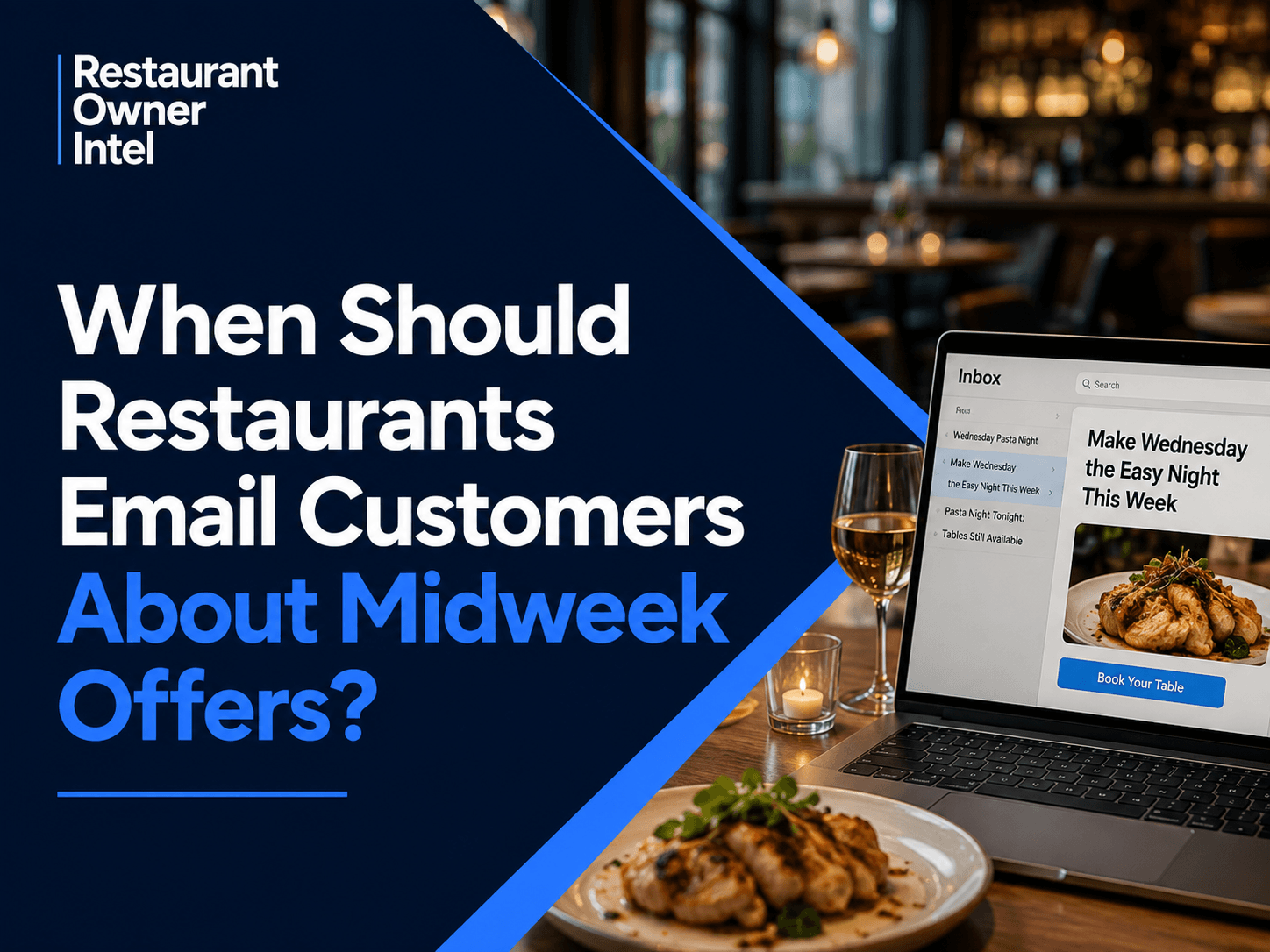
So the discount grows from 10% to 20%, or a free drink gets added, or another offer gets invented. But if timing is the real problem, you've now reduced margin without fixing the underlying issue. A weak result doesn't always mean weak persuasion. Sometimes it means the persuasion arrived too late. Work backwards from the customer decisionImagine a neighbourhood Italian restaurant trying to improve Wednesday dinner. It normally sends one email on Wednesday at 2pm: Wednesday Pasta Night Tonight: Two Courses for £24 There is nothing obviously wrong with that email. The offer is clear. The value is understandable. The timing appears relevant because the dinner is happening that evening. But consider the customer's situation at 2pm. One subscriber already bought ingredients for dinner. Another agreed yesterday to meet a friend at a different restaurant. Another is collecting the children at 5:30 and doesn't want to reorganise the evening. Another might happily have booked your restaurant, but by lunchtime decided Wednesday would be a quiet night at home. The restaurant is trying to create a decision after several customers have already made one. Now change the timing rather than the promotion. On Monday afternoon, the restaurant sends a short email: Make Wednesday the Easy Night This Week The message introduces Wednesday Pasta Night, shows one appetising dish, gives the two-course price and provides a booking link. The purpose isn't urgency. It is anticipation. The restaurant is putting Wednesday into the customer's head while their week is still taking shape. Then on Wednesday late morning, a second, shorter email goes to the same audience: Pasta Night Tonight: Tables Still Available This time the job is different. The customer has already been exposed to the idea. The second email isn't introducing Wednesday dinner from nothing. It is prompting people who considered it, mentioned it to someone else or simply needed another nudge before booking. Same restaurant. Same Wednesday. Same basic offer. Different sequence. The first email enters the decision window. The second email closes the gap between intention and action. That is a more useful way to think about email frequency too. Restaurant owners sometimes worry that two emails about one service will feel repetitive. They can if both emails simply repeat the same message. But a sequence doesn't require two copies of the same sales pitch. Each message can have a different job. The earlier email answers: Could this be something we do this week? The later email answers: Are we actually doing it? That difference is small operationally, but commercially it matters. You are matching the message to the customer's stage of decision-making. This also helps explain why urgency is often overused. Urgency works best when a customer already wants something but hasn't acted. It is much weaker when the customer hasn't considered the idea at all. "Only a few tables left tonight" can help someone who has been thinking about booking. It does less for someone who wasn't planning to eat out in the first place. Before adding urgency, first give the customer something to anticipate. That is especially useful for recurring midweek activity.
The strongest message may not be "tonight only." It may be the earlier message that allows someone to imagine themselves being there. Use a three-question timing testBefore blaming your next weak email on the copy, run a simple test. Ask:
You don't need perfect customer data to start. Use what you already observe. When do Wednesday reservations normally appear? Do customers book several days ahead or mostly on the day? Do couples behave differently from groups? Do event bookings happen earlier than ordinary dining? Does Sunday lunch fill gradually through the week? Are last-minute tables normally booked by regulars? Look at booking timestamps if your reservation system makes them available. Ask front-of-house staff what patterns they notice. Pay attention to when telephone enquiries arrive. You are trying to understand the shape of the decision, not build a complicated attribution model. You can then place your emails accordingly. If most customers book a Saturday occasion several days ahead, Friday afternoon may already be late. If your regulars frequently decide on lunch that morning, a same-day email may be entirely appropriate. If a special event requires people to coordinate with friends, arrange childcare or commit to a higher spend, the decision window may begin much earlier. The principle isn't "send everything sooner." The principle is match the timing to the type of decision. Spontaneous decisions need short lead times. Social decisions often need coordination. Higher-spend decisions usually need more consideration. Recurring habits may need reminders rather than explanation. Once you start looking at your marketing through this lens, email performance becomes easier to diagnose. A promotion can fail because the offer is weak. It can fail because the audience is wrong. It can fail because the message is unclear. But it can also fail because you asked for attention after the customer had mentally closed the decision. That is why simply comparing subject lines can sometimes miss the bigger issue. A brilliant subject line sent after the relevant decision may lose to an ordinary message sent while the customer is still deciding. This same thinking can improve more than email. Your Instagram post, Facebook update, table talker, Google Business Profile post and in-restaurant signage can all play different roles around the same decision window. But email is especially useful because you control when the message is sent. You don't have to hope an algorithm shows your Wednesday offer to the right customer at the right moment. You can deliberately create the sequence. Start small. Choose one quieter service you currently promote on the day itself. Look at when customers seem to make that type of plan. Move the first message earlier. Use it to create anticipation rather than pressure. Then send a shorter reminder closer to the service. Keep the offer broadly consistent so you are testing timing rather than changing several variables at once. Then compare what happens. Do bookings begin earlier? Does the reminder produce more response because customers already recognise the offer? Do you need less discounting to generate the same level of interest? Do regular customers begin treating the evening as something they remember rather than something you have to resell from scratch every week? That final point is where the idea becomes especially valuable. Good timing doesn't only help you capture a decision. Used consistently, it can help shape one. A customer who repeatedly hears about Wednesday Pasta Night on Monday may eventually start thinking about Wednesday and your restaurant together. At that point, you are no longer trying to rescue an empty service with a last-minute email. You are beginning to build the service into the customer's week. Before you rewrite your next underperforming midweek email, check the calendar first. Ask one question: Am I trying to influence the decision, or am I arriving after it? Try This With AIUse the AI you're already using: ChatGPT, Claude, Gemini, Grok, Meta AI, Copilot, or another general-purpose AI assistant. Replace the example information inside the brackets with your own information, then copy and paste the complete prompt into your AI. AI PromptAct as a practical restaurant email marketing adviser and help me work backwards from the customer's decision window rather than simply promoting the service when it happens. Analyze this one restaurant service or promotion: [PASTE OR DESCRIBE THE SERVICE OR PROMOTION YOU WANT TO FILL, INCLUDING ANY TIMING DETAILS YOU KNOW. Example: "We're a neighbourhood Italian restaurant trying to increase Wednesday dinner bookings. We run a two-course Pasta Night for £24 every Wednesday from 5:30pm. At the moment we usually send one email at about 2pm on Wednesday saying 'Pasta Night Tonight'. Most bookings can be made online and we have a reasonable list of local customers and previous diners."] Based only on what I provide, infer the likely customer decision process and clearly label any assumptions you have to make. Identify the most likely decision window, explain why our current timing may be early enough or too late, and distinguish between when customers are considering the occasion and when they're ready to act. Then design a simple two-message email sequence around that decision window: recommend when each email should be sent, give each email one clear job, and write a concise subject line and practical email copy for each. The earlier message should create anticipation and help the restaurant enter the customer's plans; the later message should prompt action without simply repeating the first email. Don't invent scarcity, customer behaviour, results, discounts or facts I haven't supplied. Finish with a short test plan showing what I should monitor over the next few sends to judge whether changing the timing is causing bookings to start earlier or improving response, while keeping the offer broadly consistent so I'm testing timing rather than several variables at once. |
Restaurant Owner Resource |
Free AI Restaurant Growth Plan |
Curious what growth opportunities your restaurant might be missing? Our free AI-powered Growth Plan analyses your restaurant's online presence, marketing and growth goals to identify opportunities you may not have considered.
|
Oct 19, 2026
Restaurant Technology: Which Tools Are Actually Worth the Investment?
From POS systems and booking software to AI and staff scheduling, here's how to choose restaurant technology that earns its place in your budget, protects your margins and makes running your business easier.
Oct 18, 2026
How to Fill Quiet Restaurant Nights Without Offering Discounts
Empty tables on a Tuesday or Wednesday can be expensive. But cutting prices isn't the only way to bring customers through the door. These practical restaurant marketing ideas can help you increase midweek bookings, give diners a reason to visit and protect your profit margins.

Oct 18, 2026
Are Delivery Apps Bringing You Sales or Taking Too Much Margin?
Delivery apps can keep your kitchen busy and your sales figures climbing. But how much of that money are you actually keeping? Here's how to uncover the real cost of restaurant delivery apps, protect your profit margins and make every order work harder for your business.
Oct 17, 2026
Why Customers Choose One Restaurant Over Another (And How to Win Their Business)
Why Customers Choose One Restaurant Over Another comes down to more than food and price. Understanding the psychology behind dining decisions can help your restaurant attract more customers, win bookings and build repeat business.
0 Comments
Join the conversation
Be the first to comment
Share your thoughts above.