
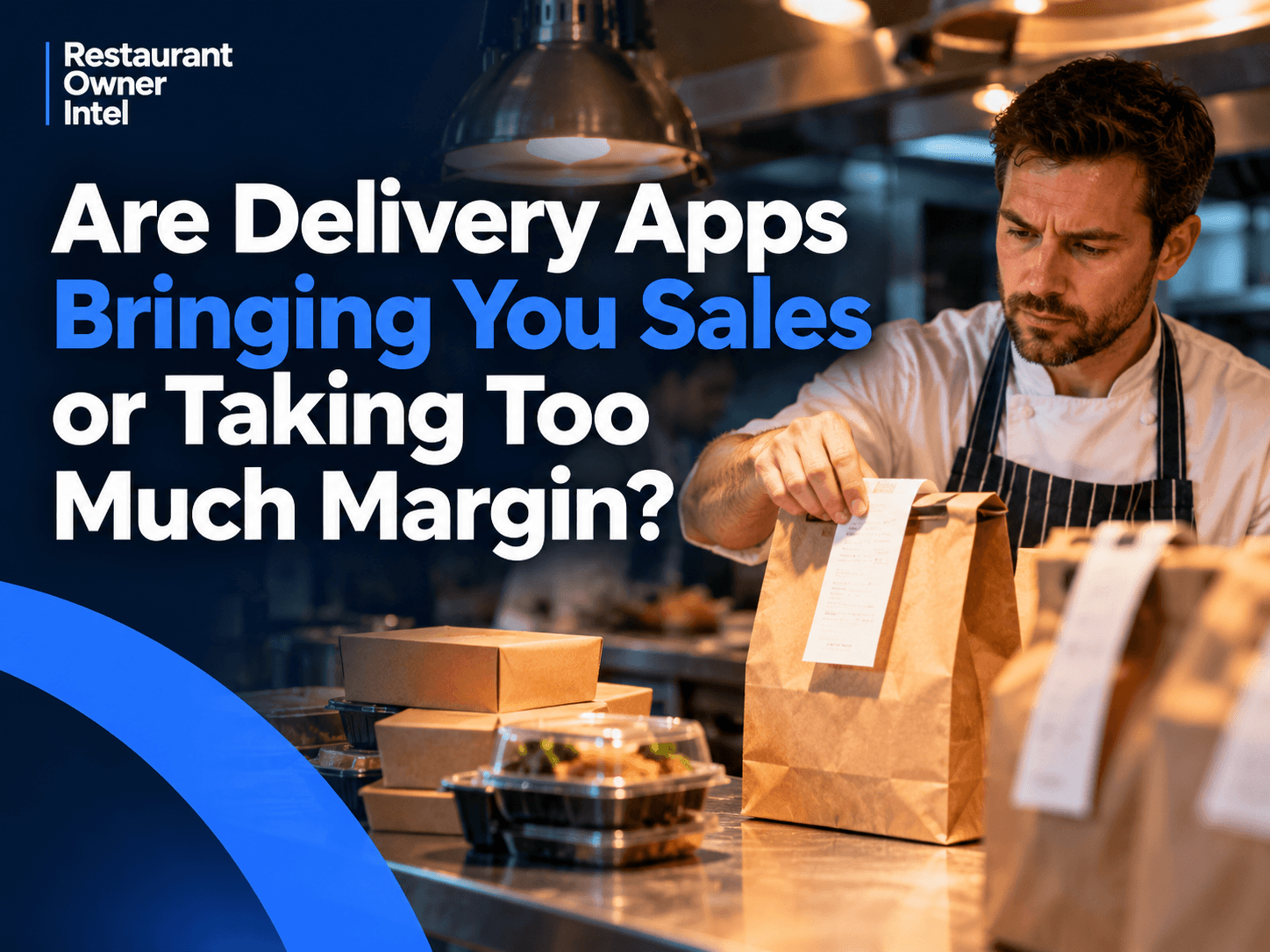
The delivery printer starts up again. Another order. Then another.
Your kitchen is busy, drivers are waiting at the counter, and the sales total on your delivery dashboard keeps climbing. From the outside, business looks good.
Then the platform statement arrives.
Between commissions, packaging, discounts and the extra pressure on your kitchen, the amount left over is considerably smaller than the headline sales figure suggested.
It's an uncomfortable situation. You're doing the work, preparing the food, paying the staff and taking responsibility when something goes wrong. Yet a sizeable share of every order goes to the company that brought you the customer.
That doesn't mean delivery apps are bad for business. Uber Eats, Deliveroo and Just Eat can put your restaurant in front of people who might never have found you otherwise.
The question is whether that extra business is worth what you're paying for it.
Are delivery apps bringing you sales or taking too much margin?
To answer that properly, you need to look beyond order volume and understand what each delivery sale actually contributes to your restaurant.
The £30 Order That Isn't Really Worth £30
Picture a customer ordering £30 worth of food through a delivery app.
It's a straightforward order. Your kitchen prepares it, the food is packed, and a driver collects it.
The dashboard records another £30 sale.
But that isn't what your restaurant keeps.
Here's how the figures could look.
| £30 delivery order | Amount |
|---|---|
| Food order value | £30.00 |
| Platform commission (30%) | -£9.00 |
| Food ingredients | -£9.00 |
| Packaging | -£1.20 |
| Additional labour | -£2.00 |
| Remaining contribution | £8.80 |
These are illustrative figures, using a 30% commission rather than a claim about any particular platform's current charges. The example also assumes the amounts are being compared on a consistent tax basis.
Your restaurant has generated £30 in food sales, but only £8.80 remains to contribute towards fixed overheads and profit.
And that's before considering other relevant expenses, such as refunds, additional marketing charges or increased energy use.
Now imagine that order includes a restaurant-funded discount.
The remaining contribution becomes smaller still.
This is why restaurant delivery profit margins matter far more than the number of orders appearing on your screen.
A busy kitchen can feel reassuring. But activity and profitability are two very different things.
Delivery Apps Aren't the Enemy. Unprofitable Orders Are.
It's tempting to look at a large commission charge and conclude that delivery platforms are simply too expensive.
Sometimes they are. But the picture isn't always that straightforward.
Think about a quiet Wednesday afternoon.
Your chef is already working. The kitchen equipment is running. Your restaurant has the capacity to prepare more food without bringing in another member of staff.
A handful of additional delivery orders could make that shift more profitable, provided they cover the extra costs and contribute something worthwhile.
Now consider a Saturday evening.
Every table is occupied. Your kitchen is working flat out. Delivery orders arrive alongside dine-in tickets, and staff are struggling to keep up.
The same delivery orders that were valuable on Wednesday could be far less attractive on Saturday, especially if they delay service for customers already sitting in your restaurant.
The platform hasn't changed.
Your operating circumstances have.
That's the distinction worth understanding. The value of delivery depends on the margin it generates, the customers it brings and the capacity your restaurant has available.
A delivery order that adds profitable revenue during a quiet period can be useful. One that disrupts a busy service while contributing very little may not be.
1. Find Out What Your Delivery Orders Actually Earn
Before changing prices or removing dishes, get a clear picture of what delivery is currently contributing.
You don't need a complicated financial system to do this.
Start with your latest platform statement and a sales report from your till.
Look at your delivery revenue, then identify the costs directly associated with fulfilling those orders.
These include platform commissions, payment or service charges, ingredients, packaging, restaurant-funded promotions, refunds and any additional labour required.
Use revenue figures excluding VAT where appropriate, and check whether your platform reports already account for discounts or adjustments. Otherwise, it's easy to deduct the same expense twice.
The calculation you're looking for is:
Delivery revenue − direct delivery-related costs = delivery contribution
That contribution isn't necessarily your final net profit. Your restaurant still has rent, insurance, equipment and other overheads to cover.
But it tells you something valuable: how much the delivery channel is contributing towards those costs.
For a clearer picture, compare delivery contribution across platforms, menu items and different trading periods.
You may discover that Friday evening produces your highest delivery revenue but Tuesday lunchtime generates a healthier contribution per order.
That's information you can use.
2. Your Best-Selling Delivery Dish Could Be One of Your Least Profitable
There's a dish on almost every menu that customers love ordering.
It sells consistently, looks impressive in photographs and attracts positive reviews.
But popularity doesn't guarantee profit.
Consider a seafood dish selling for £24, with £12 worth of ingredients.
At an illustrative 30% platform commission, £7.20 disappears before you've paid for packaging or additional labour.
That leaves £4.80.
Now compare it with a pasta dish selling for £18, using £4.50 worth of ingredients.
The same commission percentage removes £5.40, leaving £8.10 before packaging and additional labour.
| Dish | Remaining contribution |
|---|---|
| Seafood dish | £4.80 |
| Pasta dish | £8.10 |
Illustrative contribution before packaging, additional labour and other costs.
The cheaper dish leaves more money behind at this stage.
That's why copying your entire dine-in menu onto a delivery platform isn't always a sensible decision.
Some dishes are expensive to produce. Others need specialist packaging, lose quality during transport or take too long to prepare when the kitchen is busy.
Look closely at your delivery menu.
Which dishes offer a healthy contribution after fees? Which travel well? Which can be prepared quickly without slowing down service?
A carefully chosen delivery menu may generate better margins than a larger menu filled with dishes that are difficult or expensive to deliver.
It can also make life easier for your kitchen.
3. Your Dine-In Prices Might Not Work for Delivery
A customer sitting in your restaurant and a customer ordering through an app are buying the same food, but they're not necessarily creating the same costs.
Delivery adds another layer of expense.
If you're charging exactly the same price across both channels, your restaurant may be absorbing that expense without properly accounting for it.
Take a dish priced at £15.
If it sells through a platform charging 30% commission, £4.50 is deducted before you consider packaging and any additional preparation costs.
You need to know whether the remaining amount still makes the dish worth selling.
That doesn't mean adding 30% to every delivery price.
Customers compare prices, and a restaurant that becomes noticeably more expensive than its competitors can lose orders.
Instead, work backwards from the contribution you want each dish to generate.
Could a modest price adjustment improve the margin? Would a different portion format make more sense? Could a meal combination increase average order value without adding too much cost?
Check your platform agreement and applicable rules before introducing different prices across channels.
The aim is to protect profit without making your food unattractive to customers.
Sometimes the right decision will be to increase a price. Sometimes it will be to change the dish. And occasionally, it will be to remove an item from delivery altogether.
4. That Delivery Promotion Could Be Costing More Than You Think
A platform notification arrives offering you the chance to join a promotional campaign.
There's the promise of greater visibility, more orders and new customers.
It's easy to see the appeal, especially during a quiet trading period.
But a promotion only makes commercial sense if the additional business is worth the discount you're funding.
Imagine offering 20% off a £25 food order.
The customer pays £20.
If the platform charges 30% commission on that discounted amount, £6 goes to the platform.
That leaves £14 before you've paid for the food.
If ingredients cost £8 and packaging costs another £1, just £5 remains before additional labour and other expenses.
The actual result will depend on the platform's commission calculation and promotional terms.
Now picture that campaign generating 100 orders.
Your restaurant might celebrate the additional activity. Your team might spend hours preparing and packing the food.
But if each order contributes very little, the extra workload may produce a disappointing financial return.
Before agreeing to a promotion, establish who funds the discount, how commission is calculated and what the resulting orders are likely to contribute.
Then consider whether the campaign is attracting new customers or simply discounting orders from people who would have bought from you anyway.
A promotion should create profitable demand, not just cheaper sales.
5. The Customer Who Used to Order Directly Is Now Costing You Commission
Here's a situation worth thinking about.
A regular customer used to telephone your restaurant every Friday to order a takeaway.
They knew your menu, liked your food and needed very little encouragement to return.
Now they place the same order through a delivery app.
Nothing has changed about the food. Your kitchen is still preparing it. The customer is still buying from you.
But you're paying a commission on an order you might previously have received directly.
That is one of the less obvious costs of relying heavily on third-party delivery platforms.
They can introduce genuinely new customers, which has value. But they can also become an expensive middleman between your restaurant and people who already know you.
This is why building a direct ordering channel deserves attention.
Your restaurant website should make ordering straightforward, particularly on mobile.
A clear Order Online button, an easy-to-use menu and a simple checkout can remove much of the friction that sends customers back to an app.
If you offer collection, make that option obvious.
You can also add your direct ordering link to your Google Business Profile where supported and make it visible across your own marketing channels.
Direct ordering still has costs. You'll need to account for software, payment processing, marketing and delivery arrangements where applicable.
But it can give you more control over the transaction and your relationship with the customer.
The important point is convenience.
Customers aren't going to change their habits simply because direct ordering saves your restaurant money.
You need to make ordering from you just as straightforward as ordering through a platform.
6. Don't Let the Delivery App Become More Memorable Than Your Restaurant
Think about the last time you ordered food through a delivery platform.
You probably remember opening the app, scrolling through options and choosing something that looked appealing.
But how clearly did you remember the restaurant afterwards?
That's the challenge facing independent operators.
A customer might enjoy your food, leave a positive rating and order again. Yet their relationship may remain primarily with the delivery platform.
For your restaurant, that means paying commission repeatedly to serve someone who already likes what you do.
You can't always control where customers choose to order, but you can influence whether they remember your business.
Start with the food and the experience.
Make sure the meal arrives as intended. Use packaging that protects quality. Check orders carefully before they leave the kitchen.
Where practical, make your restaurant's name visible on the packaging.
Customers should know who prepared the food they enjoyed.
Your own website, social media and permitted customer communications can then give them reasons to connect with the restaurant directly.
If you're encouraging people to join an email list or loyalty programme, make sure you have the appropriate consent and follow data protection requirements.
The long-term opportunity is bigger than a single delivery order.
A customer who first finds you on an app could later order directly, collect a takeaway or book a table.
But that relationship has to be earned.
7. The Hidden Cost of Delivery Can Be Sitting in Your Dining Room
The dining room is full.
A table of four is waiting for its mains. Another table has just ordered desserts. Your kitchen is already working at capacity.
Then several delivery orders arrive almost simultaneously.
Suddenly, the chef is trying to manage two competing demands: customers in the restaurant and customers ordering through a screen.
Something has to give.
Perhaps the delivery orders take longer than expected. Perhaps a table waits an extra fifteen minutes. Maybe a dish goes out incorrectly because the team is rushing.
These problems rarely appear neatly on a delivery platform statement.
Yet they have a cost.
A poor dine-in experience can damage reviews, reduce repeat visits and make customers less willing to recommend your restaurant.
A £25 delivery order isn't particularly attractive if fulfilling it compromises the experience of a table spending £100.
This is where delivery becomes an operational decision as much as a financial one.
You may need to adjust delivery availability during peak periods, simplify the menu or set more realistic preparation times.
Some restaurants will benefit from separating delivery preparation tasks. Others may find that limiting orders during their busiest hour protects both service quality and profitability.
There isn't one answer for every restaurant.
What matters is recognising that kitchen capacity has a value.
When your team is already stretched, accepting another order isn't automatically the best commercial decision.
8. Are You Measuring the Right Delivery Numbers?
Open your delivery dashboard and you'll usually find plenty of information.
Orders received. Revenue generated. Popular dishes. Customer ratings.
Useful figures, certainly. But they don't always reveal whether the channel is improving your business.
To understand restaurant delivery app profitability, look at a smaller set of numbers that connect directly to financial performance.
Your Delivery Profitability Audit
Review the last four weeks of delivery activity. Work through these checks using your platform statements and restaurant sales records.
- Total delivery revenue and platform charges.
- Average contribution per delivery order.
- Contribution from your five best-selling dishes.
- Total cost of restaurant-funded promotions and refunds.
- Delivery performance during quiet and peak periods.
- Cost comparison between direct orders and platform orders.
- Effects on kitchen workload and dine-in service.
The results may surprise you.
You could find that your highest-volume platform produces the lowest contribution per order.
You might discover that certain promotions attract plenty of orders but barely cover their additional costs.
Or perhaps collection orders, which avoid third-party delivery costs, are quietly generating a stronger return.
Once you have the figures, you can make deliberate changes rather than guessing.
Should You Stop Using Delivery Apps?
Not necessarily.
Removing your restaurant from every delivery platform could mean losing customers and revenue that would be difficult to replace.
The more useful question is whether each platform is earning its place in your business.
A platform that introduces new customers and generates worthwhile contribution during quieter periods may be valuable.
Another that takes a large share of revenue, encourages expensive discounts and overwhelms your kitchen might deserve a different approach.
You can reduce the number of dishes available, change your delivery hours, review your pricing or negotiate commercial terms where possible.
You can also build your direct ordering channel alongside third-party platforms rather than expecting customers to change overnight.
It's worth comparing the results over several weeks, not just a particularly busy weekend.
Delivery demand fluctuates. So do staffing costs, customer behaviour and kitchen capacity.
What matters is whether the channel consistently contributes enough to justify the work involved.
Products / Tools / Resources
You don't need to invest in an expensive technology system to understand your delivery margins. A few practical tools can help you see where the money is going and make better decisions.
Google Sheets — Delivery Margin Calculator
A simple spreadsheet is enough to compare menu prices, commissions, food costs, packaging and contribution. Start with your five best-selling delivery dishes rather than trying to analyse everything at once.
Your EPOS System — Sales and Menu Performance
Check whether your existing till system can separate delivery, collection and dine-in sales. Look for item-level reports, discount tracking and hourly sales figures before paying for additional reporting software.
Delivery Packaging — Cost and Quality Review
Review your takeaway containers, bags and seals. Compare the cost per order, but don't sacrifice food quality to save a few pence. Poor packaging can lead to complaints, refunds and lost repeat business.
Direct Online Ordering — GloriaFood or Your Existing Website Provider
Explore whether your current website or EPOS provider supports direct ordering. Compare transaction charges, subscriptions, customer data access and delivery arrangements before choosing a system.
Google Business Profile — Make Direct Ordering Easier to Find
Check that your restaurant's website, opening hours and available ordering links are accurate. Customers searching for your restaurant by name should be able to find your own ordering options without difficulty.
Delivery Platform Merchant Dashboards — Check What You're Paying
Review your Uber Eats, Deliveroo or Just Eat merchant reports for commissions, promotions, refunds and order trends. Your own platform statements are the best starting point for understanding the charges your restaurant actually pays.
Try This With AI
Use the AI you're already using: ChatGPT, Claude, Gemini, Grok, Meta AI, Copilot, or another general-purpose AI assistant. Replace the example information inside the brackets with your own information, then copy and paste the complete prompt into your AI.
AI Prompt
Act as an experienced restaurant profitability adviser and help me find out whether my delivery app orders are genuinely making money or quietly eating into my margins. Analyse my restaurant's delivery performance using the following information: [Paste your delivery figures or describe your situation. For example: "I run an independent Italian restaurant. Last month we made £6,000 through Deliveroo from 240 orders. Commission is 30%, food costs average 32% of sales, packaging costs around £1 per order, and we spent £300 on promotions. We use existing kitchen staff but sometimes need extra help on busy evenings. Our best-selling dishes are £14 pasta, £18 pizza and £24 seafood linguine. We also take some direct collection orders."]
Calculate my estimated delivery contribution after platform fees, food costs, packaging, promotions and any additional costs I've provided. Show the amount retained per order and the percentage of revenue remaining, clearly distinguishing contribution from final net profit. Where figures are missing, explain what can't be calculated reliably rather than inventing costs, and label any assumptions or estimates.
Identify the three biggest potential profit leaks in my delivery operation, explaining their likely financial impact. Assess whether my delivery pricing, menu selection, promotions and kitchen capacity could be reducing profitability, using my actual figures wherever possible.
Compare the potential value of delivery app orders against direct ordering and collection without assuming those alternatives are free. Then recommend the five most useful changes I should consider, ranked by likely financial benefit, practicality and ease of implementation for an independent restaurant.
Include a simple 30-day action plan showing what to change first, what to measure and how to judge whether the changes are working. Use clear tables where helpful, simple calculations and practical restaurant examples.
Avoid generic business advice. I want to finish with a realistic understanding of whether my delivery apps are helping my restaurant make more money and exactly what I should investigate or change to improve my margins.


0 Comments
Join the conversation
Be the first to comment
Share your thoughts above.