
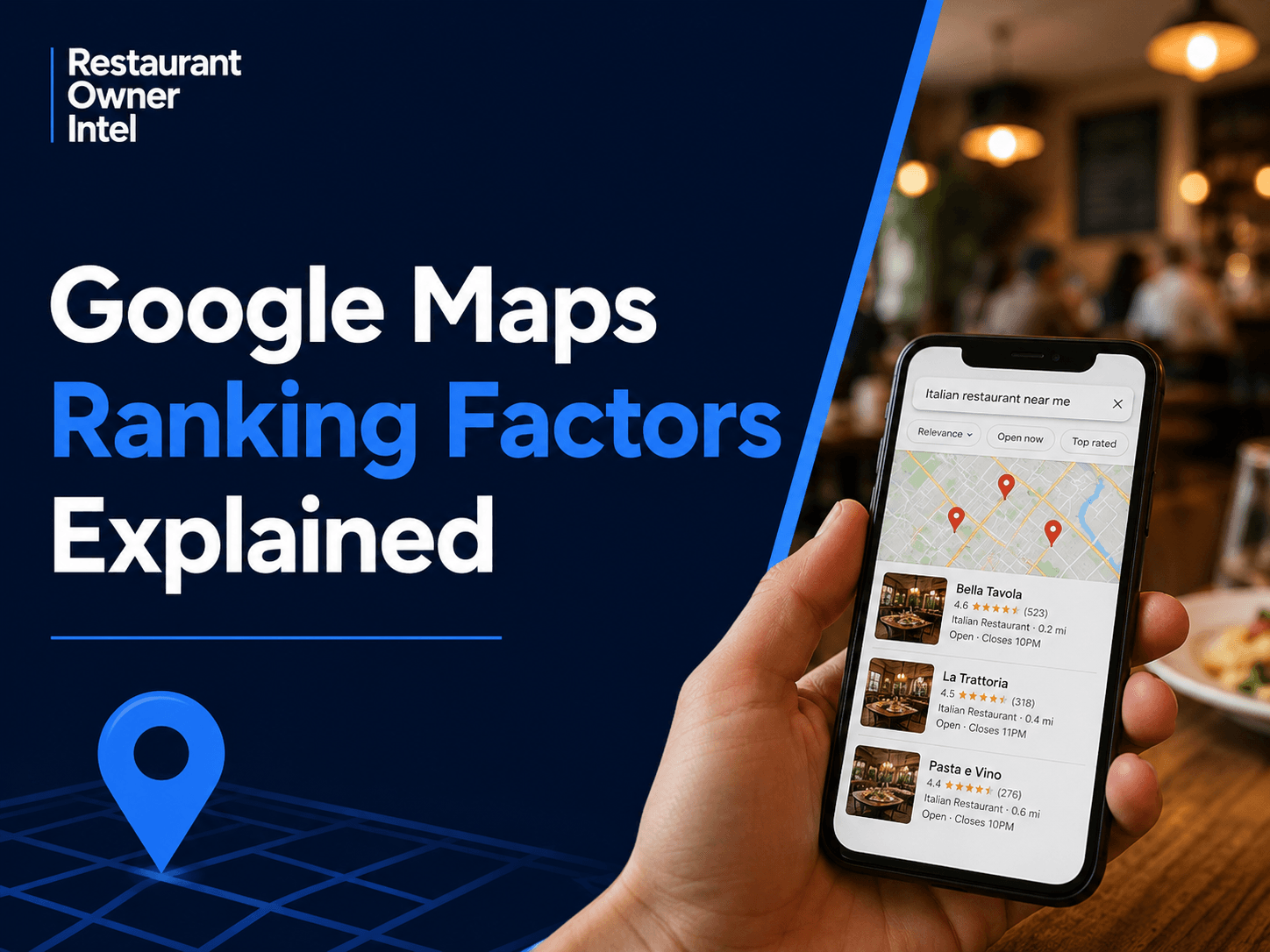
Google Maps Ranking Factors Explained: What Restaurant Owners Can Actually Influence
Understanding how Google decides which restaurants appear in local searches can help you attract more nearby customers, improve visibility and turn more searches into bookings.
A potential customer opens Google and searches for “Italian restaurant near me,” “best Sunday lunch nearby” or “restaurants open now.” Your restaurant might appear near the top of Google Maps. It might appear several places down. Or it might barely appear at all. That difference matters. People searching Google Maps for somewhere to eat are often much closer to making a decision than someone casually scrolling through social media. They may be looking for somewhere to eat tonight, checking reviews, comparing menus or deciding which restaurant is close enough to visit. So understanding Google Maps ranking factors is not simply an SEO exercise. It can affect how many potential customers discover your restaurant at the moment they are deciding where to spend their money. The good news is that Google gives businesses some useful information about how local rankings work. Google says local results are mainly determined by three factors: Relevance. Distance. Prominence. You cannot control all three. But you can influence more than many restaurant owners realise. 1. Relevance: Does Google Understand What Your Restaurant Is?Relevance is essentially how closely your restaurant matches what somebody is searching for. Imagine somebody searches for: “Thai restaurant near me.” Google needs to determine which nearby businesses are actually Thai restaurants. That sounds obvious, but Google has to build its understanding of your restaurant from the information available to it. Your Google Business Profile therefore needs to make your business clear. Google specifically recommends providing complete and detailed business information and says the categories you select affect your local ranking. Start with the correct restaurant categoryYour primary category should describe what your business actually is, rather than everything it offers. Depending on the restaurant, that could mean categories such as:
Google recommends choosing categories that are as specific as possible while still accurately representing the core business. It also advises businesses not to add categories simply as keywords. For a restaurant owner, this is one of the simplest areas to check. If your restaurant has changed concept, expanded its offer or had the same Google profile for years, review your categories and make sure they still accurately describe the business customers visit today. 2. Distance: The Ranking Factor You Cannot Optimise AwayDistance is straightforward. Google considers how far a potential business is from the person searching, or from the location specified in their search. If somebody searches for “restaurants near me,” their physical location can therefore affect what they see. If they search for “restaurants in Cambridge,” the location included in the search gives Google another geographic signal. This explains something restaurant owners often misunderstand: Your Google Maps ranking is not one fixed position. A customer searching two streets away may see a different set of results from somebody searching several miles away. Google can even decide that a restaurant farther away is a better match and rank it above a closer business when other factors make it more relevant. What can you do about distance?Not much — and that is useful to understand. You cannot legitimately optimise your way into being physically closer to every customer. What you can do is make sure your address and map location are accurate so Google and customers have the correct information. Do not waste time looking for tricks designed to beat geography. Put that effort into the ranking factors you can influence. 3. Prominence: How Established Does Your Restaurant Look?Prominence is where things become particularly interesting for established restaurants. Google describes prominence as how well known a business is. That assessment can include information Google finds across the web, including links, articles and directories. Google also confirms that review count and review scores factor into local search ranking, and that a business's position in normal web search results is another factor. In practical terms, Google is not looking at your Business Profile in complete isolation. It can build an understanding of your restaurant using information from multiple sources. That makes your wider online presence important. Your website, reviews, local mentions and other information about your restaurant can all help establish a clearer digital footprint. Google says Business Profile information can be compiled from your own submissions, publicly available web content, third-party data and user contributions. For an independent restaurant, that means local reputation matters online as well as offline. 4. Reviews Matter — But Do Not Reduce the Strategy to a Star RatingReviews deserve particular attention because Google explicitly says review count and review score can influence local ranking. But rankings are only half the reason reviews matter. Consider two restaurants appearing next to each other: Restaurant A Restaurant B Even with the same rating, customers may perceive the first restaurant differently because substantially more people have validated the experience. Reviews therefore serve two jobs. They can contribute to local visibility, and they can influence whether somebody chooses your restaurant after finding it. That makes review generation a customer acquisition issue, not simply a reputation-management task. Build review requests into normal operationsDo not wait for reviews to appear. Create a simple, consistent process. For example:
Google recommends responding to reviews and says positive reviews and helpful replies can help a business stand out. The objective should be a steady flow of genuine customer feedback — not occasional bursts of review requests. 5. Complete and Accurate Information Makes Your Restaurant Easier to MatchOne of the least glamorous Google Maps ranking factors is also one of the easiest to address: Accurate business information. Google says businesses with complete and accurate information are more likely to appear in relevant local search results. Check basics including:
For restaurants, inaccurate information can cause a second problem beyond visibility. It creates customer friction. Imagine somebody checks Google, sees that you are open, drives across town and discovers the restaurant actually closed an hour earlier. You have not simply lost one transaction. You may have created a frustrated customer and potentially a negative review. Online accuracy is both a search issue and a customer-experience issue. 6. Your Website Still Matters to Google Maps VisibilitySome restaurant owners treat their Google Business Profile and website as completely separate marketing channels. Google does not necessarily see them that way. Google says prominence includes information about businesses from across the web, and that a business's position in web results can contribute to local ranking. It also says publicly available information from official websites can be used as a source for Business Profiles. Your website should therefore make your restaurant easy to understand. At a minimum, make sure it clearly communicates:
A beautiful website that leaves customers — or Google — struggling to understand where you are, what you serve and when you open is not doing enough work for the business. 7. Photos Help Customers Judge the Restaurant Before They VisitGoogle recommends adding photos and videos to show customers what your business offers. For restaurants, that matters because customers make highly visual decisions. They want to see the food. But they also want to see the room, atmosphere, bar, outside seating and what kind of experience they can expect. A restaurant with dark, outdated or unappealing photos may lose the customer even if its Google Maps position is strong. Think beyond food photography. Useful images can include:
Your objective is not simply to satisfy an algorithm. It is to make the person viewing your listing think: “Yes, this looks like somewhere I want to eat.” 8. Do Not Ignore What Google Learns Beyond Your ProfileRestaurant owners sometimes treat Google Business Profile optimisation as a form-filling exercise. Complete every field. Add a few photos. Get some reviews. Finished. The reality is broader. Google says it can compile business information from publicly available web content, third-party sources, user contributions and information from its own interactions with local places. That means consistency matters. If your restaurant has changed its opening hours, phone number, website or concept, look beyond the Google profile itself. Check what customers — and Google — are finding elsewhere online. The clearer and more consistent your restaurant's online presence becomes, the fewer mixed signals you create. 9. Google Maps Rankings Are Not the Final GoalThere is an important distinction here. Ranking higher is useful. Getting more customers is the goal. A restaurant could improve its visibility and still fail to generate additional bookings if the profile itself is unconvincing. Imagine your restaurant appears prominently, but potential customers see:
Visibility has created an opportunity. The profile has failed to convert it. Restaurant owners should therefore think about Google Maps as a customer journey: Search → Discovery → Comparison → Trust → Action Ranking helps with discovery. Everything customers see afterwards helps determine whether that discovery turns into a call, website visit, direction request or booking. A 10-Minute Google Maps Ranking Audit for Restaurant OwnersOpen your Google Business Profile and check the following: Relevance
Distance and location
Prominence
Customer conversion
What Restaurant Owners Should Focus on FirstThere is no legitimate button you can press or fee you can pay to guarantee the top Google Maps position. Google explicitly says businesses cannot request or pay for better local rankings. That is why restaurant owners should be wary of anyone promising guaranteed Maps positions. Instead, concentrate on the fundamentals you can control: Make your restaurant easy for Google to understand. Keep your information complete and accurate. Build a consistent flow of genuine reviews. Maintain a credible presence beyond Google itself. Give customers a strong reason to choose you once they find you. And accept that distance will always influence which restaurants different customers see. The Action to Take This WeekSearch Google for three phrases a potential customer might genuinely use to find a restaurant like yours. For example: “Italian restaurant near me” Then look at your own Google Business Profile through the eyes of a customer rather than an owner. Check your category, opening hours, reviews, photos, website and booking journey. Choose the weakest area and improve it this week. Because the objective is not simply to rank higher on Google Maps. It is to turn more local searches into paying customers. |
Restaurant Owner Resource |
Free AI Restaurant Growth Plan |
Curious what growth opportunities your restaurant might be missing? Our free AI-powered Growth Plan analyses your restaurant's online presence, marketing and growth goals to identify opportunities you may not have considered.
|
Oct 19, 2026
Restaurant Technology: Which Tools Are Actually Worth the Investment?
From POS systems and booking software to AI and staff scheduling, here's how to choose restaurant technology that earns its place in your budget, protects your margins and makes running your business easier.
Oct 18, 2026
How to Fill Quiet Restaurant Nights Without Offering Discounts
Empty tables on a Tuesday or Wednesday can be expensive. But cutting prices isn't the only way to bring customers through the door. These practical restaurant marketing ideas can help you increase midweek bookings, give diners a reason to visit and protect your profit margins.

Oct 18, 2026
Are Delivery Apps Bringing You Sales or Taking Too Much Margin?
Delivery apps can keep your kitchen busy and your sales figures climbing. But how much of that money are you actually keeping? Here's how to uncover the real cost of restaurant delivery apps, protect your profit margins and make every order work harder for your business.
Oct 17, 2026
Why Customers Choose One Restaurant Over Another (And How to Win Their Business)
Why Customers Choose One Restaurant Over Another comes down to more than food and price. Understanding the psychology behind dining decisions can help your restaurant attract more customers, win bookings and build repeat business.
0 Comments
Join the conversation
Be the first to comment
Share your thoughts above.