
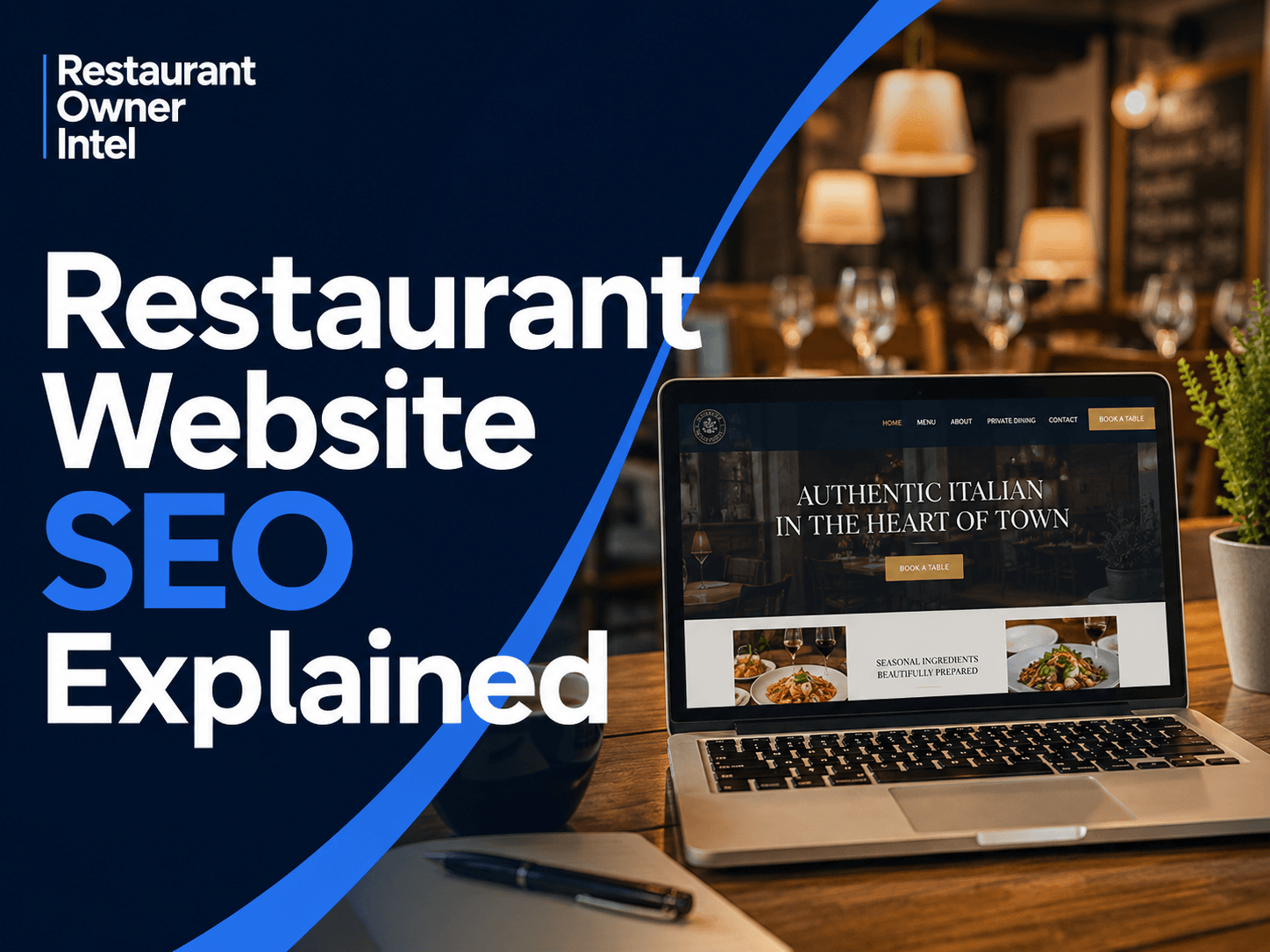
Restaurant Website SEO Explained: How to Help More Local Customers Find Your Restaurant
Restaurant Website SEO explained for independent restaurant owners. Learn practical ways to improve local visibility, attract more customers and turn Google searches into bookings.
A potential customer searches Google for “Italian restaurant near me”, “best Sunday lunch in [town]” or “restaurants with outdoor seating”.
They are hungry. They are local. And they are actively looking for somewhere to eat.
The question is: does your restaurant appear?
That is where restaurant website SEO matters.
SEO - search engine optimisation - can sound technical. For an independent restaurant, however, the basic objective is simple:
Make it easier for search engines to understand your restaurant so they can show it to people searching for somewhere like yours.
You do not need to become an SEO expert.
But you should understand the basics, because your website is one of the few marketing assets you control.
Social media posts disappear down feeds. Advertising stops when you stop paying. Your website can keep helping customers discover your restaurant every day.
Here is restaurant website SEO explained without the unnecessary jargon. What Is Restaurant Website SEO?
Restaurant website SEO is the process of improving your website so it has a better chance of appearing when potential customers search online for restaurants, cuisines, occasions and dining options in your area.
Think about what customers actually type into Google.
They might search for:
These searches have commercial value because the person searching may already be deciding where to spend money.
Good SEO helps connect that demand with your restaurant. Why Restaurant Website SEO Matters
Restaurant owners sometimes view a website as little more than an online brochure.
Customers do not.
They use it to answer questions before making a decision. Where are you?
What food do you serve?
What does the menu look like?
How much does it cost?
Are you open tonight?
Can I book?
Do you cater for dietary requirements?
Do you have parking?
Can you accommodate a large group?
A good restaurant website helps answer those questions while reducing the friction between searching and booking.
SEO helps get more relevant people onto that website in the first place.
The commercial objective is not simply “more website traffic”.
It is more useful traffic from people who could realistically become customers.
Ten local visitors considering where to eat this weekend may be worth considerably more than hundreds of visitors who have no intention of visiting your restaurant. 1. Make It Obvious What Your Restaurant Is
One of the simplest SEO improvements is also one of the most overlooked.
Your website should make it immediately clear:
What you serve + where you are.
Imagine a restaurant website where the homepage mainly says: “Welcome to The Kitchen.”
That may look clean, but it provides very little context.
Compare it with: Independent Italian Restaurant in Peterborough
That immediately gives both customers and search engines useful information.
Look at your homepage and ask: Could somebody unfamiliar with the business understand what we offer and where we are within a few seconds?
If not, make it clearer. 2. Think Like a Customer, Not a Restaurant Owner
Restaurant owners naturally use the language they use inside the business.
Customers may search differently.
A restaurant might describe itself as offering “modern seasonal British dining”.
Customers could be searching for: “Sunday roast near me” “British restaurant in [location]” “restaurants for date night” “private dining in [location]” “best restaurant for Sunday lunch”
Good restaurant SEO starts by understanding the phrases customers use when deciding where to eat.
Make a list of the main reasons people choose your restaurant.
Consider:
You do not need to create a page for every possible phrase.
You need to understand the customer demand your website should represent. 3. Get Your Page Titles Right
Every important page on your restaurant website should have a clear title.
This is sometimes called an SEO title or title tag.
Instead of something vague such as: Home | The Olive Tree
you could use something more descriptive: Italian Restaurant in [Town] | The Olive Tree
Your other pages should be equally clear.
For example: Italian Restaurant Menu in [Town] | The Olive Tree Private Dining in [Town] | The Olive Tree Christmas Parties in [Town] | The Olive Tree
The objective is not to cram keywords into every title.
It is to accurately explain what each page contains. 4. Give Important Services Their Own Useful Pages
Trying to make one homepage rank for everything your restaurant offers can limit your visibility.
If an area of the business is commercially important, consider whether it deserves its own page.
For example, a restaurant might have separate pages for:
This can help customers find information relevant to their specific search.
It can also improve conversion.
Someone searching specifically for a private dining room does not necessarily want to land on a generic homepage and hunt for information.
A dedicated private dining page can immediately show capacity, photographs, menus, facilities and how to enquire.
Good SEO and good customer experience often solve the same problem: helping people find the right information quickly. 5. Do Not Hide Your Menu
Your menu is one of the most important pieces of content on your website.
Make it easy to find.
Where possible, consider having useful menu information available directly on the website rather than relying entirely on a downloadable document.
Customers want quick answers.
They may be checking your restaurant on a phone while comparing several alternatives.
Making them download files, zoom into tiny text or search through multiple pages creates unnecessary friction.
Your menu can also provide search engines with useful context about what you serve.
Clear dish names, descriptions and menu categories naturally communicate what your restaurant offers without awkward keyword stuffing. 6. Pay Attention to Local SEO
For most independent restaurants, the objective is not to attract website visitors from everywhere.
It is to attract customers within a realistic travelling distance. Location therefore matters.
Your website should clearly show your:
Your contact page should be easy to find.
You should also keep this information consistent with your Google Business Profile and other important online listings.
If Google says you close at 10pm, your website says 11pm and another listing says 9:30pm, you are creating confusion for both customers and search engines.
Accuracy is part of marketing. 7. Connect Your Website and Google Business Profile
Your restaurant website and Google Business Profile should support each other.
Your Google profile may be where a customer first discovers you.
Your website is where they can investigate further.
They might look at photographs, browse the menu, check prices, find parking information or make a booking.
Make sure your Google Business Profile links to the correct website.
Then check that the information customers see on Google matches what appears on your site.
Pay particular attention to:
This sounds basic.
That is precisely why it gets overlooked. 8. Make Your Website Work Properly on Mobile
A restaurant website that looks impressive on a large computer screen but becomes frustrating on a phone has a serious problem.
Customers frequently search for restaurants while mobile.
They may be walking through town, sitting in a hotel, planning dinner from the sofa or trying to book somewhere at short notice.
Test your own website on a phone.
Can you quickly:
Do not test it as the owner who already knows where everything is.
Test it as a new customer trying to make a decision. 9. Website Speed Matters
Large restaurant photographs can look excellent.
They can also make websites painfully slow.
If someone taps your website and spends several seconds staring at a blank screen, some will leave.
That is bad for customer experience and can undermine your website performance.
Common causes include:
You do not need to understand the technical solution yourself.
Ask whoever manages your website: “How quickly does our site load on mobile, and what is currently slowing it down?”
That question alone can uncover useful improvements. 10. Use Your Location Naturally Throughout the Website
Search engines need to understand where your restaurant operates.
Your town, city, neighbourhood or relevant local area should appear naturally where appropriate.
That could include:
Do not repeatedly insert your location into sentences simply for SEO.
Write naturally.
The goal is clarity, not repetition. 11. Use Real Restaurant Content
Your restaurant has an SEO advantage that generic websites do not have:
real things happen there.
You have dishes, chefs, menus, events, seasonal changes, private parties, suppliers, celebrations and local connections.
These can create genuinely useful website content.
For example:
A restaurant promoting weddings could publish detailed information about its wedding dining options.
A steak restaurant could explain its cuts and cooking options.
A neighbourhood restaurant could create a strong page about private dining.
A pub could create a dedicated Sunday lunch page.
A venue running Christmas parties could publish its package well before customers begin searching.
Create content around real reasons people might choose your business.
Do not start a blog simply because somebody told you “blogs are good for SEO”.
Create pages and articles when they answer questions your potential customers genuinely have. 12. Make Every Visit Easy to Convert
Ranking higher on Google achieves little if customers arrive and cannot work out what to do next.
SEO gets people through the digital front door.
Your website then needs to turn that attention into action.
Depending on your restaurant, the primary action might be:
Book a Table
Other useful actions could include:
View Menu Call Us Order Online Enquire About Private Dining Buy a Gift Voucher
Make these actions obvious.
Do not bury your booking button in a menu or make customers navigate through several screens unnecessarily.
The commercial value of SEO comes from what happens after the click. Restaurant Website SEO Explained: A 10-Minute Owner Audit
You do not need a technical SEO report to identify obvious problems.
Open your restaurant website and answer these questions:
Every “no” is somewhere to investigate. Do You Need to Pay an SEO Agency?
Not necessarily.
There are technical areas of SEO where specialist help can be valuable, particularly if your website has significant problems or you operate in a highly competitive market.
But restaurant owners should understand what they are paying for.
Be cautious if SEO is presented as a mysterious monthly activity involving dozens of technical tasks but nobody can clearly explain the business objective.
Ask simple questions:
Which searches are we trying to appear for? Which pages are you improving? Why are those searches commercially valuable to our restaurant? Are relevant local visitors increasing? Are website bookings, calls or enquiries increasing?
SEO activity without a connection to restaurant performance can become another monthly expense nobody questions. Do Not Measure SEO by Rankings Alone
Ranking first for a phrase sounds impressive.
But the better question is:
Does that visibility produce customers?
Track outcomes where possible.
Depending on your website and booking system, useful measures could include:
The goal is not to win an SEO competition.
The goal is to help more potential customers discover your restaurant and make it easy for them to spend money with you. The Bottom Line
Restaurant website SEO does not need to start with complicated technical work.
Start with the customer.
What are they searching for?
What does your restaurant offer that matches that search?
Can Google understand it?
And once the customer reaches your website, can they quickly find what they need and take the next step?
That is the foundation. Your Action This Week
Search Google for five phrases a potential customer might use to find a restaurant like yours.
Do not search for your restaurant's name.
Search as a customer would.
Then look at what appears.
Which restaurants are visible?
Which pages are ranking?
And where is your restaurant?
That simple exercise will tell you far more about your current restaurant website SEO than searching for your own business name. |
Restaurant Owner Resource |
Free AI Restaurant Growth Plan |
Curious what growth opportunities your restaurant might be missing? Our free AI-powered Growth Plan analyses your restaurant's online presence, marketing and growth goals to identify opportunities you may not have considered.
|
Oct 19, 2026
Restaurant Technology: Which Tools Are Actually Worth the Investment?
From POS systems and booking software to AI and staff scheduling, here's how to choose restaurant technology that earns its place in your budget, protects your margins and makes running your business easier.
Oct 18, 2026
How to Fill Quiet Restaurant Nights Without Offering Discounts
Empty tables on a Tuesday or Wednesday can be expensive. But cutting prices isn't the only way to bring customers through the door. These practical restaurant marketing ideas can help you increase midweek bookings, give diners a reason to visit and protect your profit margins.

Oct 18, 2026
Are Delivery Apps Bringing You Sales or Taking Too Much Margin?
Delivery apps can keep your kitchen busy and your sales figures climbing. But how much of that money are you actually keeping? Here's how to uncover the real cost of restaurant delivery apps, protect your profit margins and make every order work harder for your business.

Oct 17, 2026
Why Customers Choose One Restaurant Over Another (And How to Win Their Business)
Why Customers Choose One Restaurant Over Another comes down to more than food and price. Understanding the psychology behind dining decisions can help your restaurant attract more customers, win bookings and build repeat business.
0 Comments
Join the conversation
Be the first to comment
Share your thoughts above.