
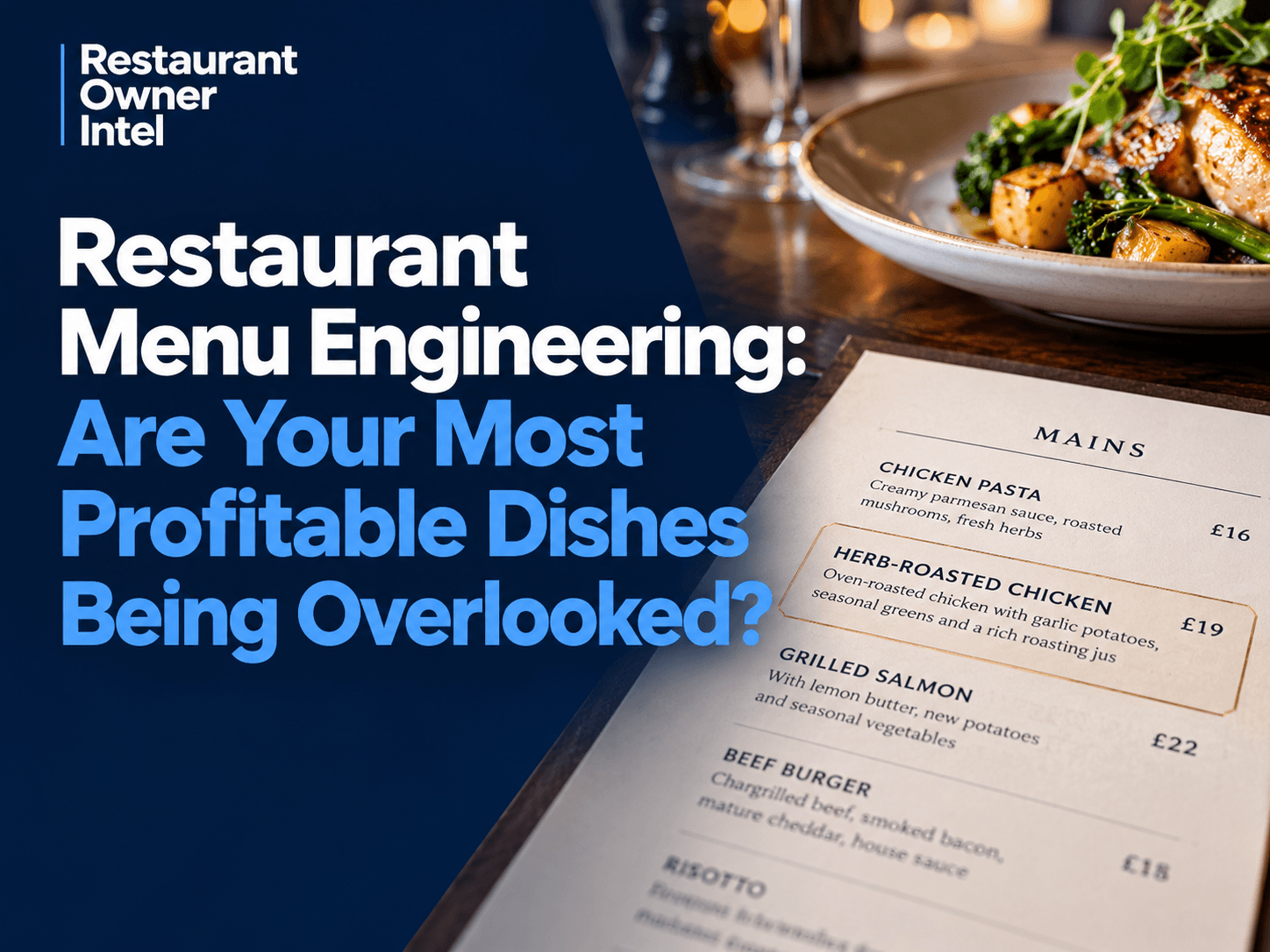
A customer sits down, opens your menu and orders the chicken pasta. It's a familiar choice. They enjoyed it last time, they know what they're getting, and the decision takes seconds.
A few lines further down sits your herb-roasted chicken. It costs a little more, delivers a stronger contribution margin and consistently receives excellent feedback from customers who try it.
But tonight, just like most nights, hardly anyone orders it.
The pasta keeps selling. The chicken gets overlooked.
And somewhere between those two dishes is an opportunity to improve your restaurant's profitability without attracting a single additional customer.
Are your most profitable dishes getting enough attention?
It's a question worth asking because the dishes customers choose don't just determine your sales. They influence how much money is left after you've paid for the food, the staff and everything else required to run your restaurant.
This is where restaurant menu engineering becomes useful. Rather than treating your menu as a list of dishes and prices, it helps you understand which items contribute most to your business and how to encourage customers to choose them.
You don't necessarily need a new menu, higher prices or another promotion.
You may simply need to look more closely at what's already there.
The Dish Everyone Orders Isn't Always the Dish That Makes You the Most Money
There's something reassuring about a dish that sells consistently.
The kitchen knows how to prepare it. Customers rarely complain. Your team can almost predict how many portions will go out on a Friday evening.
It's tempting to see that popularity as proof of profitability.
But a busy dish and a profitable dish aren't necessarily the same thing.
Consider a restaurant selling two main courses.
| Chicken Pasta | Grilled Salmon | |
|---|---|---|
| Selling price | £16.00 | £22.00 |
| Ingredient cost | £5.50 | £8.00 |
| Contribution per dish | £10.50 | £14.00 |
| Weekly portions sold | 80 | 30 |
| Weekly contribution | £840 | £420 |
Illustrative figures. Contribution is calculated after ingredient costs but before labour, overheads and other operating expenses.
The chicken pasta brings in more total contribution because customers order it far more frequently.
Yet every portion of grilled salmon contributes £3.50 more than the pasta.
Now imagine that, through better menu positioning and stronger descriptions, 15 customers each week choose the salmon instead of the pasta.
The restaurant gains an additional £52.50 in weekly contribution.
Across a year, that's approximately £2,730.
Same number of customers. Same number of main courses sold. A different mix of orders.
Of course, the calculation assumes that ingredient costs remain consistent and that the salmon doesn't introduce additional labour, waste or operational problems.
But the commercial opportunity is clear.
Increasing restaurant profit isn't always about selling more meals. Sometimes it's about making more from the meals you're already selling.
The Quiet Problem With Profitable Dishes Nobody Notices
Think about how customers actually read your menu.
They aren't sitting down to conduct a careful financial assessment of every dish. They're hungry. They're talking to friends. Perhaps they're deciding whether to order a starter or save room for dessert.
Their attention is limited.
They scan the options, recognise something appealing and make a decision.
A dish can be excellent, profitable and perfectly suited to your customers. But if it doesn't catch their attention, none of that matters.
And the problem isn't always obvious.
The dish might be sitting in the wrong place. Its description might be forgettable. Your staff might rarely mention it.
Individually, these seem like small details.
Together, they can influence hundreds of purchasing decisions every week.
Your Menu Layout Might Be Hiding Your Best Opportunities
Picture a menu with 15 main courses.
Every dish appears in the same font, with similar spacing and descriptions that run together. Nothing particularly stands out.
A customer looking for something familiar finds the burger halfway down the page and stops reading.
Three lines below is a dish that could generate considerably more contribution per sale.
The customer never reaches it.
That doesn't mean every profitable item needs a coloured box, a photograph or a large headline. A menu covered in competing highlights can become harder to read.
Instead, give selected dishes room to breathe.
Clear sections, sensible spacing and carefully chosen visual emphasis can make them easier to notice.
Start with the dishes you most want customers to consider. Can someone scanning your menu find them quickly?
If the answer is no, you may have identified your first improvement.
A Weak Menu Description Can Make an Excellent Dish Sound Ordinary
Your chef has spent time developing a dish. The ingredients work beautifully together. The sauce is rich, the seasoning is balanced, and the presentation looks impressive when it leaves the kitchen.
Then the customer reads:
Roast Chicken – Served with potatoes and vegetables.
It's accurate. But it gives them very little reason to choose it.
Now consider:
Herb-Roasted Chicken – Oven-roasted chicken with garlic potatoes, seasonal greens and a rich roasting jus.
The second version helps customers imagine what they're ordering.
There's a sense of preparation, flavour and care. The dish feels more distinctive, even though the ingredients and selling price haven't changed.
That's the value of good menu writing.
Customers can't smell the roasting chicken or taste the sauce while they're reading. Your description has to do some of that work for you.
This doesn't mean filling the menu with elaborate language.
In fact, long descriptions can make choosing harder.
The aim is to give customers enough detail to understand why a dish is worth ordering.
For your most profitable dishes, review three things:
- Ingredients: Are you mentioning the details that make the dish appealing?
- Preparation: Is there a cooking method that adds character or quality?
- Clarity: Can customers picture what they'll receive without having to ask?
A few carefully chosen words can make a dish more attractive.
Just make sure the kitchen consistently delivers what the description promises.
Restaurant Menu Engineering: Which Dishes Actually Deserve More Attention?
Before changing your menu design, you need to know which dishes are worth promoting.
A higher selling price doesn't automatically mean a stronger profit contribution.
Neither does a low ingredient cost.
What matters is the relationship between the price you charge, what the dish costs to produce and how frequently customers order it.
Restaurant menu engineering helps you examine those relationships.
One established approach separates dishes into four categories.
| Menu category | What it means | What to do |
|---|---|---|
| Stars | Popular dishes with strong contribution margins | Keep them visible and maintain quality |
| Puzzles | Profitable dishes that don't sell frequently | Improve descriptions, positioning and recommendations |
| Plowhorses | Popular dishes with weaker contribution margins | Review portions, costs and pricing carefully |
| Dogs | Dishes with low popularity and weak contribution | Consider improving, replacing or removing them |
These classifications should be based on appropriate popularity and contribution benchmarks within your own menu categories.
The group worth examining particularly closely is Puzzles.
These are dishes that make good money when customers order them, but don't sell as often as you'd like.
Perhaps customers don't understand the ingredients. Maybe the description fails to communicate the value. Or the dish simply gets lost among more familiar options.
The interesting thing about Puzzles is that the product may already be right.
You might not need to change the recipe, reduce the price or offer a discount.
You may only need to change how customers encounter it.
That makes them a sensible place to begin when looking for ways to improve restaurant menu profitability.
Your Front-of-House Team Can Influence More Than You Think
A customer closes the menu and looks towards the server.
"What would you recommend?"
It's an ordinary question. One your team probably hears every day.
But think about what happens next.
Does the server recommend their personal favourite? The dish they've sold most often? Whatever happens to be easiest for the kitchen?
Or do they know which dishes offer customers a great experience while also making a healthy contribution to the business?
A reccommendation can influence the direction of an order, especially when someone is undecided.
Imagine a customer choosing between the pasta and the slow-cooked beef.
A server might say:
"The slow-cooked beef is particularly good today. It comes with creamy mash and a rich red wine sauce."
It's a simple, natural recommendation.
There's no hard sell. No awkward script. Just useful information from someone who knows the menu.
And if the beef is one of your stronger-contribution dishes, that recommendation can benefit both the customer and the restaurant.
The key is giving staff the right knowledge.
Let them taste selected dishes when practical. Explain the ingredients, the preparation and what customers tend to enjoy about them.
Choose two or three profitable dishes that deserve more attention and make sure your team can describe them confidently.
Customers should feel guided, not pushed.
A recommendation only creates lasting value when the customer is happy with what arrives at the table.
You're Photographing Your Food. But Are You Promoting the Right Dishes?
Open your restaurant's Instagram or Facebook page.
Look at the last ten food photographs you've posted.
Which dishes appear most often?
It's worth asking whether those dishes are featured because they're commercially valuable or simply because they look good in a photograph.
A towering burger might attract attention online. A colourful dessert might generate plenty of likes.
Neither is necessarily the wrong choice.
But if your marketing repeatedly encourages customers to order dishes with weaker margins, you could be overlooking better opportunities.
Imagine your restaurant has a grilled chicken main course that delivers a strong contribution per sale.
Customers who order it enjoy it. It photographs well. Yet it rarely appears in your marketing.
Meanwhile, the same burger appears in post after post.
Why not give the chicken dish some attention?
A well-lit photograph, a description that brings out its flavour and a recommendation from your chef could encourage customers to consider it on their next visit.
You don't need to discount it.
You don't need to create an expensive campaign.
You're simply making a profitable dish more visible.
The same principle applies to your website, online ordering platform, table displays and any printed promotions.
Every place where customers encounter your food is an opportunity to influence what they choose.
How to Find Your Most Profitable Restaurant Dishes Without Complicated Software
This is where the numbers become useful.
You don't need to analyse your entire menu in one afternoon. Start with your main courses and use a recent, representative period of sales.
Your till or POS system should provide the number of portions sold. You'll also need your current ingredient costs and selling prices.
A spreadsheet is enough to begin.
Start With the Contribution Margin
For each dish, calculate:
Selling price − Ingredient cost = Contribution per dish
For example:
£19.00 selling price − £6.50 ingredient cost = £12.50 contribution per dish.
That £12.50 isn't net profit.
You still have staff wages, rent, utilities, cleaning, card fees and other expenses to cover.
But it gives you a useful measure for comparing dishes.
Make sure you're comparing prices and costs on a consistent basis, accounting for VAT where applicable. Include garnishes, sauces and the full ingredient portion rather than just the main component.
Then look at how frequently each dish sells.
A dish generating £13 per sale but selling only 20 portions a week might have room to grow.
Another generating £7 per sale and selling 100 portions could still be an important contributor to your business.
Neither figure tells the whole story in isolation.
You need to understand both contribution per portion and total contribution over time.
Look Beyond the Food Cost
Numbers on a spreadsheet can make one dish appear far more attractive than another.
The kitchen may tell a different story.
A high-contribution dish that requires lengthy preparation, specialist ingredients or creates significant waste might be less attractive than it first appears.
Likewise, a reliable dish that can be prepared quickly during a busy service may have operational advantages that aren't reflected in the basic food-cost calculation.
Before deciding what to promote, ask yourself:
Can the kitchen produce more of this dish without slowing service?
Does it use ingredients we already carry?
Is the quality consistent?
Will customers feel they've received good value?
The strongest opportunities combine healthy contribution with reliable preparation and genuine customer appeal.
Don't Redesign the Whole Menu. Test Three Dishes First.
It's easy to get carried away once you start examining menu performance.
You spot a weak description. Then an awkward layout. Then several dishes that could be repriced or removed.
Before long, you're considering a complete redesign.
But changing everything at once creates another problem.
You won't know which changes actually worked.
A more useful approach is to select three dishes with healthy contribution margins and room to increase sales.
Give each one a specific improvement.
For one dish, rewrite the description.
For another, improve its visibility within the menu.
For the third, brief your team so they can recommend it naturally when appropriate.
If you also decide to promote one on social media, record when that promotion begins.
Then monitor the results over the next 30 days.
Look at how many portions sell, whether the dishes account for a larger share of orders and what happens to total menu contribution.
Compare similar trading periods where possible. A quiet February week and a busy December weekend won't give you a particularly useful comparison.
And watch what happens elsewhere on the menu.
If customers switch from one high-contribution dish to another with a lower contribution, increased sales of the featured dish may not represent an improvement.
The objective is a better overall mix of orders, not simply a higher sales figure for one item.
The 20-Minute Restaurant Menu Profitability Check
Before your next busy service, take a fresh look at your menu.
Not as the person who created it, but as a customer seeing it for the first time.
Can you immediately spot the dishes you most want people to order?
Do their descriptions sound appealing?
Are they positioned where customers can find them without effort?
Then compare that impression with your sales figures.
Check whether you can confidently answer these questions:
- Which five main courses generate the strongest contribution per portion?
- Which dishes deliver the highest total contribution each week?
- Are there high-contribution dishes that customers rarely order?
- Do your descriptions give those dishes a fair chance?
- Does your team know enough about them to make useful recommendations?
- Are you promoting commercially valuable dishes on your website and social media?
- Have you measured whether previous menu changes improved overall contribution?
You may find that the dishes you thought were your strongest performers aren't quite as valuable as you assumed.
Or you may uncover an excellent dish that has quietly been waiting for more attention.
Either way, you'll have something more useful than a guess.
You'll have a clearer picture of how your menu is performing and where small changes could make a financial difference.
Products / Tools / Resources
You don't need an expensive menu engineering system to begin. The most useful tools are often the ones already available in your restaurant.
1. Your existing POS reporting system
Start with the sales reports from your till or POS provider. Look for item-level sales, quantities sold and sales by category. These figures show what customers actually order, rather than what you think they order.
2. Google Sheets or Microsoft Excel
A simple spreadsheet can help you compare selling prices, ingredient costs, contribution margins and weekly sales. You can also track the performance of dishes before and after making menu changes.
3. Recipe costing software
If you regularly struggle to keep ingredient costs accurate, dedicated recipe costing software may be worth considering. Look for tools that calculate portion costs, allow ingredient price updates and help you understand how changes affect contribution margins.
4. Menu design tools such as Canva
You don't necessarily need a professional designer for small layout improvements. Canva can be useful for testing cleaner menu sections, improving spacing and creating simple promotional material. Just make sure the final menu remains readable, consistent with your brand and easy to update.
5. A simple menu engineering worksheet
Create a worksheet with five columns: dish name, selling price, ingredient cost, contribution per portion and number sold. Add total contribution and use the figures to identify your Stars, Puzzles, Plowhorses and Dogs.
6. A staff tasting and briefing sheet
A single printed page can be surprisingly useful. List the two or three dishes you want staff to understand better, along with their ingredients, flavour profiles, allergens and any details customers commonly ask about.
The purpose isn't to give your team a sales script. It's to make sure that when a customer asks what they'd recommend, the answer comes from genuine knowledge of the food.
Try This With AI
Use the AI you're already using: ChatGPT, Claude, Gemini, Grok, Meta AI, Copilot, or another general-purpose AI assistant. Replace the example information inside the brackets with your own information, then copy and paste the complete prompt into your AI.
AI Prompt
Act as an experienced restaurant menu engineering and profitability adviser. I want you to analyse my restaurant's menu and identify which dishes deserve more attention because they could generate greater profit without needing more customers. Here is my menu and any sales or cost information I have available: [Paste your menu with prices and, if available, ingredient costs and weekly sales. For example: Chicken Pasta £16, ingredient cost £5.50, 80 sold weekly; Grilled Salmon £22, ingredient cost £8, 30 sold weekly; Beef Burger £15, ingredient cost £6, 95 sold weekly; Herb-Roasted Chicken £19, ingredient cost £6.50, 20 sold weekly.] Calculate the contribution per dish and total weekly contribution wherever the figures allow. Identify the strongest opportunities using restaurant menu engineering principles, distinguishing between popular dishes, high-contribution dishes and profitable dishes that may be overlooked. Where sufficient data exists, classify dishes as Stars, Puzzles, Plowhorses or Dogs, explaining your reasoning. Don't confuse contribution margin with net profit, and don't invent missing costs or sales figures. Clearly label any assumptions or inferences. Rank the three dishes most worth promoting, explaining why each deserves attention and any potential concerns around preparation time, ingredient waste or customer appeal. For each recommended dish, suggest one specific improvement to its menu description or positioning and a natural recommendation my front-of-house team could use. Then create a simple 30-day test showing what to change, which sales and contribution figures to track, and how to tell whether the changes have genuinely improved overall menu profitability rather than simply shifted orders between dishes. Keep your advice realistic for an independent restaurant with limited time and budget. Present the findings in clear tables and short, practical explanations, prioritising the changes most likely to make a measurable commercial difference.



0 Comments
Join the conversation
Be the first to comment
Share your thoughts above.