
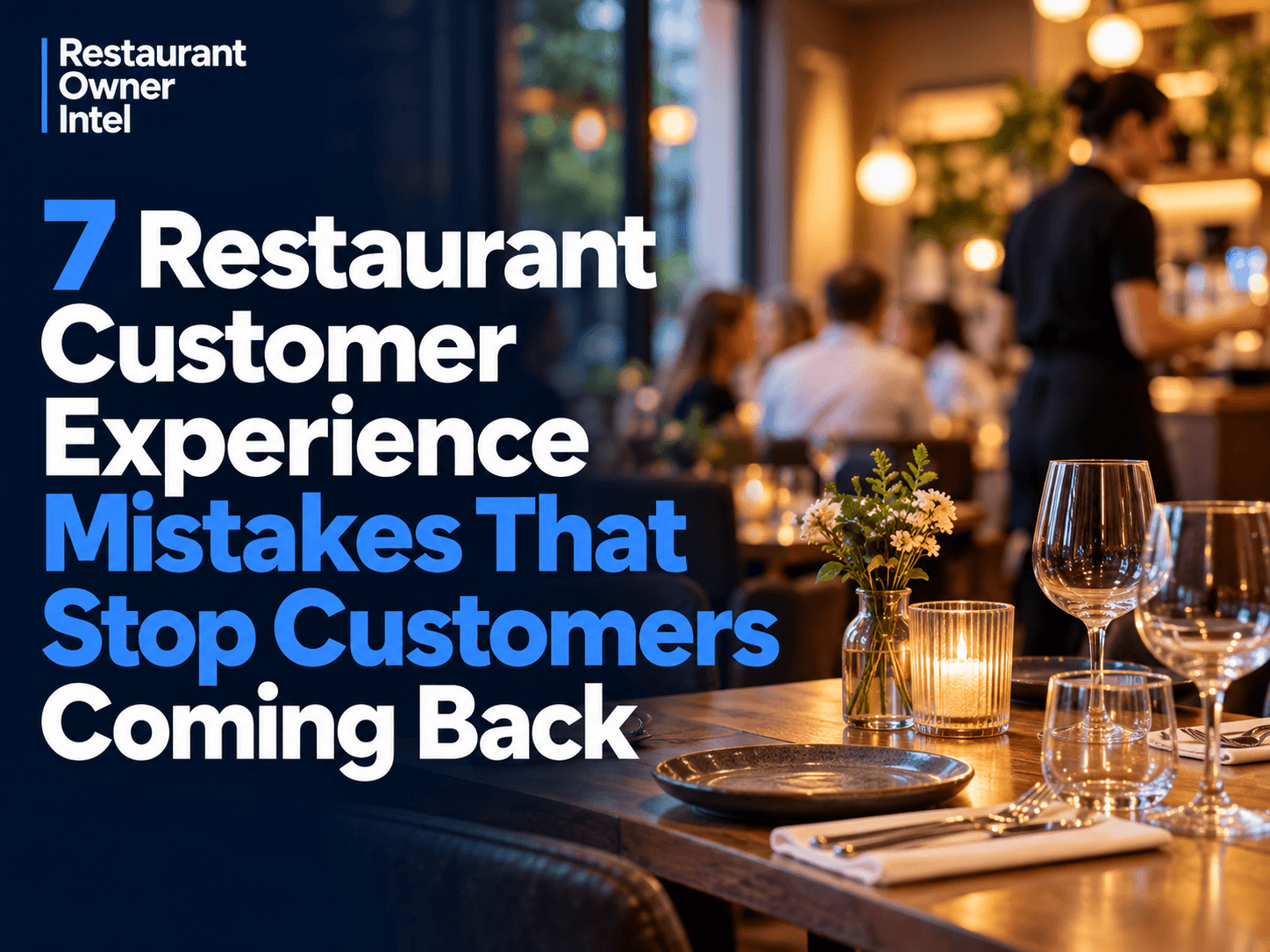
7 Restaurant Customer Experience Mistakes to Fix
Improve restaurant customer retention by fixing 7 small service mistakes that frustrate diners, reduce repeat visits and quietly cost your restaurant sales.
The plates are empty. The customer compliments the food. They pay, thank your team and head out of the door. From where you're standing, that's another successful service. Except there's something you don't know. That customer won't be coming back. Not because the meal was disappointing. Not because the bill was unreasonable. And certainly not because anything went badly enough to justify a complaint. It was the little things. The awkward wait at the entrance. The struggle to catch someone's eye for another drink. The ten minutes spent waiting to pay when they were ready to leave. Nothing dramatic. Just enough irritation to take the shine off an otherwise enjoyable evening. That's what makes small restaurant customer experience mistakes so expensive. Customers rarely tell you about them. They simply choose somewhere else next time. For an independent restaurant, this matters. You can spend considerable time and money persuading someone to visit for the first time. If the experience doesn't give them a reason to return, you're back to finding another new customer to fill that seat. The good news is that some of the biggest improvements in restaurant customer retention don't require a refurbishment, expensive software or additional staff. They begin with noticing the small things your customers notice every day. 1. The Booking Process Feels Like Hard WorkPicture someone sitting on their sofa on a Thursday evening, trying to book a table for Saturday. They find your restaurant on Google. The photographs look inviting. The menu sounds good. They've already decided they'd like to visit. Then they try to book. The reservation button is buried halfway down your website. The booking page is awkward on a phone. Or there's no online option, and nobody answers when they call. Suddenly, going somewhere else feels easier. Even customers who eventually manage to book have experienced unnecessary hassle before they've tasted a mouthful of food. What to change: Take out your phone and try to book a table at your own restaurant. Start with Google, just as a customer might. Check how quickly you can find availability, complete a reservation and receive confirmation. If you rely on telephone bookings, make the number obvious and ensure someone can answer during the hours you advertise. The easier you make that first decision, the less opportunity you give a potential customer to change their mind. 2. Nobody Seems to Notice When Customers ArriveThere's an uncomfortable moment that happens in restaurants more often than it should. A couple walks through the door. They have a reservation. They can see staff moving between tables, carrying drinks and taking orders. But nobody looks towards the entrance. They stand there, slightly in the way, wondering whether to approach someone or wait to be noticed. After a while, one of them catches a server's attention. The server is perfectly friendly. The table is ready. Everything moves along. But the welcome has already been missed. First impressions aren't only about décor, lighting or how attractive the restaurant looks. They're also about whether customers feel expected. What to change: Give your team a simple arrival routine. Someone should acknowledge customers promptly, even if they're busy and can't seat them immediately. A smile and a quick "Welcome, we'll be right with you" can remove the awkwardness in seconds. You don't necessarily need a dedicated host. You need everyone to understand that a customer standing unnoticed at the entrance is everyone's responsibility. 3. Customers Have to Chase Your Staff for ServiceThe first drink went down well. The customer would happily order another. They glance towards the bar. Their server is busy. Another member of staff walks past without looking at the table. A few minutes later, the customer stops trying. They finish their meal with an empty glass. Nobody complains. Nothing appears wrong on the till report. Yet you've potentially lost a drink sale, and the customer has spent part of their evening trying to get someone's attention. This is where customer experience and restaurant profitability meet. Poor service visibility can frustrate guests and reduce opportunities to increase average spend. What to change: Encourage staff to look beyond the task immediately in front of them. Delivering food matters, but so does noticing the customer who needs something. Build natural checks into the meal. Shortly after food arrives. When drinks are running low. When plates have been cleared and someone might fancy a dessert or coffee. There's a balance, of course. Nobody wants a server interrupting every conversation. Good service means being available without becoming intrusive. When customers feel looked after, ordering something extra becomes easy rather than an effort. 4. Your Menu Makes Choosing Feel More Difficult Than It ShouldA customer opens your menu and starts reading. The print is small. The lighting is low. Some dishes have long descriptions that don't really explain what's on the plate. Others have names that make perfect sense to the kitchen but leave customers guessing. Eventually, they choose something familiar. Not necessarily what they wanted most, but something they feel confident ordering. That's a missed opportunity for both the customer and the restaurant. Your menu is more than a list of dishes and prices. It's part of the service experience. It should make customers feel comfortable, interested and confident about their choices. What to change: Sit at one of your tables during evening service and read the menu under the same lighting your customers experience. Can you read every description comfortably? Are the prices obvious? Does the wording help you imagine the dish? Are important dietary details clear or easy to check with staff? Ask someone who doesn't know your menu to look through it. Notice where they hesitate and what they ask you to explain. A clearer menu can make ordering more enjoyable while giving appealing, profitable dishes a better chance of being chosen. 5. The Room Looks Good, but Something Feels WrongIt's a busy Friday evening. The restaurant looks lovely. Candles are glowing, the room is lively and plates of food are leaving the kitchen looking exactly as they should. At one table, though, a couple is leaning across their food to hear each other speak. At another, someone keeps pulling their jacket around their shoulders because there's a draught from the door. Across the room, a guest is trying to steady a table that rocks every time someone cuts into their food. These aren't dramatic service failures. They're physical irritations that quietly compete with the pleasure of eating out. And customers don't always mention them. They might simply remember that the evening wasn't quite as comfortable as they'd hoped. What to change: Experience your dining room from the seats you sell, not just the areas where you and your team work. Try the table nearest the entrance. Sit beside the kitchen door. Spend a few minutes at the table closest to the speakers during a busy service. Listen to the noise. Feel the temperature. Watch how staff move around the space. Check whether customers have enough room to sit and eat comfortably. Sometimes a small change to the music, seating arrangement or room temperature can improve the experience without costing much at all. 6. A Good Meal Ends With an Annoying Wait to PayThe customer has had a lovely evening. The food was good, the conversation flowed and they're already thinking about coming back. Then they ask for the bill. Five minutes pass. They ask again. The bill arrives, but now they need to wait for the card machine. Their coat is on. They're looking towards the door. The evening has finished in their mind, but they're still sitting there. It's a frustrating way to end what should have been a positive experience. The final few minutes of a restaurant visit deserve just as much attention as the welcome. They're part of what customers remember when they think back on the meal. What to change: Make paying straightforward without making guests feel hurried. Train staff to recognise when a table is finishing. Keep payment equipment accessible and working. If bills are regularly delayed during busy periods, look at whether your service sections or payment routine are causing the problem. Customers should be able to linger when they want t0. But when they're ready to leave, don't make them work for the privilege. 7. The Experience Is Pleasant, but Completely ForgettableHere's a more difficult question. What makes someone choose your restaurant for a second or third visit when they have plenty of other places to eat? Good food matters. So does reliable service. But customers can find both elsewhere. Sometimes, what brings people back is something far less complicated. Being recognised. Feeling comfortable. Knowing that someone remembers how they like things. A regular walks through the door and a server remembers their favourite table. A couple returns for an anniversary and someone acknowledges the occasion. A customer leaving after dinner receives a genuine goodbye rather than watching staff turn immediately to the next task. None of this needs to feel rehearsed. In fact, it's better when it doesn't. Independent restaurants have a real opportunity to build relationships with the people who visit them. That personal connection can be difficult to reproduce through discounts or advertising alone. What to change: Encourage your team to recognise returning guests and remember useful preferences where appropriate. Use reservation notes carefully for seating preferences or occasions customers have chosen to share. Make the farewell as warm as the welcome. Give staff the freedom to have natural conversations rather than relying on scripted lines. You don't have to make every visit extraordinary. You do want customers to feel that coming back would be a pleasure. The Restaurant Customer Retention Problem You Can't See in Your Sales ReportsA wrong order is obvious. A cold main course usually gets mentioned. If a customer has a serious complaint, there's a reasonable chance someone on your team will hear about it. But what about the customer who simply decides the experience wasn't worth repeating? They don't ask for the manager. They don't write an angry review. They might even leave a tip and say they had a nice evening. Then, when Saturday comes around again, they book somewhere else. That's why restaurant customer retention can be difficult to manage through complaints alone. The absence of negative feedback doesn't necessarily mean the experience was strong enough to encourage another visit. Consider a restaurant with an average customer spend of £35. If ten customers who might otherwise have returned once a month stop visiting, that's £350 in potential monthly revenue. Over twelve months, it becomes £4,200. This is an illustrative calculation, not a forecast. It assumes those ten monthly visits disappear and aren't replaced by other customers. It also represents revenue rather than profit. Still, it highlights an important commercial point. The cost of a disappointing experience may not appear on the day it happens. It can emerge gradually through fewer repeat visits and a growing dependence on attracting new customers. A 15-Minute Customer Experience Audit Worth Doing During ServiceYou know your restaurant better than anyone. That familiarity is useful, but it can also make everyday problems harder to spot. The wobbly table becomes the table that's always been a little awkward. The slow card machine becomes something everyone works around. The confusing entrance stops looking confusing because your team knows exactly where customers should stand. Your customers don't have that familiarity. Spend fifteen minutes observing one service as if you're visiting for the first time. Look for the moments when guests hesitate, wait unnecessarily or need to ask for help.
Then speak to your team. Not in a formal meeting, necessarily. A quick conversation before or after service can be enough. Ask them: "What do customers keep asking us for that we could make easier?" Someone may mention that guests regularly struggle to find the toilets. Another might point out that customers at a particular table can never catch a server's attention. You may discover that paying takes longer whenever the restaurant is full because there aren't enough working card machines. These observations are useful because they're specific. They give you something you can actually change, rather than another vague instruction to improve service. Products / Tools / ResourcesImproving restaurant customer experience doesn't have to begin with buying something. Start by understanding where customers experience unnecessary effort. If a particular problem keeps appearing, the following tools and resources may be worth considering. Online Reservation and Guest Management SystemsIf customers struggle to book, a straightforward reservation system can make the process easier. Look for mobile-friendly booking, clear confirmations and the ability to record useful guest preferences. Examples worth evaluating include ResDiary, OpenTable and TheFork Manager. Compare fees, booking ownership, customer data access and how well each option fits your restaurant before committing. Google Business ProfileYour Google Business Profile is often one of the first places customers encounter your restaurant. Check that your opening hours, telephone number, website and reservation links are accurate. Review customer feedback for recurring complaints about waiting, booking, comfort or service. It's a free starting point for finding and fixing problems that affect the customer experience before and after a visit. Portable Card Machines and Payment SystemsIf guests regularly wait to pay, review the payment equipment and process you already use. An additional portable card terminal or a more reliable connection may solve the problem without changing your entire till system. Providers such as Square and PayPal POS (formerly Zettle) offer payment solutions to investigate. Check transaction charges, hardware costs and compatibility with your existing setup. Simple Customer Feedback ToolsA short feedback form can help uncover frustrations customers might not mention to staff. Tools such as Google Forms or Typeform can be used to ask a few focused questions after a visit. Keep it brief. Ask what customers enjoyed, whether anything felt inconvenient and what would make their next visit better. Make participation optional, respect customer privacy and avoid turning a pleasant evening into a lengthy survey. A Simple Service Observation SheetOne of the most useful resources costs almost nothing: a printed sheet or shared document where your team records recurring customer frustrations. Create three columns: What happened, how often it happens and what we could change. Keep the sheet somewhere your team can access it. Over several services, patterns may become clear that would otherwise be dismissed as isolated incidents. |
Restaurant Owner Resource |
Free AI Restaurant Growth Plan |
Curious what growth opportunities your restaurant might be missing? Our free AI-powered Growth Plan analyses your restaurant's online presence, marketing and growth goals to identify opportunities you may not have considered.
|

Oct 22, 2026
How to Get Your Restaurant Recommended by ChatGPT and AI Search
AI is changing how customers decide where to eat. Here's how to make your restaurant easier for ChatGPT and AI search tools to find, understand and recommend — without expensive technology or complicated marketing.

Oct 21, 2026
Restaurant Menu Engineering: Are Your Most Profitable Dishes Being Overlooked?
Your restaurant could be selling plenty of food while missing opportunities to make more profit. Here's how restaurant menu engineering can help you identify your most valuable dishes, give them the attention they deserve and improve what you earn from every service.
Oct 20, 2026
How to Get More Google Reviews for Your Restaurant (Without Annoying Customers)
Want more Google reviews for your restaurant? Learn simple ways to get genuine customer reviews, improve your reputation and attract more local diners.
Oct 19, 2026
Restaurant Technology: Which Tools Are Actually Worth the Investment?
From POS systems and booking software to AI and staff scheduling, here's how to choose restaurant technology that earns its place in your budget, protects your margins and makes running your business easier.
0 Comments
Join the conversation
Be the first to comment
Share your thoughts above.