
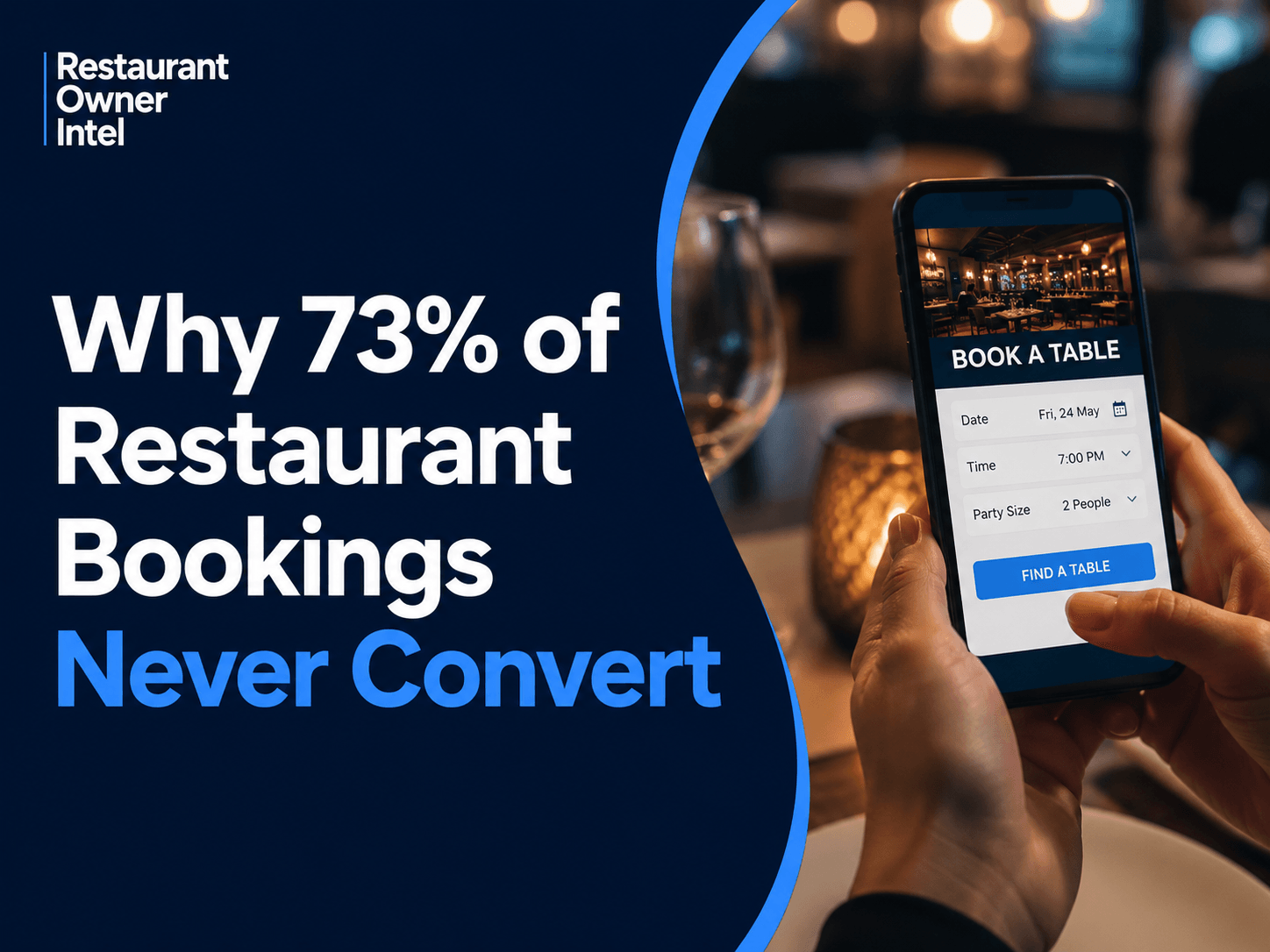
Why 73% of Restaurant Bookings Never Convert
Learn how optimizing a restaurant website for online reservations can increase direct bookings, improve the mobile booking experience, reduce no-shows, and help your restaurant keep more revenue.
Most restaurant owners invest heavily in attracting customers through social media, Google, email marketing and local advertising. But all that effort can be wasted if your website makes it difficult to reserve a table.
Most diners don't decide where to eat the moment they discover your restaurant. They compare options, browse menus, read reviews and then visit your website before making a reservation. If your booking process is slow, confusing or frustrating, they'll often leave and book somewhere else.
Research shows that around 65% of diners visit a restaurant's website before making a reservation, while nearly 60% prefer to book online. In many cases, the restaurant with the easiest booking experience wins.
The good news is that optimizing a restaurant website for online reservations doesn't usually require an expensive redesign. Small improvements to speed, mobile usability and booking flow can significantly increase direct reservations while reducing reliance on third-party platforms.
Here are the changes that can have the biggest impact.
Speed Fixes Convert More Browsers Into Bookings While optimizing a restaurant website for online reservations
A slow website quietly costs restaurants reservations every day.
Studies suggest restaurants can generate dozens of additional reservation requests each month simply by reducing page load times to under two seconds. Every extra second a visitor waits increases the likelihood they'll leave before completing a booking.
Fortunately, improving speed is often easier than owners expect.
Start by running your website through Google PageSpeed Insights. It quickly highlights the biggest performance issues.
The fastest improvements usually come from:
Remember that your reservation system is the most important feature on your website. Everything else should support it - not delay it.
A slow website is even more damaging on mobile devices. Roughly half of all online reservations are now made on smartphones, often while people are travelling, leaving work or deciding where to eat at short notice.
Don't just test your site using your desktop browser. Pick up your own phone and try making a reservation. If you become frustrated, your customers almost certainly will too.
Booking Button Placement Matters When optimizing a restaurant website for online reservations
Many restaurant websites unintentionally hide the most important button on the page.
Customers shouldn't have to search for your booking system.
Your reservation button should appear in three highly visible locations:
Research suggests that 44% of guests view a restaurant less favourably if making a reservation feels difficult. Most won't spend time hunting through menus or clicking multiple pages.
They'll simply book somewhere else.
Use clear, direct wording such as:
These consistently outperform vague labels like "Reservations."
The button should also stand out visually. Choose a colour that contrasts with the rest of your website so it's immediately obvious.
One of the biggest mistakes restaurants make is linking customers to a contact form or sending them to another website.
Instead, your booking widget should appear directly on your own website, allowing guests to complete the reservation without leaving your domain.
The fewer interruptions in the process, the higher your conversion rate.
Even small usability improvements matter.
Display available times immediately.
Show party size, date and time selection on one screen wherever possible.
Every unnecessary click gives customers another opportunity to abandon the booking.
Mobile Design Changes Everything About optimizing a restaurant website for online reservations
Today's diners increasingly book from their phones, often while making last-minute decisions.
If your website isn't designed for mobile first, you're almost certainly losing reservations.
Start with the basics.
Your phone number should be clickable using a tel: link so visitors can call instantly if they prefer speaking to someone.
Next, review your menu.
Many restaurants still upload PDF menus that require users to pinch, zoom and scroll sideways. They're frustrating to read and difficult for search engines to understand.
HTML menus are far better.
They're easier to browse, improve SEO and create a smoother experience on every device.
Form design also deserves attention.
Each field should automatically display the appropriate keyboard:
Large buttons are equally important.
Aim for tap targets of at least 48 pixels with enough spacing to prevent accidental taps.
Enable browser autofill using standard field names such as:
rather than custom field names.
These seemingly small improvements reduce friction and can significantly improve booking completion rates.
As part of optimizing a restaurant website for online reservations, remember that convenience is everything.
If booking takes less than a minute, more diners will complete the process instead of leaving for a competitor.
Direct Booking Systems Save Money While optimizing a restaurant website for online reservations and Building Guest Relationships
Every reservation that comes through your own website is worth more than one that comes through a third-party platform.
It's not just about avoiding commission fees. It's about owning the customer relationship.
Research shows that around 71% of diners prefer booking directly through a restaurant's website. They often trust the information more, expect better prices or loyalty rewards, and appreciate dealing directly with the restaurant.
Yet many restaurants still encourage guests to book through platforms that charge commission on every reservation.
Those fees quickly add up.
For busy restaurants, they can cost thousands each year that could instead be invested in marketing, staff training or improving the customer experience.
A direct booking system also gives you something even more valuable—customer data.
When guests reserve through your own website, you can:
Third-party platforms rarely provide the same level of customer ownership.
The booking experience is also entirely under your control.
Instead of redirecting guests to another website, keep the reservation process on your own domain. A seamless experience builds trust and reinforces your brand.
Restaurants offering both online and telephone bookings typically capture more reservations overall, but your website should always encourage guests to book directly whenever possible.
Confirmation Messages Reduce No-Shows While optimizing a restaurant website for online reservations
Getting a reservation is only half the battle.
Making sure the guest actually arrives is equally important.
No-shows cost restaurants thousands every year, especially during busy service periods when empty tables cannot be resold.
Fortunately, automation solves much of the problem.
Every online booking should trigger an immediate confirmation email or SMS.
Guests want reassurance that their reservation has been received, and an instant confirmation builds confidence in your booking system.
Your confirmation should include:
The reminder message is even more important.
Sending an SMS around 24 hours before the reservation can dramatically reduce no-show rates. Industry data suggests automated reminders can reduce no-shows to below 8%, compared with rates of 20% to 30% for manual systems.
Don't make cancelling difficult.
It might seem counterintuitive, but making cancellation easy actually protects revenue.
A cancelled table can often be resold.
An unexplained no-show usually cannot.
Include a simple cancellation or modification link in every reminder so guests can update their plans with minimal effort.
Real-Time Availability Prevents Costly Mistakes During optimizing a restaurant website for online reservations
Customers expect to see live availability.
If your website simply says, "Call for availability," many diners won't bother.
They'll move to another restaurant that shows available tables immediately.
Research suggests nearly half of restaurant reservations are now made on the same day.
Those last-minute bookings depend on accurate, real-time availability.
Your reservation system should synchronise instantly across every booking channel.
When someone books through your website, availability should update immediately across:
Disconnected systems create two expensive problems:
A modern reservation system should also understand how your restaurant operates.
For example, if a table normally turns every 90 minutes, your software shouldn't offer unrealistic booking times that disrupt service.
Likewise, table combination logic should automatically recognise when larger parties require two or more tables rather than simply removing individual tables from availability.
These operational details improve both customer experience and service efficiency.
Google Business Profile Integration Drives More Direct Bookings While optimizing a restaurant website for online reservations
Many diners never reach your homepage.
They discover your restaurant through Google Search or Google Maps first.
That's why your Google Business Profile has become one of the most important booking channels you own.
Restaurants with complete, regularly updated profiles typically receive far more clicks than neglected listings.
Enable Reserve with Google if your reservation provider supports it.
This allows guests to book directly from Google Search or Google Maps without searching for your website again.
Just as importantly, keep your profile accurate.
Review it regularly to ensure your:
are all correct.
Outdated information creates unnecessary friction and encourages diners to look elsewhere.
Photos also influence booking decisions.
Replace dark, outdated images with bright, professional photographs that accurately reflect your food, dining room and atmosphere.
Upload fresh images regularly to show that your restaurant is active and well maintained.
Don't overlook reviews either.
Responding to every review demonstrates that you value customer feedback.
Thank positive reviewers personally and respond constructively to negative experiences.
Future diners often judge your restaurant as much by your responses as by the reviews themselves.
Finally, use Google Posts to promote:
Regular updates keep your profile active and give customers more reasons to book.
Deposit Requirements Protect Revenue Without Hurting Conversions
Deposits can be an effective way to reduce costly no-shows, but only when they're used appropriately.
Many restaurant owners either avoid deposits completely or require them for every booking. In reality, the right approach depends on your restaurant, your customers and the size of the reservation.
For fine dining restaurants, deposits often make sense for every booking because each empty table represents significant lost revenue.
For casual restaurants, deposits are usually better reserved for:
Even a modest deposit of £10 per person can dramatically improve attendance rates.
The key is transparency.
Explain your deposit policy before the booking is confirmed. Customers should understand:
Unexpected charges damage trust far more than clearly communicated policies.
Avoid requesting full prepayment unless it's appropriate for your concept. A small commitment encourages attendance without creating unnecessary friction.
Modern payment platforms such as Stripe and Square integrate easily with most reservation systems, allowing deposits to be processed automatically without creating extra work for your team.
If a guest cancels within your stated notice period, process refunds promptly. A fair and consistent policy builds goodwill and encourages future bookings.
Analytics Reveal What's Really Working When optimizing a restaurant website for online reservations
One of the biggest advantages of digital reservations is that almost everything can be measured.
Most restaurant owners track how many bookings they receive.
Far fewer track why they receive them.
That's where valuable opportunities often hide.
Start by identifying where reservations originate.
For example:
Understanding your strongest booking channels allows you to invest more confidently in the marketing that delivers results.
Next, measure your booking completion rate.
How many people begin making a reservation?
How many actually finish?
A high abandonment rate usually points to one of three problems:
These are often quick fixes with a significant commercial return.
You should also monitor:
If your analytics show that most customers visit your menu before reserving, make sure your menu includes highly visible "Book a Table" buttons throughout the page.
Likewise, if most reservations are made during the evening, ensure your booking system performs flawlessly during those peak hours.
Finally, review your booking journey every quarter.
Technology changes.
Customer behaviour changes.
Your competitors improve.
Regular testing ensures your website continues converting visitors into paying guests.
Restaurant Website Reservation Checklist
Take ten minutes to review your own website.
Can you answer yes to these questions?
Every "no" represents an opportunity to increase direct reservations.
Common Mistakes When optimizing a restaurant website for online reservations
Many restaurants lose bookings because of avoidable mistakes.
The most common include: Hiding the booking buttonCustomers shouldn't need to search your website to reserve a table. Using PDF menusThey're frustrating on mobile devices and offer little SEO value. Redirecting customers elsewhereEvery additional website increases the chance of losing the reservation. Asking for too much informationOnly request the details you genuinely need. Long forms reduce completion rates. Ignoring mobile usersMost diners now browse and book from their phones. Design your booking experience for mobile first.
Failing to test the booking journeyRestaurant owners often assume everything works because it worked when the system was first installed.
Regularly complete your own booking process from start to finish. You'll often discover small issues before your customers do.
Frequently Asked Questions
How much does a restaurant reservation system cost?Direct booking systems typically cost between $159 and $299 per month without charging commission on every reservation. Third-party platforms often combine monthly subscription fees with per-cover charges. For many busy restaurants, a direct booking system pays for itself by reducing ongoing commission costs.
What percentage of restaurant reservations happen on mobile devices?Around half of all online restaurant reservations now come from mobile devices, with the percentage even higher for same-day bookings. If your mobile booking experience is slow or difficult to use, you're likely losing valuable reservations.
Should I require deposits for all restaurant reservations?Not necessarily. Fine dining restaurants often benefit from requiring deposits for every booking. Casual restaurants generally see better results by using deposits only for large parties, special events or high-demand service periods.
How can I reduce restaurant reservation no-show rates?Automated confirmation emails and SMS reminders remain two of the most effective ways to reduce no-shows. Include an easy cancellation link so guests can update their reservation rather than simply failing to arrive.
Why do people abandon restaurant booking forms before completing them?The biggest reasons include:
Reducing friction at every stage of the booking journey leads to more completed reservations.
Should restaurants use third-party booking platforms or direct booking systems?Third-party platforms can introduce new customers to your restaurant, but encouraging repeat guests to book directly through your own website is usually more profitable. Direct bookings eliminate commission fees, give you ownership of customer data and provide greater control over the guest experience.
What features should every restaurant booking system include?A modern reservation system should include:
These features improve both the customer experience and operational efficiency.
Every Reservation Starts With a Better Website
Most restaurant owners think they need more marketing to increase reservations.
In many cases, they simply need a website that converts more visitors into bookings.
Optimizing a restaurant website for online reservations isn't about creating the most impressive design. It's about removing friction wherever it exists.
A faster website, clearer booking buttons, a mobile-first experience, live availability and automated guest communication can all increase direct reservations while reducing reliance on commission-based booking platforms.
Even small improvements can produce measurable results.
Start by reviewing your website from a customer's perspective.
Time how long it takes to make a reservation on your phone.
Count the number of clicks.
Look for anything that slows the process or creates uncertainty.
Then fix one issue this week.
Your website should be your hardest-working member of staff—bringing in reservations around the clock, even while your restaurant is closed. |
Restaurant Owner Resource |
Free AI Restaurant Growth Plan |
Curious what growth opportunities your restaurant might be missing? Our free AI-powered Growth Plan analyses your restaurant's online presence, marketing and growth goals to identify opportunities you may not have considered.
|
Oct 19, 2026
Restaurant Technology: Which Tools Are Actually Worth the Investment?
From POS systems and booking software to AI and staff scheduling, here's how to choose restaurant technology that earns its place in your budget, protects your margins and makes running your business easier.
Oct 18, 2026
How to Fill Quiet Restaurant Nights Without Offering Discounts
Empty tables on a Tuesday or Wednesday can be expensive. But cutting prices isn't the only way to bring customers through the door. These practical restaurant marketing ideas can help you increase midweek bookings, give diners a reason to visit and protect your profit margins.

Oct 18, 2026
Are Delivery Apps Bringing You Sales or Taking Too Much Margin?
Delivery apps can keep your kitchen busy and your sales figures climbing. But how much of that money are you actually keeping? Here's how to uncover the real cost of restaurant delivery apps, protect your profit margins and make every order work harder for your business.

Oct 17, 2026
Why Customers Choose One Restaurant Over Another (And How to Win Their Business)
Why Customers Choose One Restaurant Over Another comes down to more than food and price. Understanding the psychology behind dining decisions can help your restaurant attract more customers, win bookings and build repeat business.
0 Comments
Join the conversation
Be the first to comment
Share your thoughts above.