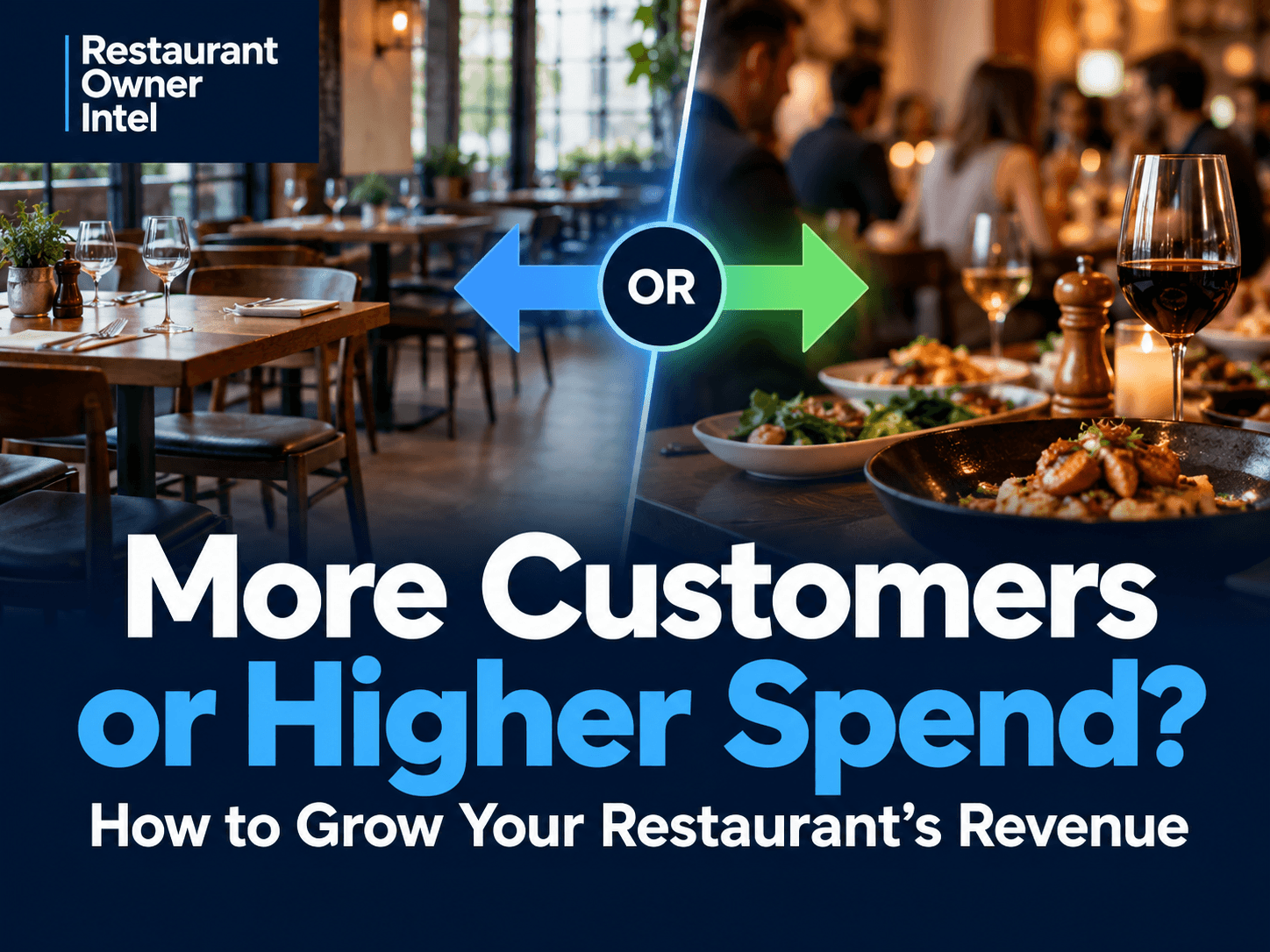
It's Wednesday evening. Your kitchen is ready, your team is on the clock, and half the tables are empty.
Across town, another restaurant has the opposite problem. Every table is occupied, the kitchen is working flat out, and customers are being turned away.
Both owners want to increase restaurant revenue.
But giving them the same growth advice would be a mistake.
The first restaurant needs more people through the door. The second might earn considerably more by improving what existing customers spend.
Yet when restaurant sales need a boost, the response is often predictable: more advertising, more social media activity, another promotion, perhaps a discount to encourage bookings.
Before investing in any of those things, there's a more useful question to ask.
Would your restaurant make more money by serving additional customers, or by earning slightly more from the customers it already has?
It sounds straightforward. The financial implications are anything but.
And the answer could save you from spending money solving the wrong problem.
Two Ways to Increase Restaurant Revenue - But Which Makes More Profit?
Strip away the complexity of restaurant growth and two numbers sit at the centre of your revenue.
Number of customers × Average spend per customer = Revenue
Let's put that into a realistic restaurant scenario.
Your restaurant serves 1,000 customers each month. The average customer spends £30.
That gives you monthly revenue of £30,000.
Now imagine you want to increase sales by 10%.
You have two options.
Option 1: Attract more customers
Increase monthly customer numbers from 1,000 to 1,100.
Keep average spend at £30.
Your monthly revenue rises to £33,000.
Option 2: Increase average spend
Keep customer numbers at 1,000.
Increase average spend from £30 to £33.
Your monthly revenue also rises to £33,000.
On paper, the result is identical.
An additional £3,000 in monthly revenue.
But look a little closer.
Those extra 100 customers might require advertising, promotional discounts, more ingredients and additional staff hours.
Increasing average spend by £3 could involve better menu presentation, more appealing side dishes or helping staff make appropriate recommendations.
Neither strategy is guaranteed to be more profitable.
The difference lies in what it costs to generate those additional sales.
And that's why increasing restaurant revenue and increasing restaurant profit are not necessarily the same thing.
Empty Tables? Attracting More Restaurant Customers May Be Your Biggest Opportunity
An empty table represents capacity you're paying for but not using.
The rent doesn't fall because Wednesday was quiet. Your equipment still needs maintaining. The lights are on, and your team may already be scheduled to work.
If your restaurant has room to serve more customers without significantly increasing operating costs, attracting additional diners can make commercial sense.
But there's an important distinction between needing more customers and needing more customers at particular times.
Picture a neighbourhood restaurant that fills up every Friday and Saturday evening.
The owner is pleased with weekend trade but frustrated by quiet weekday services.
Running a general advertising campaign might bring in more enquiries for Saturday night — when there's little availability left.
That doesn't solve the problem.
A better approach is to identify the services where additional customers would make the greatest difference.
Stop Marketing the Restaurant. Start Marketing the Empty Tables.
Your marketing should reflect the trading patterns of your business.
If Tuesday evenings are consistently quiet, give people a reason to visit on Tuesdays.
That doesn't automatically mean discounting your food.
You could introduce a changing midweek menu, promote a particular dining occasion or organise a small event that suits your restaurant and local customers.
Then make sure people can find it.
Your Google Business Profile should have accurate opening hours, current photographs, a working booking link and an up-to-date menu.
Your website should make reserving a table straightforward, particularly on mobile.
Your existing email subscribers should know what's happening.
And your social media content should communicate a clear reason to visit, rather than simply reminding people that your restaurant exists.
A photograph of tonight's special might generate interest.
A photograph of tonight's special, accompanied by a clear invitation to book for Wednesday evening, gives interested customers something to act on.
The distinction matters.
The objective isn't more visibility. It's more profitable bookings during the services that need them.
Be Careful What You Spend to Fill Those Tables
A busy restaurant can still have disappointing profits.
Imagine launching a 25% discount to fill a quiet evening.
Bookings increase. The dining room looks healthier. Your team feels busy.
But after the discount, food costs, additional labour and advertising expenditure, how much money is left?
You might discover that you've worked considerably harder for very little additional profit.
This doesn't mean promotions are always a bad idea.
A carefully designed offer can attract new customers, introduce people to your restaurant and encourage future visits.
But the numbers need to work.
Before launching a promotion, calculate the expected revenue after discounts and the additional costs involved in delivering it.
Then consider whether those customers are likely to return at your normal prices.
A restaurant full of customers who only visit when everything is discounted isn't necessarily a stronger business.
Already Busy? Increasing Restaurant Average Spend Could Be the Smarter Move
Now consider the restaurant that's consistently busy.
Tables are occupied. The kitchen is working efficiently. Customer numbers are healthy.
Finding another 100 diners might sound attractive, but where would they sit?
And would squeezing more customers into an already busy service improve the experience?
In this situation, increasing restaurant average spend deserves serious attention.
You've already persuaded customers to choose your restaurant.
They've travelled to you, taken their seats, opened the menu and decided to spend money.
That is a valuable opportunity.
The question is whether you're making it easy for them to enjoy everything your restaurant has to offer.
Your Menu Might Be Leaving Money on the Table
Think about the last time you reviewed your menu from a customer's perspective.
Not as the owner who knows every dish, ingredient and margin.
As someone seeing it for the first time.
Which dishes catch the eye?
Are the most profitable options easy to notice?
Do your descriptions make the food sound appealing?
Are starters, sides and desserts presented as worthwhile additions, or do they feel like an afterthought?
A customer might happily order a side of roasted vegetables, a sharing starter or a dessert.
But if those options are buried in a crowded menu, poorly described or rarely mentioned, the opportunity can disappear.
Consider a restaurant serving a popular steak dish.
The steak sells well, but relatively few customers order sides.
Rather than increasing the steak's price, the restaurant improves the presentation of its side dishes and helps staff explain which ones complement the meal.
Some customers begin adding a side they might otherwise have overlooked.
Average spend increases.
The customer gets a more complete dining experience.
And, provided those sides make a healthy contribution after their direct costs, the restaurant earns more from the same table.
That's a more sustainable approach than simply pushing prices higher.
Better Recommendations, Not Aggressive Upselling
Nobody enjoys feeling pressured into buying something they don't want.
A server who repeatedly pushes extras can make an otherwise pleasant meal uncomfortable.
But thoughtful recommendations are different.
A couple ordering a special meal might appreciate hearing about a sharing dessert.
Someone choosing a particular dish may welcome a wine recommendation.
A family looking for a quick lunch probably doesn't need a lengthy sales conversation.
Good service involves recognising the difference.
Your staff should understand which dishes complement one another, which extras customers genuinely enjoy and which recommendations make commercial sense.
That knowledge can improve both customer satisfaction and average spend.
It doesn't require a complicated sales script.
It requires product knowledge, good judgement and confidence.
What Could an Extra £2 Per Customer Mean for Your Restaurant?
Small increases in average spend can look insignificant when you're reviewing individual transactions.
Two pounds here. Three pounds there.
Hardly enough to get excited about.
But across hundreds of customers, the picture changes.
Imagine your restaurant serves 1,500 customers each month.
If average spend increases by just £2, that's an additional £3,000 in monthly revenue.
Maintain that improvement for a full year, with customer numbers unchanged, and the additional revenue reaches £36,000.
Of course, that's revenue rather than profit.
Additional dishes and drinks have associated costs.
And you need to ensure that higher spending isn't simply the result of price increases that discourage customers from returning.
Nevertheless, the calculation demonstrates something worth paying attention to.
You don't always need more customers to generate a meaningful increase in restaurant sales.
Sometimes you need to make better use of the customer demand you've already earned.
The Capacity Problem: More Customers Aren't Always the Answer
There's a point at which attracting additional customers can become counterproductive.
Your dining room might be full, but that doesn't mean your restaurant is operating at its most profitable level.
Perhaps the kitchen is struggling to keep up.
Maybe customers are waiting too long for food.
Or staff are rushing between tables, trying to manage a service that's becoming increasingly difficult.
Adding more diners could make those problems worse.
Even when tables are available, your kitchen or staffing arrangements may limit how many customers you can serve comfortably.
That's why restaurant capacity needs to be considered alongside customer numbers.
Ask yourself:
- Which services regularly reach capacity?
- When do we have unused tables?
- Can the kitchen handle additional orders without slowing service?
- Would more customers require extra staff hours?
- Are we losing bookings because customers can't find suitable availability?
The answers help determine where growth is realistic.
If you're turning customers away on Saturday evenings, increasing demand for Saturday isn't your immediate priority.
You might benefit more from encouraging customers to book earlier, visit on quieter days or spend a little more during their existing visits.
If your restaurant is half-empty on Wednesday, however, improving average spend alone may leave a substantial opportunity untouched.
The right growth strategy should work with your restaurant's capacity, not against it.
The Profit Question That Changes Everything
Revenue is easy to celebrate.
A busy weekend, a record sales day or a strong month can make a restaurant feel successful.
But revenue doesn't tell you how much money you've actually made.
Let's return to our earlier example.
Two different strategies each generate an additional £3,000 in monthly sales.
One attracts more customers through advertising.
The other increases average spend through menu improvements and staff recommendations.
The advertising campaign might involve promotional costs, discounts, extra ingredients and additional labour.
The average-spend strategy might involve some staff training and higher ingredient costs from additional purchases.
Which is better?
You can't know without comparing the costs.
For a useful assessment, calculate the additional contribution each strategy produces after the costs directly associated with generating those sales.
For example, suppose the extra £3,000 in revenue from a customer acquisition campaign involves £1,200 in additional variable and marketing costs.
That leaves £1,800 in additional contribution before any other changes in overheads.
Now suppose the average-spend strategy generates the same £3,000 but involves £900 in additional direct costs.
That leaves £2,100 in contribution.
In this hypothetical example, the average-spend strategy produces £300 more contribution from the same revenue increase.
But reverse the circumstances and attracting customers could easily become the better option.
A restaurant with unused capacity and strong local demand might attract additional diners at very little marketing cost.
The important lesson isn't that one strategy always wins.
It's that the best restaurant growth strategy is the one that produces the strongest sustainable improvement in profit, not simply the largest increase in sales.
There's a Third Growth Opportunity Hiding in Your Customer Base
So far, we've looked at two choices.
Attract more customers.
Or increase what existing customers spend.
But there's another opportunity that can be just as valuable.
Getting satisfied customers to visit more often.
Think about a customer who enjoys your restaurant but only visits once every couple of months.
They like the food. The service is good. They've never had a reason to complain.
They simply don't think about your restaurant very often.
Now imagine giving that customer a compelling reason to return every month.
Their annual visit frequency could double.
You haven't needed to acquire a completely new customer.
You haven't necessarily increased what they spend on each visit.
You've made your restaurant a more regular part of their routine.
For independent restaurants serving local communities, that can be a powerful growth opportunity.
Give Customers a Reason to Come Back
Repeat visits rarely happen because a restaurant sends endless reminders asking people to return.
Customers need a reason.
That might be a seasonal menu, a new dish, a regular event or simply the confidence that they'll enjoy another good meal.
Email marketing can help you stay in touch with customers who have agreed to hear from you.
A well-timed message about a new menu or upcoming event can put your restaurant back into consideration.
Consistent service matters just as much.
Customers who enjoy a meal but experience disappointing service on their next visit may not return for a third.
And regular customers often contribute to another important source of growth: recommendations.
They bring friends, organise family meals, mention your restaurant to colleagues and leave reviews.
A strong base of repeat customers can therefore support both customer retention and new customer acquisition.
Before spending heavily on finding new diners, consider whether you're doing enough to encourage previous customers to return.
How to Choose the Best Restaurant Growth Strategy
It's tempting to look for a single answer.
More customers or higher spend?
But the right choice depends on what's actually happening inside your restaurant.
Fortunately, you don't need an expensive consultancy project to begin finding out.
Your till reports, booking records and management accounts should already contain much of the information you need.
Start with five questions.
1. Are Customer Numbers Actually Growing?
Look at the number of customers you're serving each week.
Not just your total sales.
A restaurant can report higher revenue while serving fewer diners, particularly after menu price increases.
Compare customer numbers across similar periods.
Then break the figures down by service.
A strong Saturday evening can hide disappointing weekday trade.
Understanding when customers visit is just as important as knowing how many you serve.
2. What Is Your Restaurant's Average Spend?
Divide your total sales by the number of customers served during the same period.
For example:
£18,000 weekly revenue ÷ 600 customers = £30 average spend per customer.
Track that figure over time.
If average spend is increasing, find out why.
Are customers ordering more?
Are they choosing higher-value dishes?
Or have menu price increases simply pushed the number upwards?
These situations have different implications for future growth.
3. Where Do You Have Room for More Customers?
Review your busiest and quietest services.
Identify where additional customers could be accommodated without putting unnecessary pressure on staff or compromising the dining experience.
A quiet Tuesday lunch might offer an obvious opportunity.
A fully booked Saturday evening probably doesn't.
Be realistic about your kitchen's capacity as well as the number of available tables.
4. Which Menu Items Actually Make You Money?
A higher selling price doesn't automatically mean a more profitable dish.
Review the contribution your menu items make after their direct costs.
Look at both popularity and profitability.
A dish with a healthy margin but very few sales might benefit from better menu positioning or a more appealing description.
A popular dish with a weak margin may need a different approach.
Understanding those differences helps ensure that increasing average spend also supports profitability.
5. What Will It Cost to Generate the Extra Revenue?
This is the question that brings everything together.
If you want more customers, estimate the cost of attracting and serving them.
If you want higher average spend, calculate the likely costs of the additional items sold and any changes required.
If you want more repeat visits, consider the cost of communicating with customers and creating reasons for them to return.
Then compare the likely additional contribution from each opportunity.
You may find that one approach offers a noticeably better return for the time and money involved.
A 30-Day Test to Find Out What Works
You don't need to commit to a major marketing campaign or redesign your entire menu to test a growth idea.
A focused 30-day experiment can provide useful evidence.
The key is to change one meaningful thing at a time.
If You Need More Customers
Choose one service with spare capacity.
Let's say Wednesday evenings are consistently quiet.
For the next 30 days, concentrate your efforts on attracting additional Wednesday bookings.
Update your Google Business Profile with relevant information.
Send an email to customers who have agreed to receive your updates.
Promote a specific dining occasion through your existing social media channels.
Make booking easy.
Then track the results.
How many customers visited?
How much revenue did they generate?
What did the marketing cost?
And, importantly, how much additional contribution did those visits produce?
If You Need Higher Average Spend
Choose two or three menu opportunities.
Perhaps your profitable side dishes aren't selling particularly well.
Or customers rarely order dessert despite positive feedback about the options available.
Improve how those items are presented.
Make sure staff understand them and can recommend them naturally.
Track average spend, item sales and the contribution those purchases generate.
Avoid relying on average spend alone.
An increase caused by selling more low-margin products may not deliver the financial improvement you expected.
If Repeat Visits Are the Opportunity
Choose a simple reason for previous customers to return.
It could be a seasonal menu, a new midweek dining experience or an upcoming event.
Communicate it through your existing customer email list.
Where your booking or till system allows it, monitor returning customers and visit frequency.
Compare results with previous periods, while allowing for seasonal changes and other factors that may influence demand.
A 30-day test won't always provide a definitive answer.
But it can help you move away from assumptions and towards decisions based on what customers actually do.
Products / Tools / Resources
You don't need a complicated collection of software to understand where your restaurant's next growth opportunity lies.
In fact, adding more technology before understanding the problem can create extra work without improving performance.
Start with the systems you already use. The following tools and resources can help you measure customer numbers, increase average spend and make better decisions about restaurant growth.
1. Your Existing EPOS System
Best for: Understanding revenue, customer numbers and average spend.
Your electronic point-of-sale system should be the first place you look.
Depending on its reporting features, it may show sales by day, time, menu category and individual item.
Some systems also provide customer counts, average transaction values and product-level performance.
Use those reports to identify which services generate the strongest revenue and which menu items contribute most to sales.
One important detail: average transaction value isn't necessarily the same as average spend per customer.
If a single bill covers four diners, you'll need the customer count to calculate average spend accurately.
Start by reviewing the reports available in your current system before paying for additional analytics software.
2. Google Business Profile
Best for: Helping local customers find and choose your restaurant.
Google Business Profile is a free tool that deserves regular attention.
Customers searching for somewhere to eat may encounter your restaurant through Google Search or Maps before they ever visit your website.
Accurate opening hours, appealing photographs, current menus and clear booking information can help turn that interest into visits.
Review your profile regularly.
Check that customers can find the information they need without having to search elsewhere.
Where available, use its performance reporting to monitor how people interact with your listing.
Those interactions are useful indicators of interest, although they shouldn't be treated as confirmed bookings.
3. Restaurant Booking and Customer Management Software
Best for: Understanding demand, managing capacity and encouraging repeat visits.
A booking system can provide useful information about how customers use your restaurant.
Depending on the platform, you may be able to review booking patterns, cancellations, no-shows, customer visit history and demand across different services.
That information can help identify opportunities to attract customers during quieter periods.
It may also reveal which guests return regularly.
Platforms such as OpenTable and SevenRooms offer restaurant-focused reservation and guest management capabilities.
Before investing, check the pricing structure, contract terms, customer data access and whether the features will genuinely improve your operation.
The best system isn't necessarily the one with the most features.
It's the one your restaurant will actually use.
4. Menu Performance Reports and Costing Spreadsheets
Best for: Identifying profitable opportunities to increase average spend.
A simple spreadsheet can be one of the most valuable tools in your business.
Record each menu item's selling price, direct ingredient cost, sales volume and contribution per sale.
Then compare popularity with profitability.
This helps identify dishes that deserve more attention and items that may need reviewing.
You can build the spreadsheet using Google Sheets or Microsoft Excel.
You don't need an elaborate model.
A clear picture of what sells, what it costs and what remains after direct costs is a useful starting point.
5. Email Marketing Software
Best for: Encouraging previous customers to return.
An email list gives you a way to communicate with customers who have chosen to hear from your restaurant.
That makes it particularly useful for promoting seasonal menus, upcoming events and quieter dining occasions.
Platforms such as Mailchimp and Brevo provide email marketing tools suitable for smaller businesses.
Look for something straightforward that allows you to manage subscribers, create campaigns and review results.
Make sure you collect and use customer contact details in accordance with applicable privacy and marketing rules.
A modest, engaged customer list can be more useful than a large database of people who rarely open your messages.
6. A Simple Restaurant Growth Tracking Sheet
Best for: Comparing growth opportunities without adding unnecessary complexity.
Before purchasing another subscription, consider creating a basic weekly tracking sheet.
Include:
- Total revenue
- Number of customers served
- Average spend per customer
- Sales by service
- Marketing expenditure
- Estimated additional contribution from growth activities
- Repeat customer numbers, where available
Update it at the same time each week.
Over several weeks, patterns may begin to emerge.
You might discover that customer numbers are healthy but average spend has barely moved.
Or that average spend is increasing while customer numbers quietly decline.
Perhaps one underperforming weekday service represents a bigger opportunity than your entire social media advertising budget.
The value of the tracking sheet isn't the amount of information it contains.
It's whether the numbers help you recognise where your restaurant could earn more — and what it would cost to make that happen.
Try This With AI
Use the AI you're already using: ChatGPT, Claude, Gemini, Grok, Meta AI, Copilot, or another general-purpose AI assistant. Replace the example information inside the brackets with your own information, then copy and paste the complete prompt into your AI.
AI Prompt
Act as an experienced restaurant profitability adviser and help me decide whether my restaurant should focus first on attracting more customers, increasing average spend per customer, or encouraging existing customers to visit more frequently. Analyse my restaurant's current performance using this information: [Example: I run a 60-seat independent Italian restaurant. We serve around 800 customers per month, with average spend of £32 per person. Friday and Saturday evenings are usually full, but Tuesday and Wednesday are quiet, with around half our tables empty. Our monthly revenue is approximately £25,600. We spend £300 per month on social media advertising, but I'm unsure whether it generates bookings. Our starters and desserts sell reasonably well, but side dishes are rarely ordered. We have regular customers but don't actively encourage repeat visits.]. Based on my information, identify which of the three growth opportunities should be my first priority and explain why, considering available capacity, customer demand, likely costs, profit margins and operational limitations. Compare the potential financial impact of attracting 10% more customers against increasing average spend by 10%, showing the calculations and clearly distinguishing additional revenue from additional profit. Don't invent missing costs or margins; explain what information would be needed to calculate profitability accurately. Identify the three biggest opportunities I may be overlooking, ranked by likely commercial value and ease of implementation. Then recommend one realistic, low-cost improvement I should test over the next 30 days, with specific actions, what to measure and how to judge whether it's working. Finish with a simple weekly scorecard containing no more than five useful metrics. Keep your recommendations practical for a busy independent restaurant owner, avoid generic marketing advice, and clearly label any assumptions or estimates. Your objective is to help me make a better commercial decision, not simply increase sales.
0 Comments
Join the conversation
Be the first to comment
Share your thoughts above.