
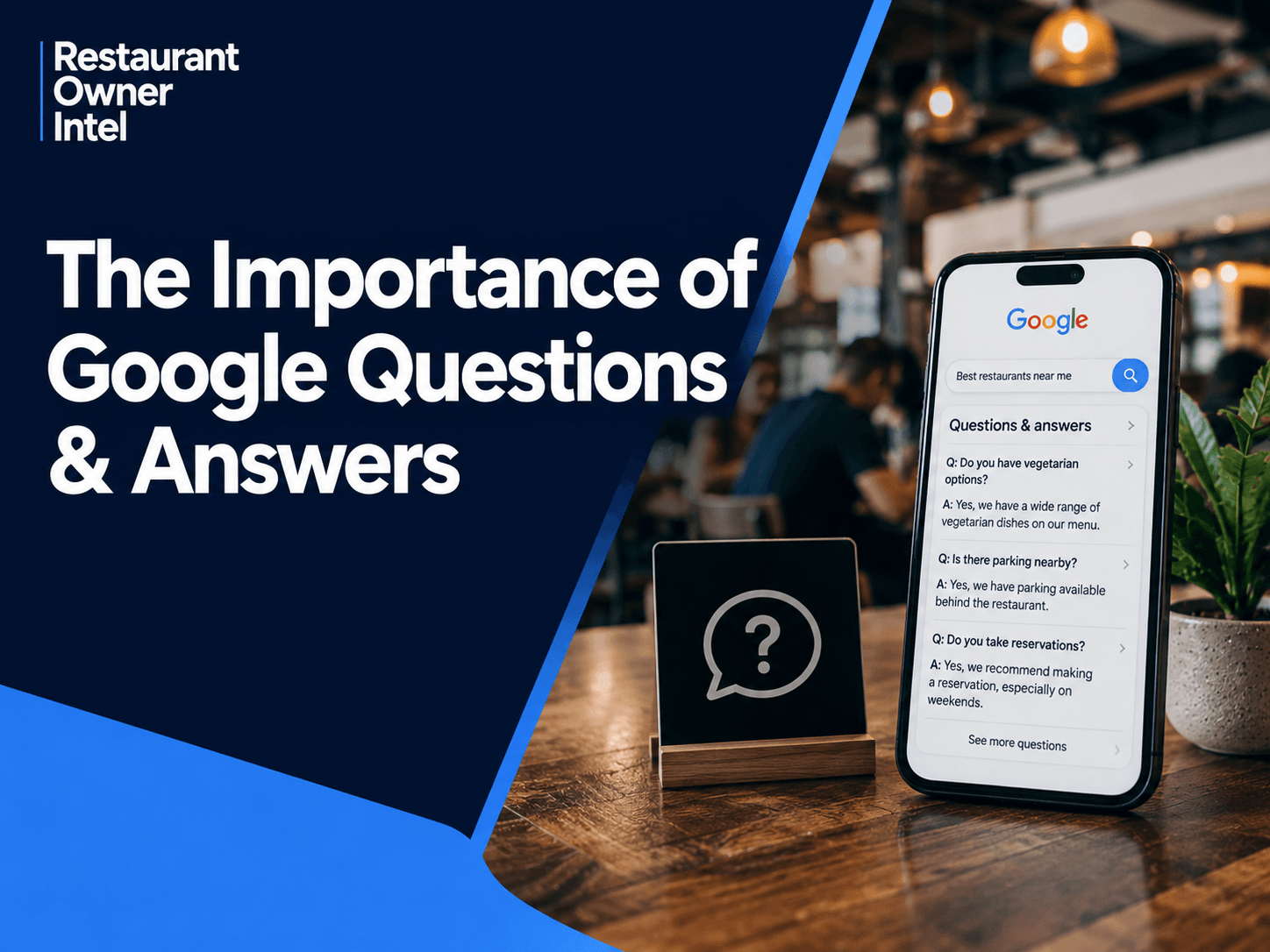
The Importance of Google Questions & Answers for Restaurants
Discover the importance of Google Questions & Answers for restaurants and how clearer online information can build customer confidence, remove booking friction and help more diners choose your restaurant.
A potential customer finds your restaurant on Google.
They like the photos. Your reviews look good. The menu sounds promising.
But they still have one question.
Do you have gluten-free options?
Or perhaps:
Is there parking nearby? Can you accommodate a large group? Do you have outdoor seating? Are children welcome?
These might sound like small details. But when someone is deciding where to eat, a small unanswered question can become a reason not to book.
That is why the importance of Google Questions & Answers goes beyond another feature on your Google Business Profile.
Google is increasingly trying to give customers useful information about businesses directly within Search and Maps. For restaurant owners, the lesson is simple:
Make it easy for Google — and your customers — to understand your restaurant. Google Questions & Answers Is Changing
Restaurant owners familiar with Google Business Profile may remember the traditional Questions & Answers section, where customers could post questions and businesses or other users could respond.
Google has been changing this experience.
Instead of relying entirely on customers scrolling through old questions or waiting for someone to answer a new one, Google is increasingly using information from different sources to help answer questions about businesses.
That makes the underlying principle more important, not less.
Your restaurant needs clear, accurate and useful information wherever Google may look for it.
That includes your:
The restaurant with the clearest digital information has a better chance of removing uncertainty when a customer is deciding where to eat.
How AI Changes Google Questions & Answers
Google is increasingly using AI to answer detailed questions about local businesses.
That means a potential customer may not need to find a traditional question and answer written by another customer. They may be able to ask Google a specific question such as:
“Does this restaurant have good vegetarian options?” “Is this restaurant suitable for a family with young children?” “Can I come here with a large group?” “Is there parking nearby?”
Google can use information it understands about the restaurant - including information from your Business Profile, website, reviews and other sources - to help produce an answer.
For restaurant owners, this changes the job.
You are no longer only providing information for people who visit your website or Google Business Profile. The information you publish may also help AI understand what your restaurant offers and answer customer questions about it.
That makes accurate, specific information increasingly valuable.
For example, instead of your website simply saying: “We cater for all occasions.”
it is more useful to clearly explain: “We accept group bookings for up to 16 guests and offer a separate private dining room for larger parties.”
The second version gives customers better information. It also gives Google clearer information from which to understand your restaurant.
The same principle applies to dietary requirements, accessibility, parking, children, outdoor dining, private events, takeaway, opening hours and reservations.
The clearer your restaurant is online, the easier it becomes for both customers and AI-powered search tools to understand what you offer. Why Restaurant Questions Matter
Think about the questions your team receives every week.
“Do you take bookings?” “Do you have vegan dishes?” “What time does the kitchen close?” “Can we bring a dog?” “Do you cater for allergies?” “Is there a children’s menu?” “Can you accommodate a table of 12?”
Customers searching on Google may have exactly the same questions.
And these are rarely questions asked simply out of curiosity.
They are often buying questions.
Someone asking whether you can accommodate 12 people may be organising a birthday dinner.
Someone asking about gluten-free dishes may be choosing between you and another restaurant.
Someone checking parking may already be considering visiting tonight.
Answering these questions clearly removes friction from the decision. The Importance of Google Questions & Answers Comes Down to Customer Confidence
Customers do not always call a restaurant when information is missing.
They may simply move on.
Imagine two restaurants.
Both have similar ratings, menus and prices.
Restaurant A makes it easy to establish that it accepts reservations, has nearby parking, offers vegetarian dishes and accommodates larger groups.
Restaurant B leaves most of that information unclear.
Which feels easier to book?
This is where seemingly minor pieces of information can have commercial value.
You are reducing the number of unanswered questions between “This restaurant looks good” and “Let’s book it.” Your Reviews Are Becoming an Information Asset
Reviews are normally discussed in terms of reputation.
There is another reason to take them seriously.
Customer reviews contain huge amounts of information about your restaurant.
Diners might mention:
That information can help other customers understand what your restaurant offers.
So your review strategy should not simply focus on achieving a higher star rating.
You want a steady flow of genuine, detailed reviews from real customers.
A review saying: “Great restaurant.” is positive.
But a genuine review explaining that the customer visited for a family birthday, that staff handled a gluten allergy well and that there were plenty of vegetarian choices provides considerably more useful context.
Do not script what customers should write.
Instead, make it easy for satisfied customers to leave honest reviews about their experience. Your Website Needs to Answer Real Customer Questions
This change also makes your restaurant website more important.
Look at it from a customer's perspective.
Can someone quickly establish:
Customers want answers.
A simple FAQ section can be particularly useful.
For example: Do you offer vegetarian and vegan options?
Yes. We have vegetarian and vegan dishes available across our menu. Please speak to a member of the team about specific dietary requirements. Do I need to book?
Walk-ins are welcome when tables are available, but we recommend booking ahead on Friday and Saturday evenings. Can you accommodate large groups?
We accept group reservations for parties of up to 14 in our main restaurant. For larger parties and private events, contact us directly.
Clear answers help customers make decisions.
They also create clear information about your restaurant that search engines can understand. Check Your Google Business Profile for Information Gaps
Your Google Business Profile should not be something you set up once and forget.
Check it regularly.
Incorrect opening hours, missing attributes, an old menu link or outdated information can create unnecessary friction.
Start with the basics:
Opening hours: Are normal and special hours correct? Website: Does the link work and lead customers somewhere useful? Menu: Can customers easily find your current menu? Reservations: Is the booking route clear? Categories: Does your profile accurately describe the business? Photos: Do recent images accurately represent the restaurant? Reviews: Are customers receiving professional responses?
The objective is not to fill every available field simply because it exists.
It is to give prospective customers the information they need to choose you.
Use Customer Questions to Improve More Than Google
There is another useful opportunity here.
Keep a list of the questions customers repeatedly ask.
Ask your front-of-house team what comes up most often on the phone, at the door, in messages and during bookings.
Those questions reveal where customers need more information.
If ten people a week ask where to park, the problem may not be the customers.
Your parking information may simply be difficult to find.
If people constantly ask whether you offer gluten-free food, make that information clearer on your menu and website.
If large groups regularly ask whether you accommodate parties, create a dedicated group-booking page.
Frequently asked questions are useful customer research.
Every repeated question is a potential information gap you can fix. A 15-Minute Google Questions & Answers Audit
Search for your restaurant as a customer would and review the information available. Ask yourself:
Every “no” is worth investigating.
Not because completing a checklist guarantees a higher Google ranking, but because missing information can create friction at exactly the moment someone is considering your restaurant. Do Not Try to Game the System
There is an important distinction between providing useful information and trying to manufacture signals for Google.
Focus on accuracy.
Do not create misleading claims, fake customer questions or artificial reviews.
Your goal is much simpler:
Make your restaurant easy to understand.
Give customers accurate information. Keep your profile current. Build useful content on your website. Encourage genuine reviews. Answer recurring customer questions clearly.
That creates a stronger online presence regardless of how Google changes the exact format of its Q&A features. The Bigger Lesson for Restaurant Owners
Google is becoming more than a directory containing your address, telephone number and reviews.
Customers increasingly expect Google to help them answer a more useful question:
“Is this restaurant right for me?”
Your online information helps provide that answer.
A diner may want a romantic table for two.
Another needs somewhere suitable for three children.
Someone else needs vegan food.
Another customer is organising dinner for 15 colleagues.
The more accurately your online presence explains what you offer, the easier it becomes for the right customer to choose your restaurant.
And that is the real importance of Google Questions & Answers.
It is not about maintaining another marketing feature.
It is about removing uncertainty between discovery and booking. What to Do This Week
Write down the 10 questions customers ask your restaurant most often.
Then search for your restaurant on Google and visit your own website.
See how many of those questions a potential customer could answer without calling you.
If important answers are missing, add them to the appropriate places.
Start with the questions most likely to affect a booking.
Because when a customer is deciding where to eat, making the decision easier can be one of the simplest marketing improvements you make. |
Restaurant Owner Resource |
Free AI Restaurant Growth Plan |
Curious what growth opportunities your restaurant might be missing? Our free AI-powered Growth Plan analyses your restaurant's online presence, marketing and growth goals to identify opportunities you may not have considered.
|
Oct 19, 2026
Restaurant Technology: Which Tools Are Actually Worth the Investment?
From POS systems and booking software to AI and staff scheduling, here's how to choose restaurant technology that earns its place in your budget, protects your margins and makes running your business easier.

Oct 18, 2026
How to Fill Quiet Restaurant Nights Without Offering Discounts
Empty tables on a Tuesday or Wednesday can be expensive. But cutting prices isn't the only way to bring customers through the door. These practical restaurant marketing ideas can help you increase midweek bookings, give diners a reason to visit and protect your profit margins.

Oct 18, 2026
Are Delivery Apps Bringing You Sales or Taking Too Much Margin?
Delivery apps can keep your kitchen busy and your sales figures climbing. But how much of that money are you actually keeping? Here's how to uncover the real cost of restaurant delivery apps, protect your profit margins and make every order work harder for your business.

Oct 17, 2026
Why Customers Choose One Restaurant Over Another (And How to Win Their Business)
Why Customers Choose One Restaurant Over Another comes down to more than food and price. Understanding the psychology behind dining decisions can help your restaurant attract more customers, win bookings and build repeat business.
0 Comments
Join the conversation
Be the first to comment
Share your thoughts above.