
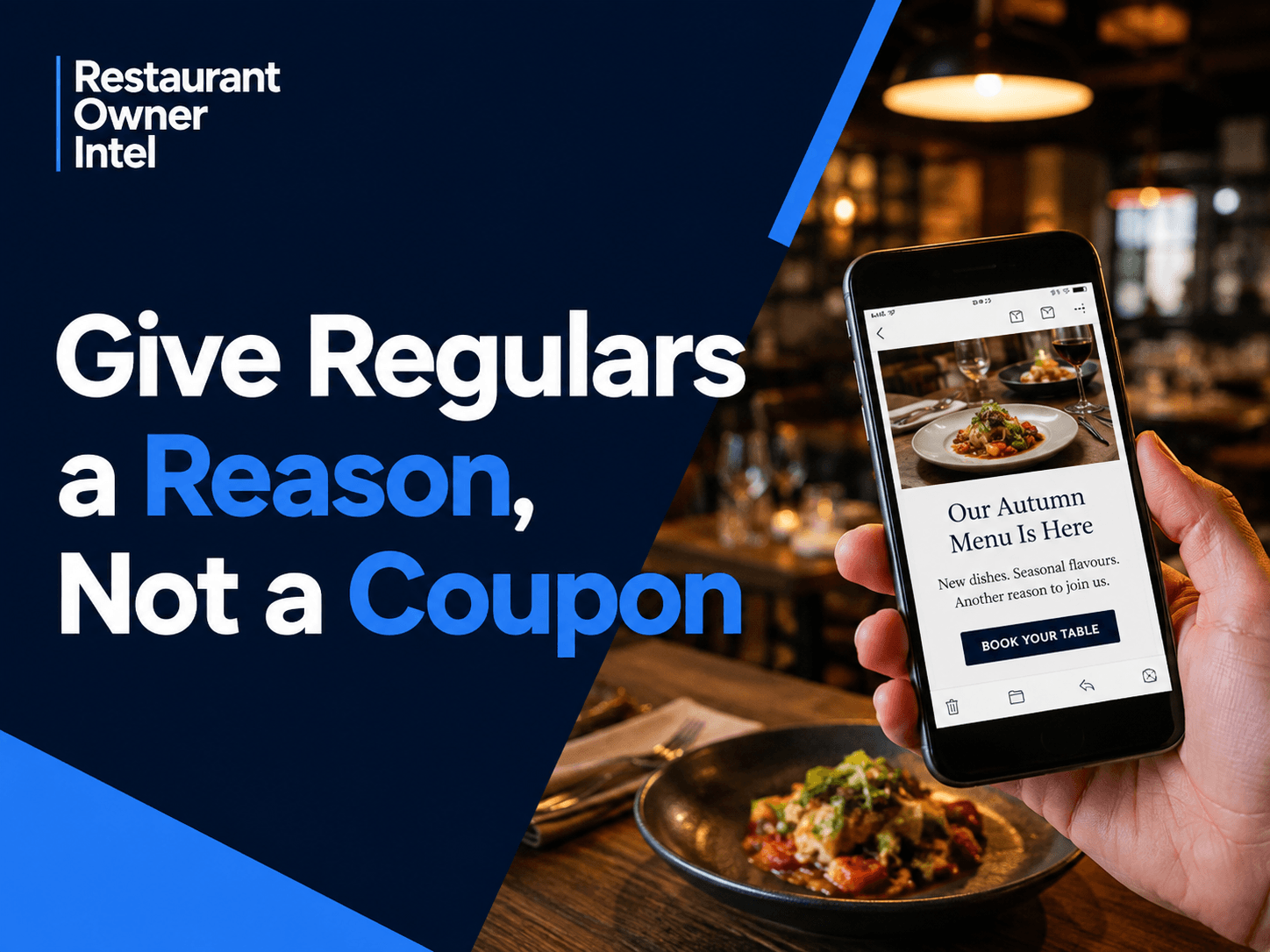
Give Regulars a Reason, Not a Coupon
Learn how restaurant email marketing can encourage repeat visits using menu changes, occasions and insider updates instead of relying on constant discounts.
Restaurant owners often use email marketing with a simple assumption: if you want customers to come back, give them an offer. Ten percent off. A free dessert. Two courses for a set price. A midweek deal. A voucher that expires on Thursday. These offers can create a reason to act. The problem starts when they become the restaurant's default reason to act. If regular customers learn that opening your emails usually leads to a discount, you're not just promoting the restaurant. You're establishing an expectation about what your emails are for. That changes the relationship. Instead of thinking, “What's happening at the restaurant?”, customers can begin thinking, “What's the offer this time?” And once that happens, an ordinary invitation to return has to compete with the discounted invitations you've trained them to expect. The better distinction is simple: A coupon reduces the cost of returning. A reason increases the desire to return. Restaurant email marketing becomes much more useful when you understand the difference. Find the reason before you find the incentiveImagine you run a neighbourhood Italian restaurant. A customer has visited four times in the past six months. They've already demonstrated that they like the restaurant. They know where you are. They've experienced the food. They've accepted your pricing. You don't need to persuade them from zero. Then you send this: 20% off your next meal this week. Book now. That might produce a booking. But ask a more useful question: What job did the 20% discount actually do? Did that customer need a lower price? Or did they simply need a reason to think about your restaurant again? Those aren't the same problem. Now imagine the restaurant has just changed three dishes for autumn. There's a new wild mushroom pappardelle, a slow-cooked beef dish has returned, and the kitchen has added a pear dessert that will only be around for the season. The email becomes: The autumn dishes have arrived Then it shows the customer what's new, explains what's returned and gives them an easy route to book. No discount. Yet the email still contains a reason to visit. More importantly, it gives a regular customer something they haven't already experienced. That's the deeper opportunity with email. Your regulars don't necessarily need to be convinced that your restaurant is good. Often, they need their attention refreshed. Restaurants naturally produce reasons to return all the time:
The mistake is failing to recognise these as marketing assets. When that happens, the restaurant reaches for the easiest substitute: money off. A useful test before sending any promotional email is therefore: If I removed the discount, would there still be a reason to read this email and consider visiting? If the answer is yes, you may not need the discount. If the answer is no, don't automatically put the discount back. First ask whether the email itself needs a stronger reason to exist. That question protects you from using price to compensate for weak communication. Give customers one of three reasons to returnYou don't need dozens of complicated email formats. For regular customers, most non-discount emails can be built around three types of return reason: change, occasion or access. Change means there's something meaningfully different to experience. A menu has changed. A dish has returned. There's a new chef's special. The outdoor area has reopened. You've added something customers have been asking for. The commercial logic is straightforward. A regular customer may already know your restaurant, but they don't necessarily know what's changed since their last visit. Email closes that information gap. Suppose someone loves your restaurant but last visited eight weeks ago. From their perspective, the restaurant may be mentally frozen at the point of that previous visit. If you've since introduced a new menu and they don't know about it, that change can't influence their next dining decision. Tell them. Occasion gives the customer a reason to connect the restaurant with a particular moment. Sunday lunch. Date night. Mother's Day. A pre-theatre meal. A local festival. A Friday evening with friends. A family celebration. An early dinner before an event. This matters because people don't only choose restaurants. They choose restaurants for something. An email can help make that connection. Instead of: “Come back and see us soon.” You can communicate: “Planning dinner before Saturday's concert? We're serving from 5pm.” The second message has a job to do. It places the restaurant inside a real decision the customer may soon make. Access gives subscribers or regulars useful information, priority or a sense of being closer to the restaurant. That could mean early notice that Christmas reservations are open, first look at a new menu, advance booking for an event, news that a popular dish is returning, or an invitation to something with genuinely limited capacity. Notice that access doesn't have to mean a financial reward. This is where restaurants sometimes underestimate the value of information. If a regular customer loves your Sunday roast, knowing that bookings have just opened for a busy weekend may be valuable. If they always come for a seasonal dish, knowing it's returning next Friday may be valuable. You're helping the customer get something they want rather than simply making it cheaper. That gives you a useful filter for future emails: What's the value here: change, occasion or access? An email can contain more than one, but it should usually have a clear primary reason. If you can't identify one, the message may be little more than “remember we exist.” That's when discounts start looking tempting. Discounts aren't the enemy. Dependency is.None of this means a restaurant should never email an offer. There are situations where an incentive can make commercial sense. You may want to stimulate demand during a genuinely quiet period, support a specific promotion, introduce customers to a different service, or give people a reason to act within a particular window. The issue isn't whether you discount. It's whether the discount is doing a specific job. Consider a restaurant that's consistently busy on Saturday but quiet on Tuesday. Sending regulars 20% off any visit, including Saturday, gives away margin on a service that didn't need help. A more disciplined promotion would begin with the actual business problem: Tuesday needs demand. Even then, price isn't automatically the first answer. Could Tuesday have its own reason to visit? Perhaps there's a changing pasta special only available that evening. Maybe Tuesday becomes steak night with a specific menu, a monthly tasting event, or the evening when a popular sharing dish is served. Now the restaurant is trying to make Tuesday more desirable, not merely cheaper. If that isn't enough and an incentive is needed, the offer has a defined purpose. You're using price deliberately to influence a specific behaviour. That's very different from sending discounts because “we haven't emailed the list for a while.” A useful decision rule is: Don't ask, “What offer should we send?” Ask, “What behaviour are we trying to create, and does it require an offer?” That one change in sequence improves the quality of the decision. It also changes how you plan restaurant emails. You start looking around the business for things worth communicating before inventing promotions. What's changing next month? What will regulars be interested to know? What's coming back? Which dining occasions could you become associated with? What's happening locally? What do customers regularly ask about? What deserves early notice? What part of the restaurant might a regular customer enjoy but not have tried? Which quiet service needs a stronger reason to exist? These questions turn email marketing into something more useful than a digital coupon book. They make email a way to keep the restaurant mentally current. That matters because regular customers already have a bank of experiences with you. Your job isn't always to make the next visit financially irresistible. Sometimes it's simply to put a fresh, relevant reason to return in front of them at the right moment. So before your next restaurant email goes out, remove the offer temporarily and read what's left. If the email suddenly has nothing to say, that's useful information. Don't immediately restore the coupon. Find the reason first. Try This With AIUse the AI you're already using: ChatGPT, Claude, Gemini, Grok, Meta AI, Copilot, or another general-purpose AI assistant. Replace the example information inside the brackets with your own information, then copy and paste the complete prompt into your AI. AI PromptAct as a commercially minded restaurant email strategist. Review the restaurant information I provide and identify the strongest reasons I could give regular customers to book again without automatically relying on discounts. Use three lenses: change, occasion, and access. Change means something new, different, returning, seasonal, or newly available; occasion means a specific moment or reason customers might choose to visit; access means useful early information, priority, availability, or insider knowledge that regular customers would value. Here is my restaurant information: [Paste or describe what's currently happening in your restaurant, for example: “We're an independent Italian restaurant. We've just launched our autumn menu with three new pasta dishes, our wild mushroom pappardelle is back, Tuesdays are our quietest night, Christmas bookings open next week, and there's a concert at the theatre nearby on Saturday. We usually email customers a 20% off offer when bookings are slow.”] From this information, identify and rank the 5 strongest non-discount reasons to email regular customers. For each one, tell me whether it primarily uses change, occasion, or access; explain why a regular customer could genuinely care about it; show the specific booking behaviour the email should try to create; and give me a strong email angle plus a suggested subject line that communicates the reason to return without inventing urgency, scarcity, or facts I haven't supplied. Then identify any situation where a discount might genuinely have a specific commercial job rather than simply compensating for a weak email, and explain your reasoning. Finish by choosing the single email opportunity you'd send first and explain why. Use this decision rule throughout: don't ask “What offer should we send?” Ask “What behaviour are we trying to create, and does it require an offer?” If you make any useful assumptions from my information, clearly label them as inferences. |
Restaurant Owner Resource |
Free AI Restaurant Growth Plan |
Curious what growth opportunities your restaurant might be missing? Our free AI-powered Growth Plan analyses your restaurant's online presence, marketing and growth goals to identify opportunities you may not have considered.
|
Oct 19, 2026
Restaurant Technology: Which Tools Are Actually Worth the Investment?
From POS systems and booking software to AI and staff scheduling, here's how to choose restaurant technology that earns its place in your budget, protects your margins and makes running your business easier.
Oct 18, 2026
How to Fill Quiet Restaurant Nights Without Offering Discounts
Empty tables on a Tuesday or Wednesday can be expensive. But cutting prices isn't the only way to bring customers through the door. These practical restaurant marketing ideas can help you increase midweek bookings, give diners a reason to visit and protect your profit margins.

Oct 18, 2026
Are Delivery Apps Bringing You Sales or Taking Too Much Margin?
Delivery apps can keep your kitchen busy and your sales figures climbing. But how much of that money are you actually keeping? Here's how to uncover the real cost of restaurant delivery apps, protect your profit margins and make every order work harder for your business.
Oct 17, 2026
Why Customers Choose One Restaurant Over Another (And How to Win Their Business)
Why Customers Choose One Restaurant Over Another comes down to more than food and price. Understanding the psychology behind dining decisions can help your restaurant attract more customers, win bookings and build repeat business.
0 Comments
Join the conversation
Be the first to comment
Share your thoughts above.