
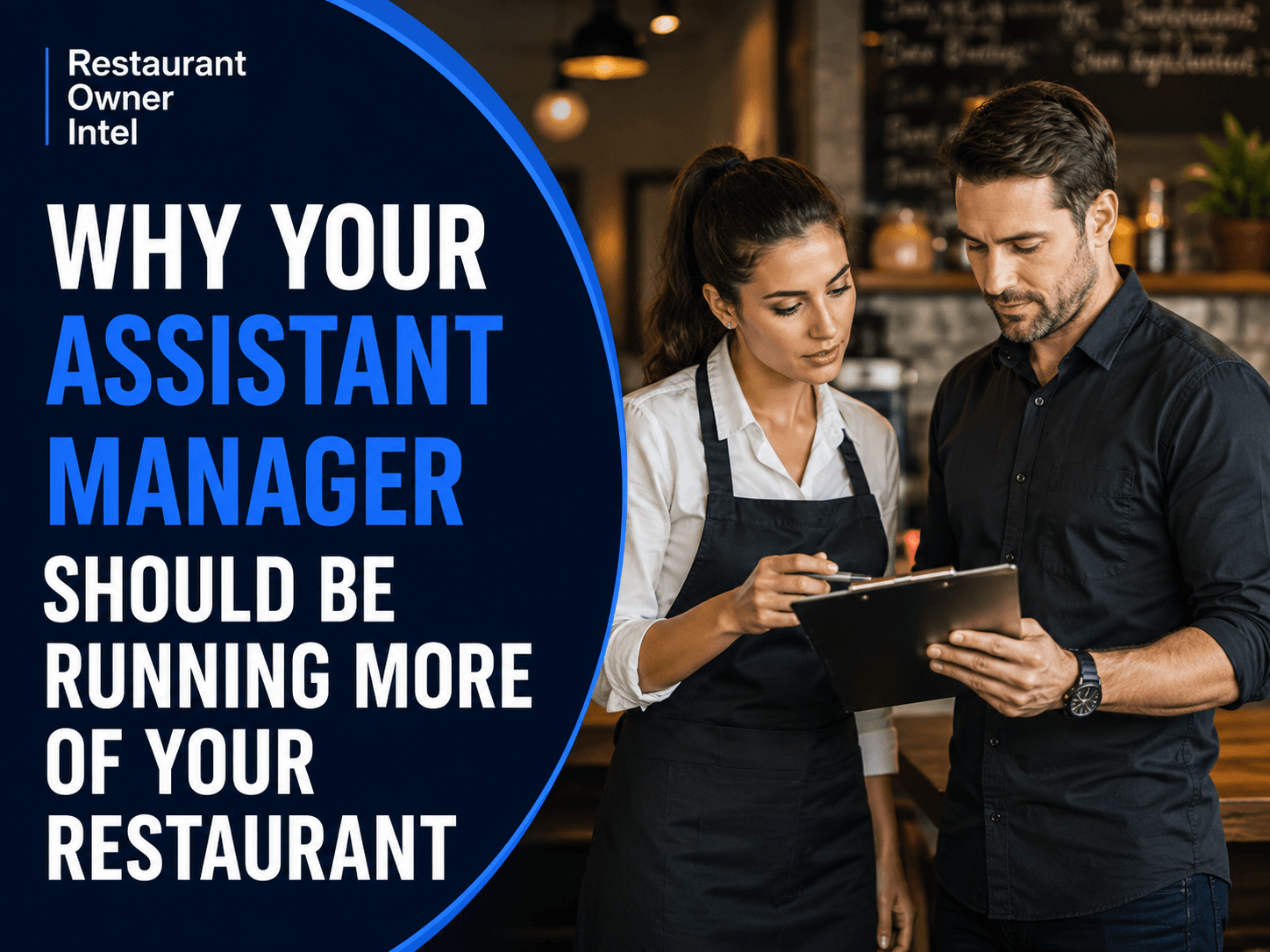
Why Your Assistant Manager Should Be Running More of Your Restaurant
Developing your assistant manager isn't just about filling a position. It's one of the simplest ways to improve operations, reduce stress and give yourself more time to focus on growing your restaurant.
Most restaurant owners know the assistant manager role is important.
The problem is that many never develop it beyond being a backup pair of hands.
The assistant manager becomes the person who locks up, counts stock, handles customer complaints and fills in wherever there's a gap. Meanwhile, you're still making every important decision.
If that sounds familiar, you're missing one of the biggest opportunities to improve your restaurant.
A capable assistant manager doesn't just make your life easier. They help improve consistency, develop your team, reduce costly mistakes and give you the time to focus on growing the business. Stop Treating the Role as a Job Title
An assistant manager shouldn't simply be there to "help out." They should be learning how to run the restaurant.
If every scheduling issue, supplier question or staff disagreement still lands on your desk, you've created a business that depends entirely on you.
That might feel manageable today, but it's difficult to scale and almost impossible to step away from.
The best restaurant owners build a trusted second-in-command who can confidently make decisions without needing approval every few minutes. Why Better Assistant Managers Improve Profit
Developing an assistant manager isn't just about reducing your workload.
It has a direct impact on the bottom line.
A well-trained assistant manager can:
Each of these small improvements protects margins while creating a better experience for both customers and employees. The Skills Every Assistant Manager Should Learn
Many owners expect assistant managers to "pick things up" as they go.
That's rarely enough.
Instead, create a structured development plan covering these core areas.
Inventory and Supplier Management
Teach them how to:
The goal isn't simply ordering food. It's protecting cash flow and reducing unnecessary costs.
Labour Scheduling
Scheduling isn't about filling shifts.
It's about balancing customer demand with labour costs.
A trained assistant manager should understand:
These decisions can make a significant difference to weekly profitability. Team Leadership
Restaurants perform better when every shift has confident leadership.
Train your assistant manager to:
Strong leadership creates stronger service. Customer Problem Solving
Every restaurant receives complaints.
The difference is how quickly they're resolved.
Give your assistant manager clear authority to deal with common customer issues without needing your approval.
Customers receive faster solutions, staff gain confidence and you avoid becoming involved in every difficult conversation. Authority Matters Just as Much as Training
Many assistant managers receive responsibilities without receiving authority.
They know what should happen but still need permission for every decision.
That creates delays, frustration and constant interruptions for the owner.
Instead, establish clear decision-making boundaries.
For example, decide which situations they can handle independently, when they should involve you and where they have complete ownership.
Confidence grows when people know they are trusted to act. A Simple Delegation Framework
If your assistant manager isn't ready to take on everything, don't worry.
Start small.
Choose one responsibility that currently takes up your time.
It might be:
Provide clear expectations, review the results together and offer feedback.
Once they're comfortable, delegate the next responsibility.
Small improvements soon become major time savings. Quick Self-Audit
Ask yourself these questions:
If you answered "no" to several of these, you've identified your next opportunity. Final Thought
Many restaurant owners believe they need to work harder to improve the business.
Often, they simply need to build stronger leaders around them.
A well-trained assistant manager doesn't just reduce your workload.
They improve consistency, strengthen your team, protect your profit and give you the freedom to focus on marketing, menu development, customer growth and the long-term success of your restaurant.
This week, choose just one task to delegate. Support your assistant manager through it, review the outcome together and then build from there. Over time, you'll be developing far more than an employee - you'll be building a second-in-command your business can rely on. |
Restaurant Owner Resource |
Free AI Restaurant Growth Plan |
Curious what growth opportunities your restaurant might be missing? Our free AI-powered Growth Plan analyses your restaurant's online presence, marketing and growth goals to identify opportunities you may not have considered.
|
Oct 19, 2026
Restaurant Technology: Which Tools Are Actually Worth the Investment?
From POS systems and booking software to AI and staff scheduling, here's how to choose restaurant technology that earns its place in your budget, protects your margins and makes running your business easier.

Oct 18, 2026
How to Fill Quiet Restaurant Nights Without Offering Discounts
Empty tables on a Tuesday or Wednesday can be expensive. But cutting prices isn't the only way to bring customers through the door. These practical restaurant marketing ideas can help you increase midweek bookings, give diners a reason to visit and protect your profit margins.

Oct 18, 2026
Are Delivery Apps Bringing You Sales or Taking Too Much Margin?
Delivery apps can keep your kitchen busy and your sales figures climbing. But how much of that money are you actually keeping? Here's how to uncover the real cost of restaurant delivery apps, protect your profit margins and make every order work harder for your business.

Oct 17, 2026
Why Customers Choose One Restaurant Over Another (And How to Win Their Business)
Why Customers Choose One Restaurant Over Another comes down to more than food and price. Understanding the psychology behind dining decisions can help your restaurant attract more customers, win bookings and build repeat business.
0 Comments
Join the conversation
Be the first to comment
Share your thoughts above.