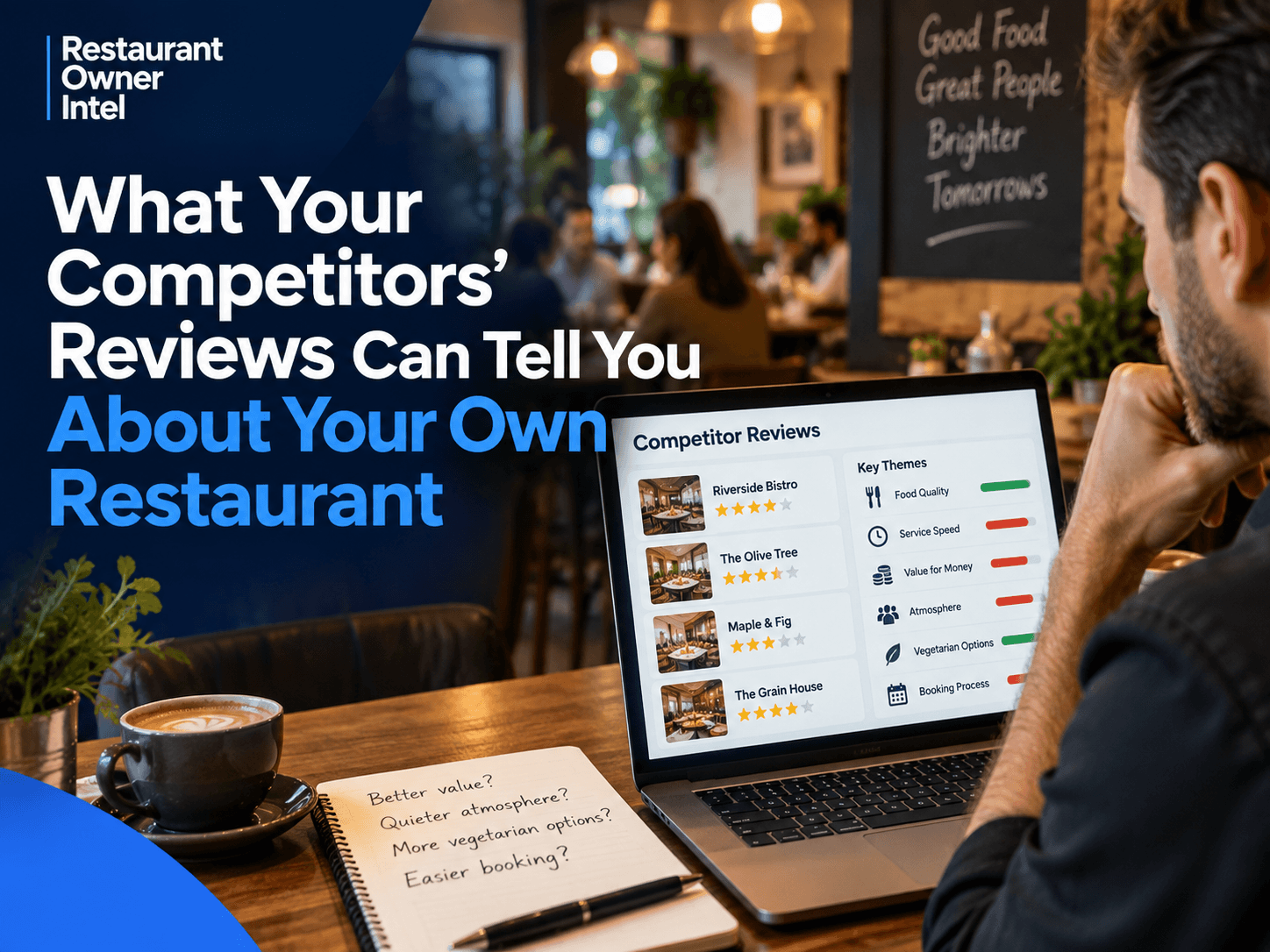
What Your Competitors’ Reviews Can Tell You About Your Own Restaurant
Use AI restaurant review sentiment analysis to uncover recurring customer needs, competitor weaknesses and local market gaps your restaurant could act on.
Most restaurant owners pay attention to their own reviews. They watch the star rating. They notice new complaints. They respond when necessary. They might even look for recurring problems such as slow service, cold food or poor value. But there's another source of customer intelligence sitting in public that many restaurants barely use: the reviews of nearby competitors. Those reviews aren't simply telling you whether another restaurant is good or bad. They're showing you what local diners value, what frustrates them, what they struggle to find and what repeatedly makes them choose one restaurant over another. With AI restaurant review sentiment analysis, you can examine those reviews at a scale that would be painfully slow to do manually. More importantly, you can stop looking at individual comments and start looking for patterns across the local market. That's the real opportunity. Your own reviews tell you how customers experience your restaurant. Competitor reviews can tell you what customers are looking for from the entire local market. That distinction changes what reviews are useful for. Stop looking for weaknesses. Start looking for gaps.The obvious way to analyse a competitor's reviews is to look for complaints. "The service is slow." "The portions are too small." "There weren't enough vegetarian options." "It was too noisy." "The booking process was difficult." That can be useful, but simply collecting complaints doesn't give you much of a strategy. You can quickly end up with a long list of things other restaurants apparently do badly. A stronger question is: What do customers repeatedly want that the local market isn't consistently giving them? That's a market gap. AI sentiment analysis is useful here because it can help group different language around the same underlying issue. Customers rarely describe a problem using identical words. One person might write: "Couldn't hear ourselves speak." Another: "Far too loud for a family meal." Another: "Nice food but wouldn't come back for dinner because of the noise." Read individually, they're three opinions. Grouped by theme, they may point towards the same customer need: a comfortable environment where conversation is easy. The same applies to value. One customer might say a restaurant was "expensive for what you get." Another might mention "tiny portions." Someone else might say they "expected more for the price." The wording changes, but the underlying sentiment may be similar. AI can help you sort large numbers of comments into themes such as food quality, service speed, friendliness, price, perceived value, atmosphere, noise, booking, dietary options, portion size, cleanliness or consistency. But the software isn't making the business decision for you. Your job is to work out whether a recurring theme represents a useful gap you could realistically own. A simple way to think about this is to separate frequency, frustration and fit. Frequency: Does the theme keep appearing across multiple reviews or competitors? Frustration: Does it appear to matter enough to affect the customer's experience, recommendation or intention to return? Fit: Could your restaurant credibly do something better about it without damaging the concept, economics or experience that already works? You need all three. A request that appears repeatedly but has little effect on customer choice may not deserve much attention. A major frustration that only appears at one poorly run competitor may be their operational problem rather than a market opportunity. And even a genuine market gap isn't automatically right for your restaurant. If local diners repeatedly complain that restaurants don't offer enough entertainment for young children, for example, that doesn't mean a quiet fine-dining restaurant should install a children's play area. The gap has to fit the business. That's where human judgement remains essential. What a useful competitor-review pattern actually looks likeImagine you run an independent Italian restaurant. You analyse reviews from several restaurants serving a similar local audience. You don't ask AI, "Which competitor has the worst reviews?" That's not particularly useful. Instead, you ask it to identify recurring positive and negative themes across the restaurants, distinguish isolated complaints from repeated patterns, and show the types of language customers use around those themes. Three things begin appearing. Customers regularly praise the food across the market. That's useful information, but not necessarily an opportunity. Good food is already expected. Customers occasionally complain about parking. That matters, but unless you can influence parking availability, it may not give you an actionable advantage. Then another pattern appears. Across several restaurants, diners repeatedly mention vegetarian choices. One review says there are "only a couple of proper options." Another says the vegetarian dishes feel "like an afterthought." A positive review of another restaurant specifically praises having "several dishes to choose from rather than the usual one." Now you've found something more interesting. The signal isn't simply that some people are vegetarian. The signal is that choice itself may be part of the experience customers value, and some restaurants may not be meeting that expectation consistently. You can now investigate. Look at competitor menus. Compare the number, variety and prominence of vegetarian dishes. Look at whether those options are starters adapted into mains, predictable substitutes or genuinely distinctive dishes. Check your own menu against the same standard. Suppose your restaurant already has several strong vegetarian dishes, but they're scattered around the menu and rarely featured in your marketing. You might not need a new menu. You may have discovered a positioning opportunity you already possess but haven't communicated. That could change which dishes you photograph, what you feature on your website, how your menu is organised, what your team mentions to enquiries, and which aspects of the restaurant you promote locally. Notice what happened. You didn't copy a competitor. You didn't react to one review. You used repeated customer language to identify an unmet or under-served expectation, checked whether it fitted your restaurant, and then made a commercial decision. That's what turns review analysis into customer research. The same reasoning could uncover a service opportunity. Imagine customers across several nearby restaurants repeatedly mention waiting too long to pay. One says, "Everything was great until we tried to get the bill." Another says, "Waited 20 minutes after we'd finished." Another describes staff as friendly but difficult to find at the end of the meal. You could dismiss those as service complaints about other businesses. Or you could recognise something broader: the final ten minutes of the restaurant experience may be a recurring point of friction in your local market. Now check your own operation. How quickly can customers get the bill? Can they easily signal they're ready to leave? Are staff attentive after plates are cleared? Does payment become slower during peak periods? The competitor intelligence has given you a reason to inspect something in your own business before your customers have to complain about it. That's an important use of AI sentiment analysis that gets missed. It isn't only a tool for finding opportunities. It can be an early-warning system. Don't confuse customer demand with review noiseReview analysis becomes dangerous when every repeated phrase gets treated as a strategy. Customers ask for contradictory things. Some want larger portions. Others want lighter meals. Some want a lively atmosphere. Others want somewhere quiet. Some want an extensive menu. Others prefer a smaller, more focused choice. The goal isn't to satisfy every sentiment. The goal is to understand which customer expectations are commercially relevant to the restaurant you want to run. This gives you a useful decision rule: Don't act because customers mention something. Act when a recurring customer need intersects with a gap in the market and a strength your restaurant can credibly deliver. That intersection matters. Suppose reviews show strong demand for faster meals at lunchtime. A restaurant with a large kitchen, complicated dishes and a leisurely dining proposition might struggle to own that position without changing the operation significantly. A nearby restaurant already serving dishes that can be produced quickly may be able to turn the same insight into a genuine advantage. Same customer research. Different decision. There's another trap to avoid: assuming negative sentiment is always more valuable than positive sentiment. Praise can reveal gaps too. If customers repeatedly praise one competitor for remembering regulars, another for exceptionally warm staff, and another for making celebrations feel special, they're showing you what earns emotional value in that market. You can then ask whether those experiences are common enough to be expected or rare enough to differentiate a restaurant. Positive reviews also reveal the language customers naturally use when describing value. Restaurant owners often position themselves using internal language: premium ingredients, authentic recipes, locally sourced produce, family-run hospitality. Customers may care about completely different things. They might repeatedly praise "never feeling rushed", "staff remembering our order", "being able to hear each other", "proper portions" or "someone actually answering the phone." Those phrases are commercially useful because they reveal what customers notice. And what customers notice is often more important than what the restaurant thinks should impress them. The practical exercise is straightforward. Choose a small group of nearby restaurants competing for roughly the same customer occasion as you. That last part matters. A fast-casual lunch venue and a special-occasion restaurant may be geographically close while competing for very different needs. Use AI to organise the reviews into recurring themes rather than simply summarising whether sentiment is positive or negative. Then apply the three-part test: Frequency. Frustration. Fit. Look for themes appearing across multiple restaurants. Identify which seem connected to customer satisfaction, disappointment, recommendations or return intentions. Then ask which of those needs your restaurant could credibly meet better. Don't finish with a report. Finish with a decision. Maybe you discover customers struggle to find good vegetarian choice locally. Maybe people repeatedly complain about complicated booking. Maybe diners value quiet tables more than you expected. Maybe "friendly service" isn't enough because customers are specifically praising restaurants where staff recognise regulars. Maybe the market doesn't have a food problem at all. It has a convenience problem, a hospitality problem or a value-perception problem. Your competitors have already spent years attracting customers, serving them and generating reactions. Those customers have then publicly described what they liked, disliked, expected and wished had been different. AI simply makes that enormous pile of unstructured feedback easier to interrogate. The competitive advantage doesn't come from having the AI. It comes from asking a better question of the information. So don't ask, "What are customers complaining about at my competitors?" Ask: "What are local diners repeatedly asking this market to do better, and which of those things could we become unusually good at?" That's when competitor reviews stop being something you monitor and start becoming customer research you can actually use. Try This With AIUse the AI you're already using: ChatGPT, Claude, Gemini, Grok, Meta AI, Copilot, or another general-purpose AI assistant. Replace the example information inside the brackets with your own information, then copy and paste the complete prompt into your AI. AI PromptAct as a commercial restaurant customer-insight analyst. Analyse the competitor review material I provide and identify the strongest opportunities my restaurant could potentially use to improve its positioning or customer experience. Group differently worded comments that point to the same underlying customer need, such as service speed, perceived value, dietary choice, atmosphere, noise, booking friction, portion size, hospitality or convenience. Don't simply count complaints or summarise each competitor. Look for patterns across multiple restaurants and evaluate each meaningful theme using three tests: frequency, meaning whether it appears repeatedly; frustration, meaning whether customers indicate it materially affects their experience, recommendation or likelihood of returning; and fit, meaning whether it could plausibly represent an opportunity for a restaurant competing for similar customers. Separate isolated complaints from credible market signals, include positive sentiment when it reveals what local diners particularly value, and don't assume every customer request should be acted on. Rank the 3 strongest potential opportunities, explain the recurring customer need behind each one, show the review evidence or language that led you to it, state whether the conclusion is directly supported or an inference, and explain what I should investigate in my own restaurant before acting. Finish by identifying the single most promising question I should investigate first using this decision rule: act when a recurring customer need intersects with a gap in the market and something my restaurant could credibly deliver. Don't invent information that isn't present in the material. [PASTE YOUR COMPETITOR REVIEW MATERIAL AND ANY BRIEF CONTEXT YOU HAVE HERE. Example: "I run an independent Italian restaurant aimed mainly at couples, families and casual evening diners. Below are recent reviews I've collected from four nearby Italian and Mediterranean restaurants: 'Lovely food but only two vegetarian mains'; 'Great atmosphere, although we waited ages to pay'; 'Good pasta but far too loud to have a conversation'; 'Really impressed by the vegetarian choices'; 'Staff were friendly but disappeared after our mains'; 'Easy online booking and we never felt rushed'..."] |
Restaurant Owner Resource |
Free AI Restaurant Growth Plan |
Curious what growth opportunities your restaurant might be missing? Our free AI-powered Growth Plan analyses your restaurant's online presence, marketing and growth goals to identify opportunities you may not have considered.
|

Oct 18, 2026
How to Fill Quiet Restaurant Nights Without Offering Discounts
Empty tables on a Tuesday or Wednesday can be expensive. But cutting prices isn't the only way to bring customers through the door. These practical restaurant marketing ideas can help you increase midweek bookings, give diners a reason to visit and protect your profit margins.

Oct 18, 2026
Are Delivery Apps Bringing You Sales or Taking Too Much Margin?
Delivery apps can keep your kitchen busy and your sales figures climbing. But how much of that money are you actually keeping? Here's how to uncover the real cost of restaurant delivery apps, protect your profit margins and make every order work harder for your business.
Oct 17, 2026
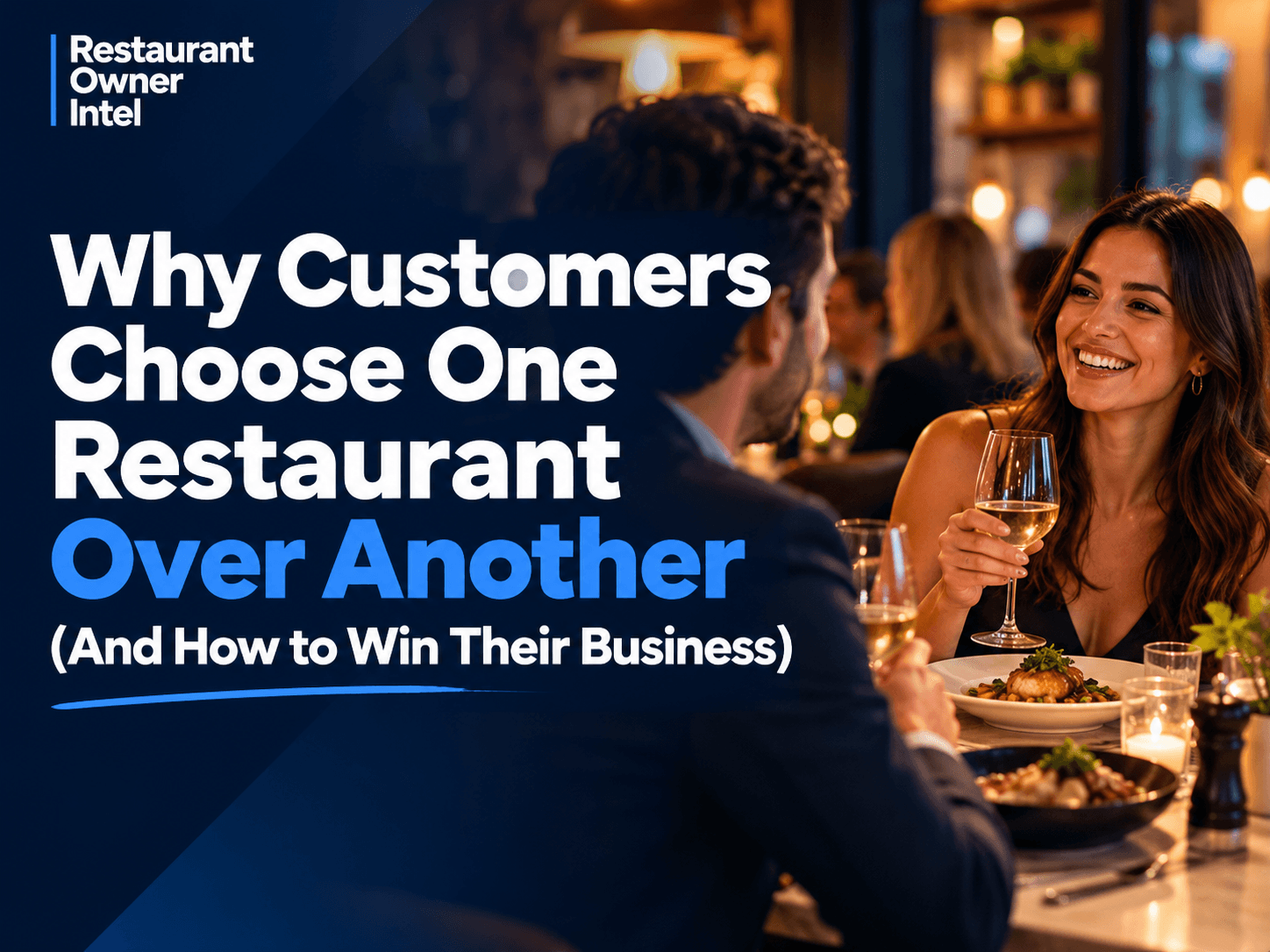
Why Customers Choose One Restaurant Over Another (And How to Win Their Business)
Why Customers Choose One Restaurant Over Another comes down to more than food and price. Understanding the psychology behind dining decisions can help your restaurant attract more customers, win bookings and build repeat business.
Oct 16, 2026
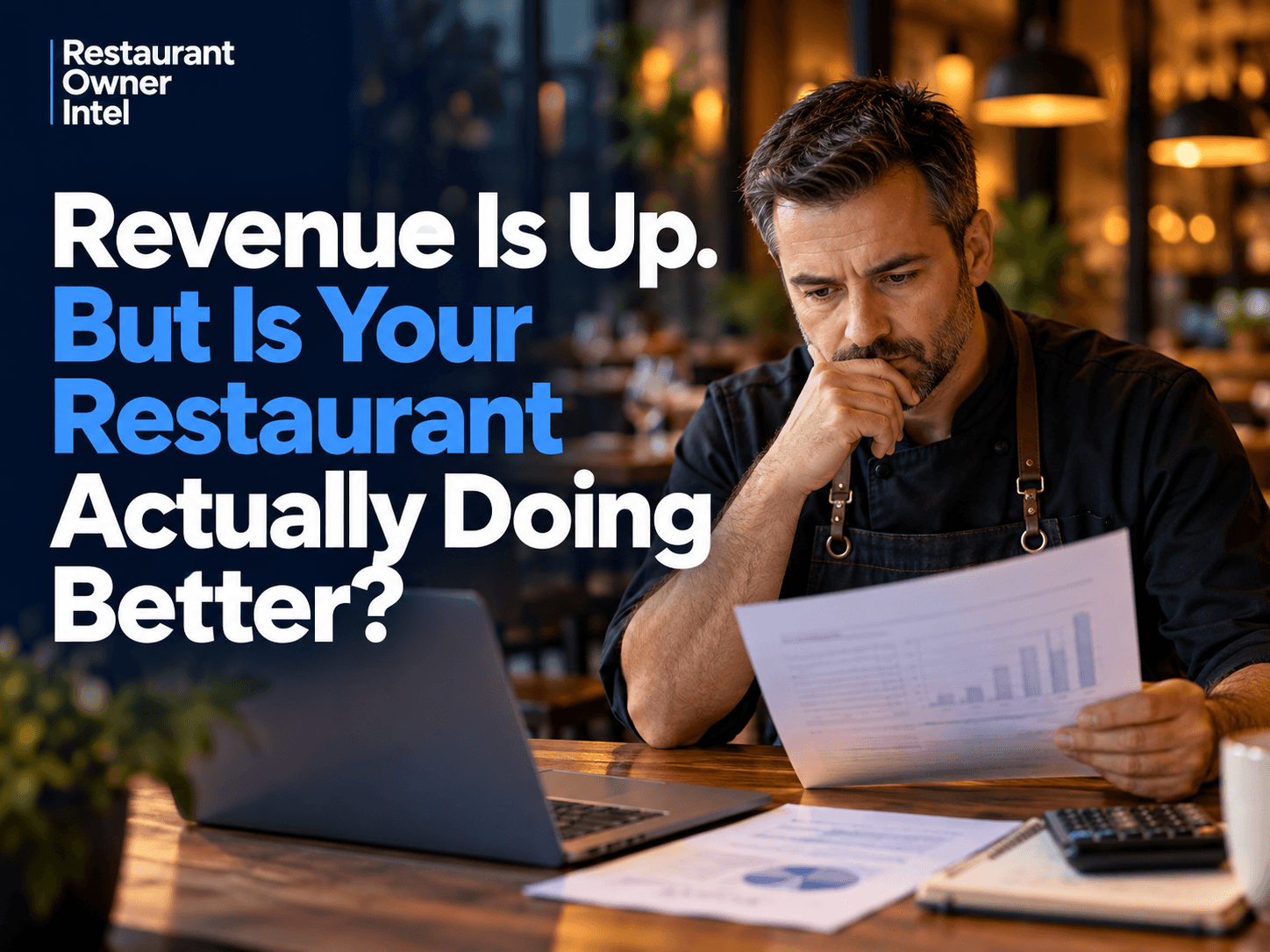
Revenue Is Up. But Is Your Restaurant Actually Doing Better?
Higher sales can create the impression of a healthier restaurant business. But unless customer numbers, operating costs and profit margins are improving too, revenue growth may be hiding a very different story.
0 Comments
Join the conversation
Be the first to comment
Share your thoughts above.