
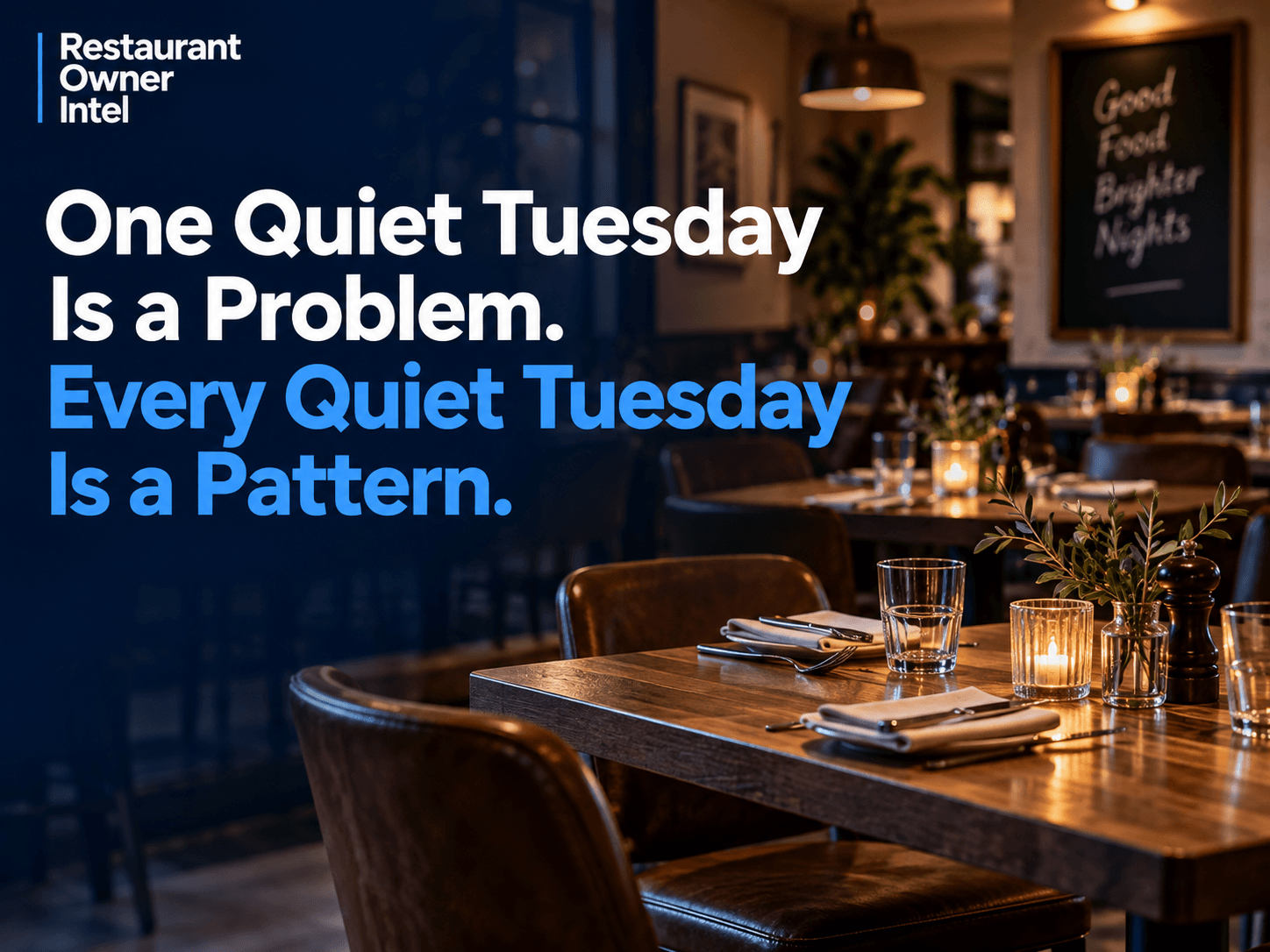
One Quiet Tuesday Is a Problem. Every Quiet Tuesday Is a Pattern.
Learn how restaurant email campaigns can turn recurring quiet nights into memorable customer occasions that encourage bookings and repeat visits without relying on constant discounts.
Stop repeatedly rescuing slow nights with promotions. Use restaurant email marketing to turn recurring quiet services into occasions customers remember, plan for and return to. A quiet Tuesday can happen for dozens of reasons. Bad weather. A local event. School holidays. A strange week. Customers staying home after an expensive weekend. But if Tuesday is quiet every week, the problem changes. You no longer have an empty-night problem. You have a recurring demand pattern. That distinction matters because the usual response to a quiet night is reactive. Bookings look weak, someone notices the diary is thin, and the restaurant sends an email offering customers a reason to come in. “Tables available tonight.” “20% off this Tuesday.” “Book now for a complimentary dessert.” That may produce a few bookings. But next Tuesday arrives and the restaurant is facing exactly the same problem again. The email rescued a date. It didn't change the pattern. For a restaurant owner, that should trigger a different question. Not: How do we fill Tuesday? But: What could make people choose Tuesday deliberately? That is where email becomes much more useful. Instead of treating email as an emergency button you press whenever bookings are weak, you can use it to help build a customer habit around a night that currently has no strong reason to exist in the customer's calendar. Stop rescuing nights. Start building reasons to return.Restaurants naturally have uneven demand. Friday and Saturday often have their own momentum. Customers already understand what those nights are for. They meet friends. Go on dates. Celebrate birthdays. Have family meals. Stay out later. Tuesday doesn't always have that built-in reason. That means repeatedly advertising “availability” is rarely enough. Availability is important to the restaurant because empty tables cost money. It isn't automatically important to the customer. The customer needs a reason why this particular Tuesday is worth leaving the house for. This creates a useful distinction: A rescue campaign fills capacity. A habit campaign gives the capacity an identity. A rescue campaign says: “We're quiet. Here's a reason to book.” A habit campaign says: “This is what happens here on Tuesdays.” That sounds like a small change in wording. It isn't. The first starts with the restaurant's problem. The second starts with something the customer can recognise, remember and potentially repeat. Imagine an independent Italian restaurant that regularly struggles on Tuesdays. The owner sends an occasional email when bookings are poor: 20% off food this Tuesday. Book now. A few subscribers take the offer. Some were already thinking about eating out. Others respond because the discount makes the meal cheaper. The following Tuesday, bookings are weak again. Now imagine the restaurant creates Tuesday Pasta Night instead. Each Tuesday features three pasta dishes that aren't on the normal menu, perhaps alongside a simple fixed-price starter-and-pasta option. The dishes change regularly enough to give customers something new to discover, while the concept stays the same. The emails change too. Instead of an emergency promotion, subscribers start receiving something recognisable: “Tuesday's pasta is rigatoni with slow-cooked beef ragu.” “Next Tuesday we're bringing back the wild mushroom tagliatelle.” “Three Tuesday pastas. One is only here this week.” Now the restaurant isn't simply trying to generate bookings. It's teaching customers what Tuesday means. That is a very different use of email. The objective isn't necessarily to turn every Tuesday subscriber into a weekly visitor. It is to establish an association strong enough that when somebody thinks, “Where should we eat midweek?” the restaurant has already supplied an answer. Tuesday has become a product rather than leftover capacity. That distinction is useful well beyond pasta nights. A neighbourhood bistro could create Wednesday steak night. A family restaurant could create an early-evening midweek family supper. A small fine-dining restaurant might run one monthly neighbourhood menu on the first Thursday of every month. A pub kitchen could build a recurring pie night. The exact concept matters less than the underlying mechanism. You are attaching a recognisable reason to a recurring period of weak demand. And email helps reinforce the association until customers don't need the whole idea explained every time. Use the calendar testThere is a simple test restaurant owners can use when assessing a recurring quiet service: Could a customer realistically put this in their calendar before seeing this week's email? If the answer is no, you probably still have a promotion rather than a habit. “15% off meals this Tuesday” doesn't naturally belong in someone's calendar because customers don't know whether it will exist next week. “Tuesday Pasta Night” can. “First Thursday Neighbourhood Supper” can. “Wednesday Steak Night” can. The calendar test forces you to think beyond this week's occupancy. The day is predictable.Customers shouldn't need to investigate when it happens. If the offer appears on random Tuesdays, disappears for three weeks and comes back on a Wednesday, you make the behaviour harder to learn. The reason to visit is recognisable.The customer should be able to explain the idea in one sentence. “They do a special pasta menu on Tuesdays.” “They have steak night every Wednesday.” “They run a neighbourhood supper on the first Thursday of the month.” If explaining the concept requires a paragraph of conditions, discounts and exclusions, it is probably too complicated to become a habit. There is enough continuity to create recognition.You don't need to serve exactly the same menu every week. In fact, variation can create another reason to open the email. But the underlying proposition should remain stable. The pasta changes. Pasta night doesn't. The steak cut changes. Steak night doesn't. The monthly menu changes. The monthly supper doesn't. That combination of consistency and variation is particularly useful. Consistency helps customers remember the occasion. Variation gives the restaurant something worth emailing about. The economics still need to make sense.Filling seats isn't automatically a win. If a quiet-night concept requires heavy discounting, complicated preparation, extra labour or low-margin dishes, the restaurant can become busier without solving much commercially. The purpose is to create profitable demand for spare capacity. That means the offer should fit the kitchen, staffing model and margins of that specific service. A restaurant with unused kitchen capacity on Tuesday may be able to introduce three special pasta dishes efficiently. Another restaurant might find that the same idea creates too much prep for too few covers. The concept has to work operationally as well as appeal to customers. This is why the right starting point isn't, “What promotion could we email?” It's: What repeatable occasion can this restaurant deliver well on the night we actually need customers? Once that exists, the email campaign has a much clearer job. It doesn't need to invent demand from scratch every week. It can reinforce the routine. One email might introduce next week's dish. Another could remind subscribers that bookings have opened. Another might show a photograph from last Tuesday. Another might tell regular attendees what is changing this week. Another might invite customers who visited the event previously to return. The emails remain fresh because the details change, while the underlying customer proposition stays familiar. That matters because many restaurants make the opposite mistake. Every quiet week produces a different promotion. Tuesday is 20% off one week. Free dessert the next. Two-for-one mains later in the month. Then a complimentary drink. Each promotion may have some individual appeal, but collectively they teach the customer very little except that the restaurant occasionally discounts Tuesdays. There is no behaviour being built. There is no occasion becoming familiar. There is no simple story customers can tell someone else. You keep purchasing attention without building recognition. A recurring night gives that marketing effort somewhere to accumulate. Week one's email helps explain the concept. Week four's email benefits from customers having seen it before. Month three doesn't necessarily require you to persuade from zero. This is the deeper opportunity behind quiet-night email marketing. The best campaign isn't always the one that produces the most bookings from a single send. Sometimes it is the campaign that makes future sends easier because customers already understand what the night represents. Before sending another emergency email for the same weak service, look back over the diary. If Tuesday was quiet once, solve Tuesday. If Tuesday has been quiet repeatedly, diagnose the pattern. Then ask three questions:
If the answer to all three is yes, stop treating that service as an empty space that needs rescuing. Build something that belongs there. The rule is simple: when the quiet night repeats, the marketing should stop being a rescue operation and start creating a routine. The bigger question then becomes not how many people you can persuade to come next Tuesday, but whether you're building a Tuesday customers will eventually think about before you email them. Try This With AIUse the AI you're already using: ChatGPT, Claude, Gemini, Grok, Meta AI, Copilot, or another general-purpose AI assistant. Replace the example information inside the brackets with your own information, then copy and paste the complete prompt into your AI. AI PromptAct as a practical restaurant business adviser and help me turn a consistently quiet service into a repeatable customer occasion rather than another one-off promotion. Use this information as your only restaurant-specific input: |
Restaurant Owner Resource |
Free AI Restaurant Growth Plan |
Curious what growth opportunities your restaurant might be missing? Our free AI-powered Growth Plan analyses your restaurant's online presence, marketing and growth goals to identify opportunities you may not have considered.
|

Oct 18, 2026
How to Fill Quiet Restaurant Nights Without Offering Discounts
Empty tables on a Tuesday or Wednesday can be expensive. But cutting prices isn't the only way to bring customers through the door. These practical restaurant marketing ideas can help you increase midweek bookings, give diners a reason to visit and protect your profit margins.

Oct 18, 2026
Are Delivery Apps Bringing You Sales or Taking Too Much Margin?
Delivery apps can keep your kitchen busy and your sales figures climbing. But how much of that money are you actually keeping? Here's how to uncover the real cost of restaurant delivery apps, protect your profit margins and make every order work harder for your business.

Oct 17, 2026
Why Customers Choose One Restaurant Over Another (And How to Win Their Business)
Why Customers Choose One Restaurant Over Another comes down to more than food and price. Understanding the psychology behind dining decisions can help your restaurant attract more customers, win bookings and build repeat business.

Oct 16, 2026
Revenue Is Up. But Is Your Restaurant Actually Doing Better?
Higher sales can create the impression of a healthier restaurant business. But unless customer numbers, operating costs and profit margins are improving too, revenue growth may be hiding a very different story.
0 Comments
Join the conversation
Be the first to comment
Share your thoughts above.