
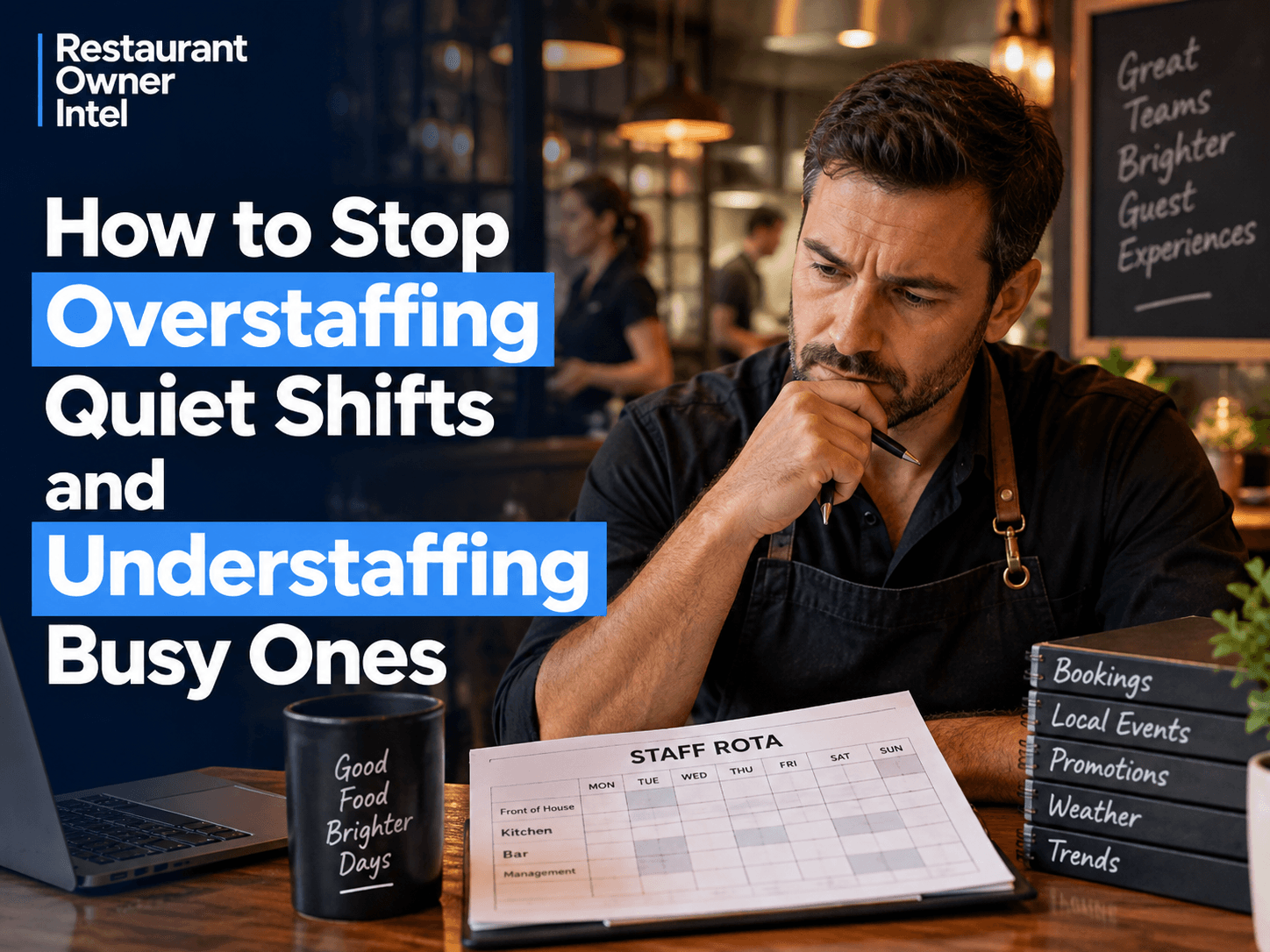
How to Stop Overstaffing Quiet Shifts and Understaffing Busy Ones
How to replace instinct-only restaurant scheduling with a simple demand check that helps you match labour more closely to expected trade.
Of course, restaurant owners don't build rotas completely at random. They know Friday is usually busier than Tuesday. They know Saturday evening needs more people than Monday lunch. They remember which shifts caught them short last month. After years in the restaurant, they develop a feel for how many people they'll need. That experience is valuable. The problem starts when experience becomes the forecasting system. A rota built mainly on instinct assumes the next shift will behave roughly like the shifts you remember. Sometimes it will. Sometimes you'll put six people on because "Thursday is normally decent" and spend the evening watching labour cost climb while tables sit empty. Other times, you'll schedule cautiously because a particular lunch is normally quiet, then discover that a local event, strong bookings and unusually high recent demand have all pointed towards a busier service. Now you're short. Customers wait longer. Staff rush. Managers jump onto the floor. Tables take longer to turn. Service becomes reactive precisely when the restaurant has the most opportunity to generate revenue. The better question isn't: "How busy are we normally on this shift?" It's: "What evidence do we have about demand for this particular shift?" That small change creates a much better way to build a rota. Separate the baseline from the signalsStart with what normally happens. If you're scheduling next Friday evening, look at comparable Friday evenings. Recent covers, sales, bookings, takeaway volume and staffing levels can establish a reasonable baseline. But the baseline isn't the forecast. That's the distinction worth remembering: History tells you what's normal. Signals tell you why this shift might not be normal. A restaurant that ignores history is guessing. A restaurant that looks only at history can still miss what's about to happen. Suppose your restaurant usually serves around the same level of covers on a Tuesday evening. That gives you somewhere to start. Now look at this Tuesday. Reservations are already noticeably stronger than you'd normally expect at the point when you're writing the rota. There's a concert nearby. You've got a promotion running to your email list. The forecast suggests warm weather and you have outside seating. That isn't one piece of information. It's several demand signals pointing in the same direction. The opposite can happen too. Perhaps bookings are softer. There's no local activity. Recent Tuesdays have been quieter. Poor weather could reduce walk-in traffic for a restaurant that depends heavily on passing trade. The day still says Tuesday on the calendar. The staffing requirement may be completely different. This is where restaurant owners can replace vague instinct with a simple decision process. Before assigning labour, look at two things: Baseline demand: What would we reasonably expect if nothing unusual were happening? Demand signals: What do we know today that could push demand above or below that baseline? You don't need sophisticated forecasting software to start thinking this way. You need a consistent habit of checking the information you already have before turning expected demand into staffing. Build a pre-rota demand checkA useful demand check can be built around seven signals:
The point isn't to give every signal equal weight. It's to ask what each one means for your restaurant. Reservations, for example, can be a strong indicator for a restaurant where bookings account for a large proportion of covers. They're less complete for a casual operation where much of the trade is walk-in. Recent covers help you detect movement that an old "Fridays are always busy" assumption can hide. If the last few comparable services have consistently come in softer than expected, continuing to schedule from an older version of normal deserves questioning. Local events matter when they change the number or type of people around your restaurant. A theatre performance, football match, festival, university event or large local gathering might affect one restaurant significantly and another restaurant a mile away hardly at all. Promotions create another complication. If you've sent an offer to your customer database, launched a limited menu or heavily promoted an event, don't build the rota as though none of that marketing exists. Marketing designed to change customer behaviour should also appear in your demand thinking. Delivery needs separating from dining-room demand. A wet evening might reduce walk-ins while increasing delivery orders for some restaurants. If the kitchen receives the work either way, simply looking at expected tables won't tell you the whole labour story. Weather should also be treated as a restaurant-specific signal, not a universal rule. Sunshine might increase demand for a venue with a terrace while doing little for another operation. Heavy rain could hurt passing trade but have a different effect on delivery. Seasonality works the same way. School holidays, Christmas trading, payday patterns, tourist seasons and other recurring changes may matter, but only where your own trading history shows that they matter. This is why a checklist is better than a formula copied from somebody else's restaurant. The checklist makes sure you look. Your own numbers teach you what deserves weight. When several signals agree, pay attentionImagine you're building the rota for Saturday evening. Your instinct says to schedule roughly the same team you normally use. The baseline supports that. Comparable Saturdays are generally strong but predictable. Then you run the demand check. Bookings are ahead of their usual position several days before service. There's a major event taking place nearby that finishes around the time you normally receive a second wave of customers. Your restaurant is also running a weekend special that's been receiving more customer interest than expected. Recent Saturday covers have been healthy. Four signals are now pointing towards stronger demand. You still don't know exactly how many customers will arrive. Forecasting isn't certainty. But that's not the standard you need. The question is whether you now have enough evidence to make a different staffing decision. Perhaps that means strengthening the kitchen during the likely peak. Perhaps it means adjusting front-of-house start times. Perhaps one cross-trained employee becomes particularly valuable because they can move towards whichever part of the operation comes under pressure. Now reverse the situation. Bookings are behind their usual level. The local area is quiet. The last three comparable Saturdays have been softer. Nothing unusual is happening that should stimulate additional demand. Scheduling the normal full Saturday team because "Saturday is Saturday" is no longer a neutral decision. You're choosing to ignore several signals. This reveals an important scheduling principle: Don't react heavily to every signal. React when relevant signals begin to agree. One weak signal can be noise. Several independent signals pointing in the same direction deserve attention. That gives owners a useful way to avoid two opposite mistakes. The first is ignoring evidence because experience says something else. The second is constantly changing the rota because one variable moved slightly. You want neither. Start with the baseline. Check the signals. Look for agreement. Then decide whether the evidence is strong enough to change staffing. This also improves the conversation around labour. Instead of saying, "I think we'll be busy," a manager can say: "Bookings are ahead of a normal Thursday, there's an event nearby and the last two Thursdays were stronger than our usual baseline." That's a decision someone else can inspect. The same applies when cutting labour. "We'll probably be quiet" is instinct. "Bookings are soft, recent comparable shifts are down and there are no obvious demand drivers this week" is reasoning. That difference matters because scheduling improves when you can review the reasoning afterwards. After the shift, compare what you expected with what happened. Which signals were useful? Which did you overvalue? Did the event actually create business? Did the rain reduce walk-ins? Did the promotion create a noticeable spike? Were bookings a good indicator of final covers, or did walk-ins change the picture? Over time, you're not merely collecting restaurant data. You're learning which signals predict demand in your restaurant. A city-centre casual restaurant may discover local events are extremely useful. A destination restaurant may find advance bookings tell it far more. A takeaway-heavy operation may need to watch weather and delivery patterns closely. A restaurant in a seasonal tourist location may find the calendar itself carries more weight during particular months. That knowledge is much more useful than generic scheduling advice because it turns your own trading history into a better decision system. It also changes the role of instinct. You don't need to eliminate it. Experienced operators notice things numbers can miss. They know when a local event usually brings the wrong type of footfall. They know a booking sheet containing several large parties creates different operational pressure from the same number of covers spread across smaller tables. They know a new promotion may generate kitchen demand that isn't visible in reservations. Use that judgement. Just don't let it operate without evidence. The strongest scheduling question isn't, "What do I think will happen?" It's: "What's our normal baseline, what signals could move this shift away from it, and are enough of those signals agreeing to justify changing the rota?" Put those seven demand signals beside you the next time you schedule: reservations, recent covers, local events, promotions, delivery demand, weather and seasonality. Check them before assigning the team, not after the shift has proved you wrong. Because the aim isn't to predict every service perfectly. It's to make each staffing decision with more evidence than the last one. And once you start doing that consistently, another question becomes much easier to answer: not simply how many staff you need, but exactly where those extra or reduced labour hours will have the greatest effect. Try This With AIUse the AI you're already using: ChatGPT, Claude, Gemini, Grok, Meta AI, Copilot, or another general-purpose AI assistant. Replace the example information inside the brackets with your own information, then copy and paste the complete prompt into your AI. AI PromptAct as a practical restaurant demand and labour planning adviser. Use the information I provide to help me make a better staffing decision based on demand signals rather than gut feel. Start by establishing the most reasonable baseline for the shift from the information available, then assess these seven demand signals wherever relevant: reservations, recent covers, local events, restaurant promotions, delivery or takeaway demand, weather risk, and known seasonal patterns. Identify which signals point towards higher demand, lower demand, or provide insufficient evidence, and pay particular attention when several independent signals agree. Don't pretend to know information I haven't supplied, and clearly label any inference. Then give me: 1) your assessment of likely demand compared with the normal baseline, 2) the strongest signals driving that assessment, 3) any signals I may be overvaluing or overlooking, 4) the practical staffing implications, including where extra or reduced labour is most likely to matter, and 5) a clear final decision rule explaining whether the evidence supports increasing staffing, reducing staffing, or keeping the normal rota. Keep the recommendations realistic for an independent restaurant and explain the reasoning rather than simply telling me what to do. Here is my shift information: [Example: "I'm scheduling next Saturday evening. We normally serve around 110 to 130 covers. We already have 85 booked four days out, compared with roughly 60 at this stage most weeks. There's a concert nearby finishing around 9:30pm. We're promoting a weekend steak special by email and social media. The last two Saturdays were strong. The weather forecast currently shows heavy rain. We have a moderate delivery trade, and Saturday delivery orders usually increase when the weather is poor. I normally schedule five front-of-house staff, three kitchen staff and one manager."] |
Restaurant Owner Resource |
Free AI Restaurant Growth Plan |
Curious what growth opportunities your restaurant might be missing? Our free AI-powered Growth Plan analyses your restaurant's online presence, marketing and growth goals to identify opportunities you may not have considered.
|

Oct 18, 2026
How to Fill Quiet Restaurant Nights Without Offering Discounts
Empty tables on a Tuesday or Wednesday can be expensive. But cutting prices isn't the only way to bring customers through the door. These practical restaurant marketing ideas can help you increase midweek bookings, give diners a reason to visit and protect your profit margins.

Oct 18, 2026
Are Delivery Apps Bringing You Sales or Taking Too Much Margin?
Delivery apps can keep your kitchen busy and your sales figures climbing. But how much of that money are you actually keeping? Here's how to uncover the real cost of restaurant delivery apps, protect your profit margins and make every order work harder for your business.

Oct 17, 2026
Why Customers Choose One Restaurant Over Another (And How to Win Their Business)
Why Customers Choose One Restaurant Over Another comes down to more than food and price. Understanding the psychology behind dining decisions can help your restaurant attract more customers, win bookings and build repeat business.

Oct 16, 2026
Revenue Is Up. But Is Your Restaurant Actually Doing Better?
Higher sales can create the impression of a healthier restaurant business. But unless customer numbers, operating costs and profit margins are improving too, revenue growth may be hiding a very different story.
0 Comments
Join the conversation
Be the first to comment
Share your thoughts above.