Picture your restaurant on a Friday evening.
The lights are warm. The tables are set. Food is leaving the kitchen looking exactly as it should. There's conversation in the dining room, the familiar sound of glasses being collected, and a team that knows how to make people feel welcome.
It's the atmosphere you've spent years building.
Now picture someone sitting at home, trying to decide where to eat tomorrow night.
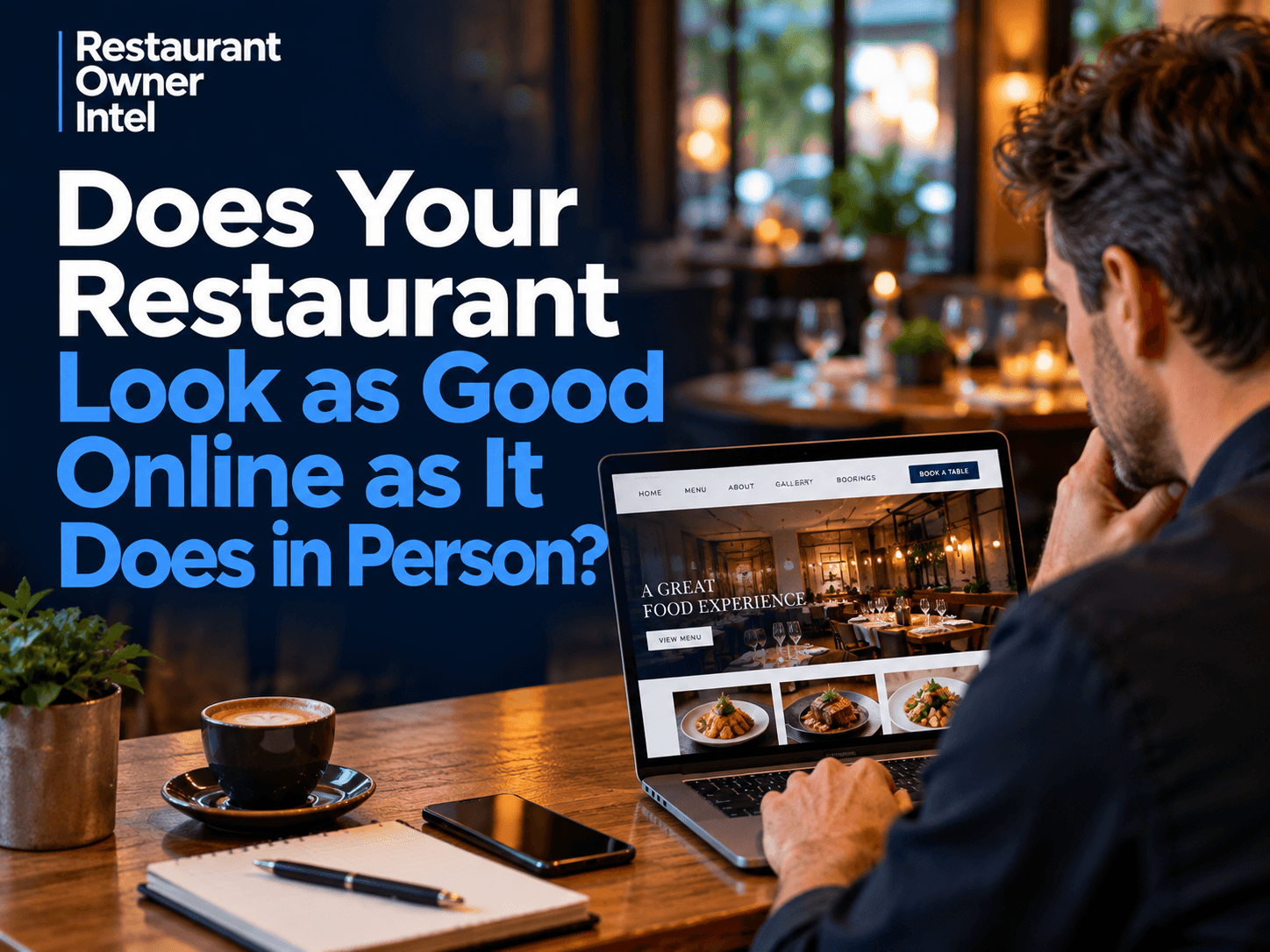
They find your restaurant on Google. The first photograph is dark and slightly blurry. The next shows a dining room you refurbished two years ago. Your menu opens as an awkward PDF, and your Instagram page hasn't shown the restaurant itself for months.
They scroll for a few seconds.
Then they look at somewhere else.
They never see your dining room at its best. They never taste the food. They never discover the service your regulars keep coming back for.
The restaurant they've judged online isn't the restaurant you've worked so hard to create.
And that's where a surprisingly expensive branding problem begins.
The Restaurant Customers See Before They Visit
A restaurant's first impression used to happen at the front door.
The sign above the entrance. The view through the window. The smell of food coming from the kitchen. The welcome when someone stepped inside.
Those things still matter enormously.
But the first impression often happens much earlier now, on a phone.
A couple planning dinner might compare three restaurants in ten minutes. They'll look at photographs, scan reviews, check menus and perhaps visit a website.
They're not conducting a detailed investigation. They're looking for enough reassurance to make a decision.
Does the food look good? Is the place somewhere they'd feel comfortable? Does it seem worth the money? Can they book without any hassle?
Every photograph, description and piece of information helps answer those questions.
This is what makes restaurant branding so commercially important.
It's not simply about having an attractive logo or a consistent colour scheme. It's about what customers believe they're going to experience.
When your online presence reflects the quality of your restaurant, it gives people reasons to choose you.
When it falls short, it creates uncertainty.
And a customer who isn't quite convinced has plenty of other restaurants to consider.
1. Your Best Dishes Deserve Better Than Bad Photographs
There's something frustrating about seeing an excellent dish represented by a terrible photograph.
You know how much care goes into it. The ingredients, the preparation, the presentation. Your chef might spend considerable time getting every element right.
Yet online, the dish appears under harsh lighting, photographed at an unflattering angle, with half the plate disappearing into shadow.
It's not doing the food justice.
The same problem happens with restaurant interiors.
Perhaps you've recently invested in better furniture, new lighting or a complete refurbishment. But the photographs appearing on Google still show the old dining room.
Someone searching for a special-occasion restaurant might dismiss your business because it looks tired, even though the reality is quite different.
Good restaurant photography doesn't need to be elaborate. It needs to be appetising, believable and current.
Start with the dishes that genuinely represent your kitchen. Photograph them in good natural light, with clean backgrounds and the same attention to presentation you'd give a paying customer.
Then photograph the restaurant itself.
Not just empty tables in the middle of the afternoon, but the room when it feels welcoming. The lighting, the atmosphere, the small details that make the place yours.
A photograph of a lively dining room can communicate something a menu never will: what it might feel like to spend an evening there.
A useful place to start: Open your Google Business Profile and look at the first five photographs. If they don't represent your restaurant at its best today, replace or supplement them with stronger images.
2. Your Google Business Profile Might Be Telling Yesterday's Story
Your Google Business Profile can be one of the most valuable pieces of online space your restaurant occupies.
It's where potential customers can find your location, opening hours, reviews, photographs, website and menu.
For someone searching locally, it may be all they need to make a decision.
But there's a difference between having a Google profile and actively looking after it.
An old menu link. Incorrect Sunday opening hours. A collection of photographs from several years ago. Reviews that never receive a response.
Individually, these details can seem harmless.
Together, they suggest a business that isn't paying much attention to how it presents itself.
That's particularly unfortunate when the restaurant itself is carefully run.
Think about the standards you expect inside your dining room. You wouldn't knowingly leave outdated menus on the tables or display incorrect opening times on the entrance.
Your Google listing deserves similar attention.
Check the information regularly, especially after changing your menu, opening hours or booking arrangements.
Add fresh photographs when you introduce new dishes or make improvements to the restaurant.
And don't overlook customer-uploaded images. Some will be excellent. Others may show your food or dining room in a less flattering light. You generally can't remove genuine customer photographs simply because you dislike them, but you can make sure your own profile contains strong, accurate images too.
Your Google Business Profile should show the restaurant customers will experience today, not the one you operated three years ago.
3. A Beautiful Restaurant Can Still Have a Frustrating Website
Imagine a customer visiting your website at 7 pm.
They're hungry. They've already decided they want to eat out. They're comparing a handful of restaurants and yours looks promising.
They tap your menu.
Nothing happens.
They try again. A large PDF opens, but the text is tiny. They zoom in, scroll sideways and eventually give up trying to read it.
Then they look for the booking button.
It's buried halfway down the page.
This is the kind of experience that can quietly cost restaurants business.
The customer might have loved your food. They might have become a regular. But the website made choosing you unnecessarily difficult.
A restaurant website doesn't have to be technically sophisticated to work well.
It needs to make the important things obvious.
Your food. Your atmosphere. Your location. Your opening hours. Your menu. And, above all, how to book a table or place an order.
The mobile experience matters particularly because customers frequently search for restaurants on their phones.
Try this yourself.
Open your website on a phone you've not used to test it before. Pretend you're visiting for the first time.
Can you find the menu immediately? Is it readable without constantly zooming in? Does the booking button stand out? Can you complete a reservation without confusion?
If the answer is no, there's something worth fixing.
You might not need a new website. You may simply need clearer navigation, better photographs, a mobile-friendly menu or a more prominent reservation button.
Those improvements aren't glamorous.
But removing obstacles between a potential customer and a booking is usually a sensible use of your marketing budget.
4. Your Instagram Should Make People Imagine Being There
Scroll through a restaurant's Instagram page and you can sometimes learn surprisingly little about the restaurant itself.
There are burgers, desserts, cocktails and plates of pasta.
But where are the people? What does the dining room feel like? Is it somewhere for a relaxed lunch, a lively birthday celebration or a quiet anniversary dinner?
Food photographs matter, of course.
But customers aren't always choosing a restaurant purely for the food.
They're choosing an experience.
Consider a small Italian restaurant with a warm, intimate dining room.
On Friday evenings, candles flicker on the tables. The restaurant fills with conversation. Plates of pasta arrive from the kitchen, and regular customers greet the owner by name.
It's exactly the kind of place someone might love for a date night.
Yet the Instagram page shows nothing but isolated photographs of food.
The restaurant's greatest selling point — its atmosphere — is almost invisible.
This is where a more thoughtful approach to social media can make a difference.
Show the restaurant during service. Introduce the people behind the food. Capture the dining room when the lighting is right. Share the small details that make visiting feel different from ordering takeaway and eating at home.
You don't need to turn every service into a filming session.
A few carefully chosen photographs and short videos each week can tell a much richer story than a constant stream of repetitive food posts.
And remember, the purpose isn't simply to make your Instagram page look busy.
It's to make someone think, "I'd like to eat there."
5. When Your Branding Doesn't Match, Customers Notice
Restaurant branding often develops gradually.
You start with a logo and a menu design. Later, you create a website. Someone designs a few social media graphics. A new takeaway menu gets printed. Perhaps the restaurant changes direction slightly, but some of the original branding remains.
Before long, different parts of the business look as though they belong to different restaurants.
The website feels modern and sophisticated. Instagram is full of bright promotional graphics. The takeaway menu uses an old logo. The photographs on Google have no consistent style.
It's not necessarily a disaster.
But it can weaken the impression you're trying to create.
Customers might not consciously identify the problem. They simply experience a business that feels less polished or less distinctive than it should.
Consistency matters because it makes your restaurant easier to recognise and understand.
A relaxed neighbourhood café shouldn't need to look like a fine-dining restaurant. A family-run pizzeria doesn't need luxury branding.
Your visual identity should suit the kind of experience you actually provide.
If your restaurant is informal, warm and welcoming, let that personality come through online.
If your business focuses on premium ingredients, careful presentation and special occasions, your photography, website and menus should support that positioning.
Start by putting your main online channels side by side.
Look at your website, Google Business Profile, Facebook page, Instagram account and online menu.
Do they feel like the same business?
If not, identify what's creating the inconsistency.
Sometimes the answer is as simple as replacing an outdated logo, using the same brand colours and improving a few photographs.
A complete rebrand may be unnecessary.
6. Your Online Menu Is Selling an Experience, Not Just Listing Prices
Your menu has a job to do long before a customer sits down.
It helps people decide whether your restaurant is right for them.
It gives them a sense of the food, the prices and the value they can expect.
And when it's presented well, it can make the thought of visiting considerably more appealing.
Take a simple example.
Chicken Burger – £15
There's nothing technically wrong with that description.
But compare it with:
Crispy chicken burger with house-made slaw, spicy mayonnaise and seasoned fries – £15
The second version gives the customer more to imagine.
They can picture the dish. They understand what's included. The description makes the food feel more distinctive without resorting to exaggerated language.
This is where menu presentation and restaurant branding meet.
The words you choose, the photographs you use and the way dishes are organised all influence how customers perceive the experience.
A poorly formatted online menu can make an otherwise excellent restaurant feel ordinary.
An accurate, attractive and easy-to-read menu helps customers understand what makes your food worth choosing.
Pay attention to your most popular dishes and the items that contribute healthy profit margins.
Do their descriptions communicate what makes them appealing?
Are your current prices correct?
Have you removed dishes that are no longer available?
And can someone read the menu comfortably on a mobile phone?
You don't need to rewrite every description.
Choose five dishes that deserve better presentation and start there.
7. Your Reviews Reveal a Side of Your Brand You Don't Control
You can choose your photographs, write your website copy and decide how your restaurant appears on social media.
Reviews are different.
They show what customers think happens when your promises meet reality.
That's why they're such an important part of your online reputation.
A restaurant might describe itself as welcoming, attentive and good value.
But if recent reviews repeatedly mention indifferent service, long waits or unexpected charges, potential customers will notice the contradiction.
The reverse is also true.
When customers consistently praise your staff, atmosphere or food, those comments reinforce the impression you're trying to create.
There's also something revealing about how a restaurant responds to criticism.
Picture two businesses receiving similar complaints about slow service.
One ignores the review entirely.
The other acknowledges the customer's experience, responds professionally and explains that the feedback has been taken seriously.
Neither response changes what happened that evening.
But the second gives future customers a better sense of how the restaurant handles problems.
You don't need lengthy replies or carefully scripted corporate language.
A straightforward, respectful response is usually more convincing.
Look at your latest reviews and ask what story they tell about your restaurant.
Are customers experiencing what your branding promises?
If not, the issue may go beyond your online presentation. It may point to something worth improving inside the business.
That's valuable information.
A 10-Minute Test That Could Change How You See Your Restaurant
It's difficult to judge your own restaurant objectively.
You know what the food tastes like. You know how good the dining room looks at night. You know the effort your team puts into every service.
A first-time customer knows none of that.
They only have what they can see.
So give yourself ten minutes and look at your restaurant as though you're considering visiting for the first time.
Don't start with your own website. Start with Google, just as a potential customer might.
Search for your restaurant and follow the same journey a customer would.
Use this checklist to identify anything that might be weakening your online impression:
- Photographs: Do the first images show your food and dining room at their best?
- Google Business Profile: Are your opening hours, contact details and menu links correct?
- Website: Does everything work smoothly on a mobile phone?
- Bookings: Can a customer find and complete a reservation without unnecessary steps?
- Social media: Does your content show the atmosphere and personality of the restaurant?
- Branding: Do your logo, colours and visual style feel consistent?
- Online menu: Are descriptions, photographs and prices accurate and appealing?
- Reviews: Are you responding professionally, and do recent comments reflect the experience you want to provide?
You may find that everything is in reasonably good shape.
Or you may notice several small problems you've become accustomed to overlooking.
The important thing is to see them through a customer's eyes.
Before You Spend More on Marketing, Look at What Customers Already See
There's a temptation to solve a slow week by increasing advertising.
Perhaps you boost a Facebook post, run a local promotion or spend more money getting people onto your website.
That can make sense when the offer is right and you can measure the results.
But consider what happens after someone clicks.
They arrive at a website with outdated photographs. The menu is difficult to read. The booking button isn't obvious.
You've paid to attract their attention, but the next part of the experience makes it harder to turn that interest into a customer.
That's an avoidable problem.
Improving your online presentation won't automatically increase bookings. Demand, location, pricing, competition and the quality of your offer still matter.
But stronger photographs, clearer information and a simpler booking journey can remove reasons for customers to hesitate.
And unlike another advertising campaign, those improvements can continue working long after you've made them.
You can even measure whether the changes are helping.
Record your website's booking enquiries, completed online reservations and relevant Google Business Profile interactions before making improvements.
Then compare the results over the following month, allowing for changes in promotions, seasonality and demand.
You may find that a relatively small investment in presentation and usability does more for your business than another round of promotional posts.
Products / Tools / Resources
You don't need a large budget or a dedicated marketing team to improve how your restaurant looks online. A handful of accessible tools can help you make practical changes.
Google Business Profile — Start here. It's free to manage and allows you to update restaurant information, add photographs and respond to reviews. Make it part of your regular restaurant management routine rather than something you check only when there's a problem.
Canva — Useful for creating consistent social media graphics, promotional images and simple branded materials. Set up your restaurant's colours, logo and preferred fonts so your content looks recognisable without redesigning everything from scratch. A free version is available.
Adobe Lightroom — A practical option for improving the brightness, colour and consistency of restaurant photographs. You don't need dramatic filters. The aim is to make your food look as close as possible to how it appears in real life. Some features require a subscription.
PageSpeed Insights — Google's free website performance tool can help identify mobile loading and usability issues. It's especially useful if your website feels slow or customers complain that pages are difficult to use.
Google Search Console — A free tool that shows how your website performs in Google Search, including search queries and clicks. It can help you understand whether people are finding your restaurant online and which pages attract interest.
A smartphone, small tripod and good natural light — Often enough to make a noticeable improvement to your food and interior photography. Before paying for an expensive photography setup, learn how to use the equipment you already own.
Your existing booking system — Review the booking reports and customer journey in the reservation software you already use. Check whether you can track completed bookings, identify abandoned booking steps or compare reservations before and after website improvements. There's little value in adding another tool if your current system already provides the information you need.

0 Comments
Join the conversation
Be the first to comment
Share your thoughts above.